

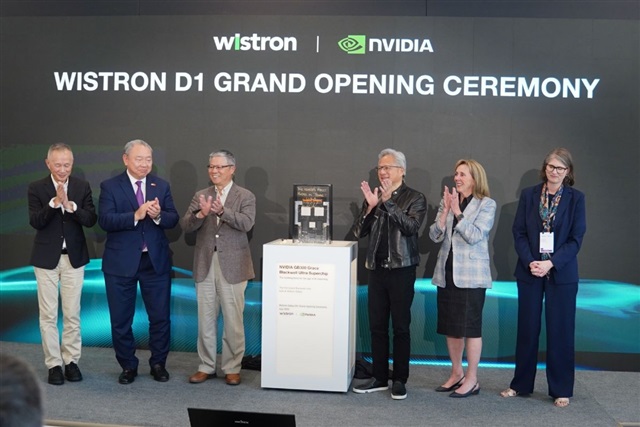
Wistron's opening of its D1 AI smart factory in Fort Worth, Texas, marks a new milestone for Taiwan's downstream electronics manufacturers. The plant will support the first US mass production of Nvidia GB300 compute boards, a development with far-reaching implications for Taiwan, the US and the global AI industry.
Speaking after the opening, Nvidia CEO Jensen Huang said Taiwanese manufacturers were indispensable to rebuilding US manufacturing. Taiwan had saved America's semiconductor and PC industries, he said, and the US should be grateful.
Wistron chairman Simon Lin struck a more measured tone. Regardless of who should thank whom, he said, the interests of Taiwan and the US were aligned. When a project serves both sides, implementation becomes much easier.
Aligned interests, however, do not make it easy to rebuild electronics manufacturing in a country where much of the industry has been absent for decades.
Lin recalled visiting the Texas plant in April and finding conflicts between local regulations and the design of its automated production lines. The episode offered a glimpse of the practical obstacles Taiwanese manufacturers face when producing in the US.
TSMC in Arizona and Wistron, Foxconn, Inventec, Compal and Delta Electronics in Texas have all encountered difficulties ranging from recruitment to regulatory compliance. Taiwanese companies must overcome and adapt to these challenges, sharpening their capabilities while demonstrating the resilience and execution for which the island's manufacturers are known.
The arrival of Wistron and other downstream electronics manufacturers in Texas also carries considerable significance for the US.
US industrial policy has focused heavily on semiconductors, a priority reflected in the recipients of government subsidies. Yet without downstream systems manufacturers capable of mass production, an upstream semiconductor cluster alone would leave the Trump administration's vision of reviving American manufacturing only half complete.
Mass production by systems manufacturers is the foundation of the electronics industry and could become an important source of US employment and economic growth. Wistron's D1 plant currently employs 400 people and plans to increase that number to 1,000 by the end of the year. Its D2 facility is already prepared and is expected to begin mass production in 2027, with D3 and D4 plants potentially following.
Wistron is not alone. Major Taiwanese electronics manufacturers including Foxconn, Inventec, Delta Electronics and Compal have also established operations in Texas, creating the prospect of substantial labour demand. The water, power, construction and other infrastructure required to build and operate their facilities will generate further investment and economic activity, providing another source of momentum for US growth.
The rapid expansion of the AI industry, meanwhile, depends heavily on support from Wistron, TSMC, Foxconn, Inventec, Quanta and other Taiwanese manufacturers.
Huang said the GB300 contains 1.5 million components, weighs two tonnes and is worth as much as US$4 million. He described it as the world's most powerful AI supercomputer and said Nvidia and Wistron were preparing to produce it at scale in much the same way smartphones are manufactured.
Nvidia leads the global AI market, but Huang said its shipment demand, which is nearly doubling each year, could not be met without Taiwanese partners. The same manufacturing support is required by AMD, Intel and cloud service providers developing custom application-specific integrated circuits.
Without Taiwan's manufacturers, the AI industry would struggle to maintain its rapid ascent under mounting geopolitical constraints.
Article translated by Levi Li and edited by Jack Wu