
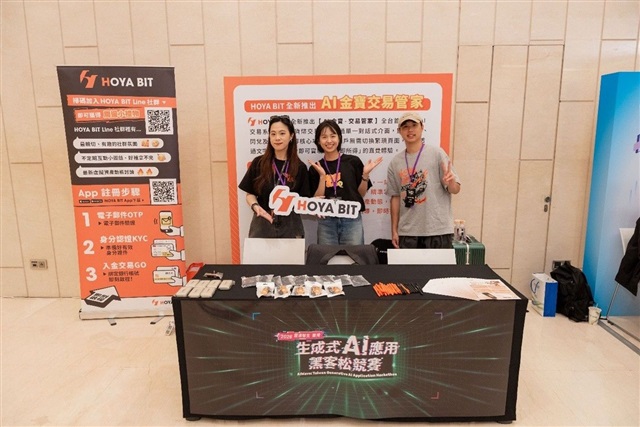
The cryptocurrency market operates 24/7, generating an overwhelming flow of news, social media posts, and messaging app updates. Investors must quickly digest vast amounts of information and determine the credibility of sources within extremely tight timeframes. George Wang, Vice President of the Technology Department at HOYA BIT, noted that while traditional trading systems excel at processing structured data, analyzing unstructured, fragmented information across diverse formats still demands significant manual labor. By the time manual analysis is complete, optimal trading opportunities often pass.
To address this, HOYA BIT participated in the "2026 Taiwan Generative AI Applications Hackathon"- guided by the Administration for Digital Industries (ADI), Ministry of Digital Affairs (MODA), organized by DIGITIMES, and supported by Amazon Web Services (AWS) with international AI technology expertise, under the "Smart Trading" challenge theme, focusing on leveraging AI to accelerate information processing and build a dynamic credibility assessment mechanism for market intelligence.
Enhancing Real-Time Processing for Retail Virtual Asset Markets
As a domestic virtual asset trading platform in Taiwan serving retail investors, HOYA BIT considers real-time market data consolidation and risk evaluation efficiency central to its AI strategy. While HOYA BIT historically relied on web crawlers and automation tools for data collection, it recently integrated Large Language Models (LLMs) for information synthesis and initiated in-house AI Agent services. However, enabling models to accurately interpret semantic nuances and verify message authenticity remains a substantial technical challenge.
Innovative Multi-Agent Consensus Architecture for Information Verification
Wang observed that participating teams followed similar methodologies during early-stage data collection and cleansing. The real differentiation emerged in downstream decision-making and verification mechanisms. The winning team, "Strawberry Soufflé Pope," proposed an architecture where seven AI agents present evidence, cross-validate information, and vote to rank the credibility of market reports. These AI agents engage in adversarial interactions while retaining the flexibility to assume domain-specific expert roles as the system expands, with an independent model ultimately consolidating various arguments and consensus points. Drawing on Web3 consensus mechanism concepts, this design offers a highly distinctive and forward-looking solution for assessing credibility in noisy, unverified data environments.
AI as a Strategic Assistant: Security, Compute Costs, and Model Governance
Addressing the potential commercialization of hackathon solutions, Wang stressed that further enhancements are required in information security, compute cost control, and user experience. In financial trading scenarios, allowing AI models to execute orders directly could result in actual asset losses if misjudgments occur. Consequently, HOYA BIT currently positions AI primarily as an "assistant" - handling data synthesis, parameter recommendations, and operational guidance - while critical trade execution remains anchored in core trading systems.
Additionally, processing massive volumes of raw, unfiltered data inflates model compute expenses. Front-end data filtering and noise reduction are essential practical considerations for enterprises seeking to reduce API calls and cloud compute overhead.
For highly regulated fintech platforms, AI integration must simultaneously satisfy data security and regulatory compliance requirements. Wang noted that Amazon Bedrock, AWS's fully managed service offering a choice of high-performing foundation models from leading AI companies, allows enterprises to deploy foundation models within a controlled, secure environment. Compared to sending sensitive data directly to public external APIs, this managed cloud approach significantly reduces concerns surrounding data sovereignty and information leakage, while eliminating the costly hardware investment and operational burden of self-hosted large models. For trading platforms balancing model performance, security, and cost governance, managed cloud model services offer an optimal deployment path.
Fostering Agility and Cross-Disciplinary Talent for Modern AI Integration
Through the hackathon, HOYA BIT gained firsthand visibility into market AI talent reserves and problem-solving approaches. Wang emphasized that given the rapid iteration of AI technology and the need for cross-departmental collaboration during deployment, HOYA BIT values self-directed learning, experimental mindset, and cross-disciplinary communication skills over any single technical capability. Looking ahead to future competitions, HOYA BIT hopes to introduce cutting-edge topics from tech communities, offering participants broader creative freedom to help enterprises discover innovative solutions that break traditional frameworks.