
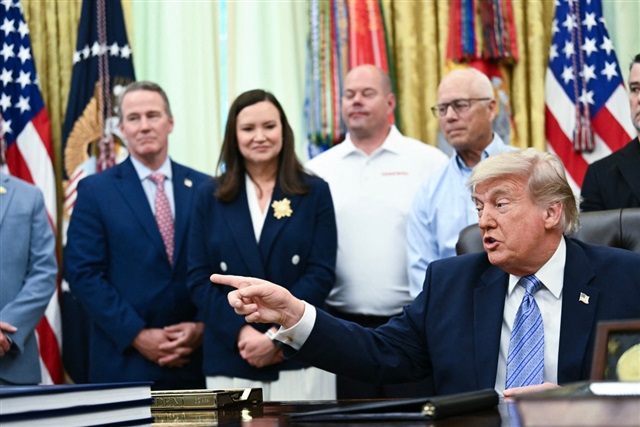
US President Donald Trump abruptly called off a highly anticipated White House signing ceremony for a sweeping executive order intended to establish a federal safety vetting framework for advanced artificial intelligence (AI) models.
According to The Wall Street Journal, Trump withdrew the draft directive just hours before a scheduled press conference with premier technology executives, openly stating to reporters that he postponed the measure because he feared certain provisions could act as a structural "blocker" to American innovation. This illustrates a tension within the administration, as national security collides with tech industry dominance.
According to the Financial Times, the executive order originally came about after National Economic Council Director Kevin Hassett and Treasury Secretary Scott Bessent received classified demonstrations of advanced commercial systems, which exposed catastrophic cybersecurity weaknesses within the global banking network. Hassett suggested that frontier AI models should be treated like prescription drugs under the Food and Drug Administration (FDA) and proven entirely safe before public release.
This was a comparison that met immediate pushback from Silicon Valley investors and tech-aligned politicians who argued that this framework would halt the US's software development pace.
The abandoned order attempted to formalize a voluntary, pre-release benchmarking infrastructure rather than impose government-heavy mandates. The Wall Street Journal reports that under the proposed compromise, leading companies, including OpenAI, Anthropic, Google, and xAI, would have voluntarily granted federal agencies an early, pre-public screening window ranging from 14 to 90 days to stress-test frontier systems for weaponized cyber capabilities.
Despite the agreement being voluntary, it would have dramatically expanded the domestic intelligence community's authority over commercial tech, designating the National Security Agency (NSA) as the primary mediator for reviewing these advanced models, while simultaneously mandating a massive cyber-professional hiring surge to reverse previous staffing cuts at the Cybersecurity and Infrastructure Security Agency (CISA).
The Trump administration is reportedly moving towards an ad-hoc regulatory strategy. Given that it opposes state-level AI safety laws, the government is choosing decentralized, independent testing agreements through the Department of Commerce (DOC) with tech giants such as Microsoft and xAI. However, this inconsistent policy approach creates industry ambiguity.
According to CBS News, the cancellation leaves the government without a unified, coherent safety framework just as Silicon Valley prepares for a loaded summer rollout of complex models. However, one trend is clear: safeguarding American tech corporations will consistently be a priority in federal regulation.
Article edited by Jack Wu