
As Large Language Model (LLM) reasoning capabilities continue to evolve, AI Agents have officially surpassed passive "Copilots" to become the core of global digital transformation. These agents are now capable of autonomous planning, multi-step execution, and real-time strategic adjustments, marking a shift in how organisations approach digital transformation. According to MarketsandMarkets' "AI Agents Market Report (2025–2030)," the global AI Agent market is projected to experience explosive growth over the next five years, reflecting widespread enterprise adoption.
At AI Expo Taiwan 2026, this shift was a central theme across the event, with multiple organisations highlighting agent-based architectures. HCLTech was among those presenting its perspective under the theme "Are You Agent-Native Yet?". The company showcased a suite of solutions tailored for semiconductor manufacturing and financial services aimed at helping enterprises operationalise AI agents and integrate them into core business processes.
Commenting on the evolving AI landscape, Terry Tai, Country Leader of HCLTech Taiwan, noted that "under the traditional Copilot model, humans act as coordinators, giving specific instructions via chat interfaces for AI to execute. In the AI Agent era, however, these agents take a high-level objective, autonomously plan, orchestrate tools, and iteratively complete tasks. Humans have transitioned from coordinators to supervisors and are no longer bogged down by tedious intermediate steps."
"The real shift comes down to reasoning capability," said Alan Flower, Executive Vice President and Global Head of Cloud and AI Labs at HCLTech. "It's what allows the latest Frontier models to work through complex intermediate steps, with agentic frameworks enabling shared knowledge across the new multi-model, multi-agent solution domain.
As organisations move to AI-Native approaches, it's becoming clear that this isn't just a technology change, it's a cultural transformation as organizations re-engineer their core value streams to be augmented and delivered by agentic AI. You need to think about the responsibilities you are prepared to delegate to AI, retain human-in-the-loop, or allow fully autonomous human-on-the-loop approaches. You need to reskill and train your workforce; teach them to assemble teams of AI agents to whom they will delegate work. For example, software engineers now need to describe software, and delegate the coding to agents, not write all of it themselves."
Solving Smart Manufacturing Pain Points: HCLTech Kinetic AI.Inspect
Taiwan's semiconductor and high-tech industries lead the world, yet traditional facility inspections still struggle with high labor costs and significant safety risks. For instance, in a semiconductor wafer fab, engineers can spend considerable time merely complying with gowning and entry protocols before addressing a single device malfunction. These logistical delays represent a significant, yet often overlooked, hidden cost for high-tech manufacturers.
HCLTech featured Kinetic AI.Inspect at the expo, a solution specifically designed to address these pain points. HCLTech builds "Hybrid Inspection Fleets" using quadrupeds (robot dogs) and drones, integrated with 3D reality capture and real-time AI analysis. This solution, already deployed by a leading global aircraft manufacturer, has delivered significant results: reducing unplanned downtime by 30%, increasing inspection frequency by 30x, and boosting post-processing productivity by up to 95%.
Flower pointed out that with Kinetic AI.Inspect, if a robot dog detects an anomaly, it doesn't just sound an alarm; it can autonomously trigger an ERP system check for spare parts. If no stock is found, it automatically generates a Purchase Order (PO) to initiate the repair process. This Agent-Native flexibility is something traditional, stationary IoT sensors cannot achieve.
Tai added that these applications extend across all manufacturing sectors, including steel, petrochemicals, and offshore wind power, where reducing on-site human risk is critical. Many Taiwanese firms expressed strong interest at the event and are currently planning Proof of Concepts (PoC).
Implementing Agentic SDLC with HCLTech AI Force
Beyond manufacturing, HCLTech introduced the AI Force platform for the software-heavy tech sector. This platform supports the full Agentic SDLC (Software Development Life Cycle), covering automated requirement documentation, API specification architecture, and code refactoring. Internal benchmarks show a 30% increase in development speed, a 45% boost in testing efficiency, and a 60% acceleration in legacy application modernization. As a TSMC Design Center Alliance (DCA) partner, HCLTech also applies AI to semiconductor R&D, automating specification interpretation and test plan generation to maximize engineering throughput.
"When you look at the B2B Accounts Payable landscape, the scale is enormous - in Taiwan alone it's worth around USD 215 billion annually. Yet much of it still runs on manual processes, with global Straight-Through Processing rates sitting at just 32.6%," said Tai.
"What we're seeing is a shift. By applying specialised agents to tasks like data extraction and duplicate payment detection, it's possible to move beyond those constraints. In some cases, STP rates are rising above 80%, invoice processing costs are dropping by more than 60%, and duplicate payments are falling to under 1%."
With over 200,000 employees globally, HCLTech operates innovation labs in the US, UK, Germany, India, and Singapore. In late 2025, HCLTech partnered with NVIDIA to launch an AI Lab focused on scaling Physical AI and cognitive robotics for industrial use. By assessing technical maturity and data readiness, HCLTech continues to help enterprises explore and incubate new technology use cases as their primary AI transformation partner.
To find out more, please visit HCLTech.
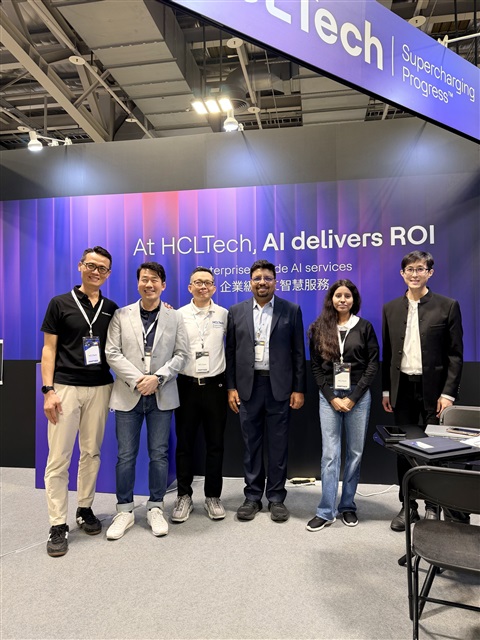
HCLTech at AI Expo Taiwan 2026. Credit: HCLTech