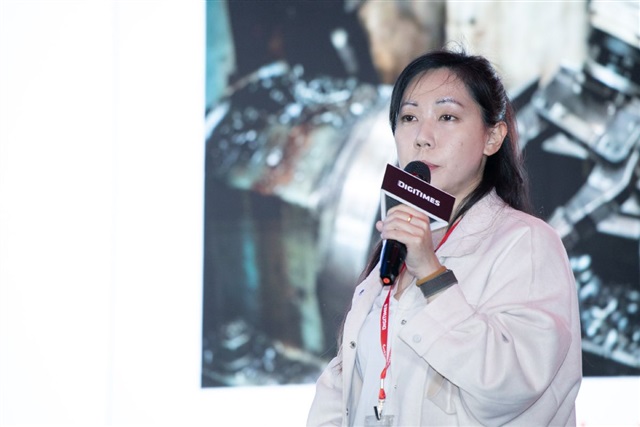
Artificial intelligence is entering a new phase centered on agentic systems, with momentum shifting from digital environments to real-world applications. Speaking at the DIGITIMES AI Expo on March 26, Aurotek said the industry focus is no longer limited to model capability, but is moving toward enabling AI to operate in physical settings such as factories, logistics and service environments.
The company said rapid advances in humanoid robots and physical AI are accelerating efforts to move beyond simulation into practical deployment, where systems can execute tasks and address operational challenges.
Bridging models with physical execution
Labor shortages remain an urgent challenge for Taiwan's manufacturing sector. While physical AI with perception and interaction capabilities is seen as a potential solution, Joyce Wen, Manager of the AI Application Development Department at Aurotek, said the transition from large language models to real-world applications is not a simple extension of existing technologies.
Even if AI can perform text generation and logical reasoning in digital environments, it cannot address production-line labor gaps without the ability to act in physical settings, Wen said.
She added that effective deployment requires two conditions: the ability to complete designated tasks accurately, and the ability to operate without disrupting existing production processes or compromising worker safety.
These requirements highlight differences in manufacturing environments. Compared with highly standardized overseas factories, Taiwan's production lines are more flexible and require rapid changeovers, making it difficult to replicate robots trained in one setting across multiple sites.
A robot that operates in a factory in Texas, for example, may not adapt easily to Taiwan, Wen said. The island's diverse, small-batch and highly variable production model requires greater adaptability, reinforcing the importance of humanoid robots as a development direction.
Physical data, not algorithms, drives deployment
Wen said the core challenge in deploying physical AI lies not in algorithms but in physical data. Unlike large language models trained on internet text, robots must learn through real-world perception and feedback, including force control, spatial relationships and physical constraints.
For example, an AI system trained on videos of folding clothes may still fail to grasp garments correctly in real-world conditions. Without force feedback data, a robot may also damage or drop objects such as a cup during handling. As a result, data collection has become the most critical and costly stage of development.
Aurotek uses virtual reality technology for motion training, allowing engineers to operate from a robot's perspective while collecting multimodal data, including motion trajectories, visual inputs and force feedback.
In practice, training even a seemingly simple action can require months of data collection and optimization. While the training process itself may take only a few hours, preparation remains time-consuming.
Generalization determines cross-environment deployment
Whether robots can be deployed across different environments depends on their level of generalization, Wen said. This can be divided into three aspects: embodiment, task and environment.
To achieve this, training data must incorporate sources of interference such as changes in lighting, background disruption and random object placement, to ensure stable performance across scenarios.
In terms of applications, Aurotek has worked with enterprises on deployment cases. In logistics, for example, the company integrates robotic arms with computer vision AI to identify parcels of different sizes and orientations, enabling automated picking and stacking.
However, the company said current robots still face limitations. A lack of tactile sensing makes it difficult to determine material properties and apply appropriate force, while unexpected situations remain challenging to handle autonomously.
Different applications also require different end effectors. Dexterous hands are suited for precision tasks, while heavy lifting requires high-load grippers, underscoring the continued need for scenario-specific customization.
Article translated by Sherri Wang and edited by Joseph Chen