
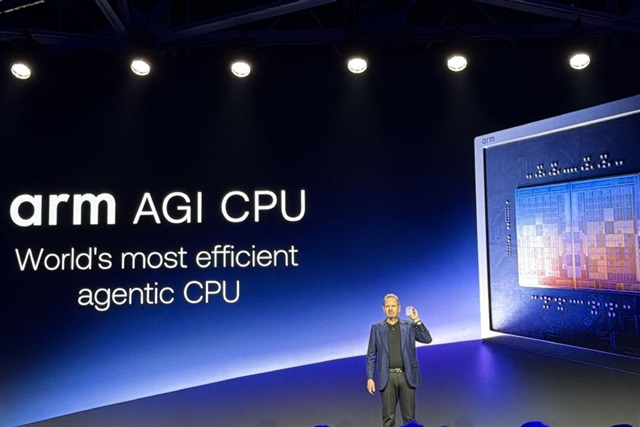
Arm has officially unveiled its first fully self-designed physical chip, the Arm AGI CPU, targeting data center mass production. The announcement came at the Arm Everywhere conference in San Francisco, sending shockwaves through an already fiercely competitive AI chip market.
It marks the most radical transformation in Arm's 35-year history. The company invested at least US$71 million over 18 months to pivot from a "design blueprint supplier" to an active physical chip competitor. The new product targets a critical bottleneck in AI infrastructure: the CPU compute gap driven by the rise of agentic AI.
Market observers believe the move could end Arm's longstanding neutral position in the industry ecosystem. Arm stresses that it does not overlap with clients' businesses and that the market can accommodate multiple players, but concerns remain over who stands to be affected.
Supply chain insiders point to TSMC subsidiary Global Unichip (GUC) as likely the first to feel the pressure, given its CPU collaborations with Google and Meta. With Arm launching a "production-ready" chip, partners like Meta may reconsider their order allocations. MediaTek and Novatek face a similarly awkward position, licensing IP from Arm while now potentially competing against Arm's own products.
Arm confirmed it will continue running three parallel models — IP licensing, compute subsystems (CSS), and physical chips — to offer clients flexibility.
Why Arm is shifting strategy
CEO Rene Haas tied the launch of the Arm AGI CPU to a fundamental shift in global computing: the move toward deploying agentic AI models.
CPUs have evolved from supporting roles into the core schedulers of modern infrastructure. The token generation surge driven by agentic AI is expected to quadruple data center CPU demand. Haas said the AGI CPU was built specifically to address the challenges this explosive demand places on performance and power consumption.
Chasing growth amid the AI wave
Industry sources estimate Arm has been planning the AGI CPU for nearly three years, partly in response to stalling growth momentum. In the third quarter of fiscal year 2026, Arm posted revenue of approximately US$1.24 billion, up 26% year-over-year, with earnings per share (EPS) of US$0.43. The headline numbers looked solid, but licensing revenue came in at only US$505 million — below expectations and enough to put the market on alert.
The AI sector has little patience for "meets expectations." With TSMC and Nvidia consistently outperforming forecasts, Arm's projected fourth quarter of fiscal year 2026 revenue of US$1.47 billion still fell short of market appetite.
That gap pushed Arm toward a major strategic shift akin to Google Pixel or Samsung Electronics' IDM approach — directly entering hardware manufacturing.
The Arm AGI CPU is built on TSMC's 3nm process and delivers up to twice the performance-per-watt efficiency of x86 rivals Intel and AMD. For cloud providers treating power as a finite resource, a more efficient CPU frees up electricity that can be redirected to GPUs.
Supply chain experts note that where x86 excels at heavy computation, the Arm AGI CPU targets what they call "undeployed areas" — workloads defined by low clock speeds, ultra-low power draw, and very high core counts. It is well-suited for lightweight tasks like AI agents fetching data, generating charts, or building Excel sheets, where extreme compute power is unnecessary.
Intel and AMD have no comparable "pure E-core, ultra-high density" offerings. While x86 virtualization can partition a single CPU, power consumption stays high, leaving a gap that Arm is now moving to fill.
Bold partnerships, inherent tensions
Arm unveiled an extensive partner lineup alongside the chip, signaling broad industry endorsement of its "value chain control" strategy. Core partners include Meta, OpenAI, AWS, Google, Microsoft, Cloudflare, SAP, and SK Telecom (SKT). OEM/ODM collaborators span Quanta, ASRock Rack, Supermicro, and Lenovo, with ecosystem support from Nvidia, Samsung, SK Hynix, Micron, Broadcom, and Marvell.
For cloud hosting and virtualization, the AGI CPU's cost advantages are expected to halve prices under future high-density deployments.
Since Nvidia's failed acquisition bid in 2020 and Arm's subsequent IPO in 2023, the company has steadily pushed its influence from mobile into the data center. Its long-term targets are ambitious: US$25 billion in annual revenue and US$9 EPS by 2031, with US$15 billion of that tied to AGI CPU sales. For context, Arm's 2025 revenue stood at just over US$4 billion.
Article translated by Charlene Chen and edited by Jerry Chen