
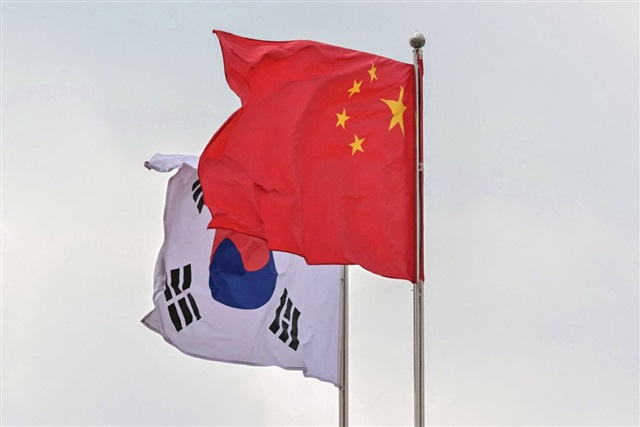
As the AI era accelerates, South Korea's competitive position is weakening relative to China. Even semiconductors, long a pillar of the Korean economy, are now assessed as being in a state of co-opetition rather than clear leadership.
Samsung Electronics and SK Hynix maintain a global advantage in memory chips, but China has gained ground in system semiconductors, particularly AI chip design, a segment central to next-generation technology leadership.
A report by the Korea Institute for Industrial Economics and Trade (KIET), titled Analysis of Korea-China Competitiveness in Advanced Industries and Policy Directions, states that although China has not achieved full semiconductor self-sufficiency under "Made in China 2025," it has built an independent ecosystem in IC design, advanced packaging, and AI semiconductors. In non-memory segments, China's competitiveness is assessed as higher than South Korea's.
The report describes semiconductors as contested overall. South Korea retains advantages in semiconductor equipment, memory production, advanced foundry processes, and global sales networks. China leads in chip R&D, product-based convergence services, and domestic market scale.
The competitive shift extends beyond semiconductors. Value chain analysis shows China ahead of South Korea in robotics, electric vehicles (EVs), batteries, and autonomous driving. Since 2015, localization rates for core components and equipment in these sectors have risen, alongside expanding global market share.
In industrial robots, South Korea retains a slight edge in product development and design, but China leads in procurement, production scale, and overseas market expansion. In EVs, China holds advantages across most value chain segments except overseas market development and battery services. In autonomous vehicles, China leads across all segments.
China's Fifteenth Five-Year Plan reinforces this shift by defining modern infrastructure as a strategic asset for competitiveness in AI, semiconductors, and high-performance computing. In AI-based manufacturing and humanoid robotics, China is advancing technological capability alongside industrial deployment.
South Korea faces structural constraints in responding to China's low-cost strategy, supported by a vast domestic market and government backing. Heavy reliance on imported raw materials, limited domestic demand, constrained policy capacity, and shortages of advanced technical talent are cited as vulnerabilities. Price competitiveness is becoming a broader concern.
KIET recommends that South Korea move beyond a simple "super-gap strategy" and widen advantages in existing strengths while developing an independent "K-manufacturing model." Through a Manufacturing AI Transformation (M.AX) strategy, Korea should identify specialized technologies across the value chain linking materials, components, and finished products, and build a trust-based global supply chain.
The report argues that China should not be viewed solely as a competitor. Detailed value chain analysis and selective engagement are required to secure technological advantages while exploring demand within China. The industrial relationship has shifted from vertical division of labor to horizontal competition, making South Korea's earlier strategy of treating China primarily as a production and procurement base ineffective.
As AI reshapes manufacturing and semiconductor ecosystems, competitiveness is defined by system integration, domestic market scale, and value chain control rather than single-sector leadership.
Article edited by Jack Wu