
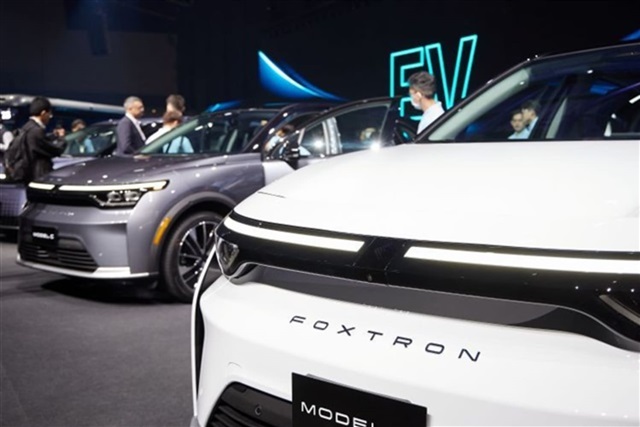
Foxconn showcased sweeping upgrades across artificial intelligence (AI), electric vehicles (EVs), advanced manufacturing, and data center hardware during its two-day Hon Hai Tech Day event. The developments underscore the company's push to evolve from the world's largest electronics contractor into a full-stack technology and platform provider. The event highlighted new strategic partnerships, including a collaboration with OpenAI and expanded work with Nvidia.
AI and data center strategy takes center stage
Under the theme "Accelerating Imagination," Foxconn emphasized deep vertical integration across AI infrastructure, smart manufacturing, smart cities, and EVs. The biggest AI-focused announcement was a strategic partnership with OpenAI to co-develop next-generation data center hardware in the US. Foxconn plans to design and manufacture key components such as cabling, cooling systems, and power modules, a move that aligns with US efforts to strengthen domestic AI supply chains.
Foxconn also expanded its collaboration with Nvidia. The company plans to deploy Nvidia's GB300 systems and will work with the chipmaker as a cloud service partner through the Kaohsiung Asia New Bay Area supercomputing center. Longstanding cooperation with Google and Alphabet, including joint work on smart-driving technologies, adds to Foxconn's network of major AI customers.
Chairman Young Liu stated that Foxconn is no longer just the world's largest contract manufacturer but is becoming a provider of compute power, energy systems, and end-to-end application solutions. When asked whether Foxconn might invest financially in OpenAI, Liu declined to confirm but said the possibility remains open.
Building an end-to-end AI hardware chain
Foxconn displayed its full AI server supply chain, stressing advancements in its in-house manufacturing capabilities. The company highlighted rising internal production rates for server racks, chassis, cold plates, and distribution manifolds. Foxconn Interconnect Technology exhibited high-current 400A AC Whip connectors, 800V busbars, and quick-release liquid cooling fittings designed for high-power AI clusters.
Alongside its GB300 rack systems, Foxconn revealed its first modular data center concept, developed with partners including Teco Electric. The modular approach can cut deployment timelines to 12 to 18 months, compared with 18 to 24 months for traditional builds, improving speed and capital efficiency. Foxconn is positioning itself as one of the few global firms capable of covering every layer of the stack, from components and subsystems to server racks, data center rooms, and complete data center facilities.
EV platform broadens with batteries, chips, and complete vehicles
On electric vehicles, Foxconn showed the production version of its Model A, led by Jun Seki, the company's chief strategy officer for EVs. Foxconn demonstrated multiple new models and components, highlighting internal capabilities in vehicle design, batteries, and semiconductor development.
The company's battery facility in Kaohsiung has begun mass production. Foxconn unveiled a 230Ah large-format pouch cell with more than 3,500 charge cycles, a solid-state and semi-solid-state cell with energy density above 320 Wh/kg, low-temperature sodium-ion batteries, and fast-charging technologies capable of reaching full power in five minutes.
Subsidiary SiliconAuto announced its first automotive MCU, which has passed ISO 26262 ASIL-B certification. Foxtron introduced an infotainment platform that integrates TomTom's mapping data with Foxconn's voice AI assistant.
Robotics and smart manufacturing push beyond the factory
Foxconn presented new robotics and smart manufacturing systems built using Nvidia Omniverse and Isaac Sim, enabling digital twins and robot training. The company displayed wheeled and legged industrial humanoids, specialized wafer-handling robots, and dexterous teleoperation hands designed for delicate tasks. Foxconn stated its goal is to bring automation beyond the factory floor by applying its in-house robotics expertise to sectors such as healthcare.
Using Kaohsiung's Asia New Bay Area as a testing ground, Foxconn demonstrated AI agents for traffic management and public services. The company also showcased a one-minute 3D cardiac reconstruction tool and the FoxBrain breast cancer clinical decision support system.
Long-term research includes quantum, satellites, and silicon photonics
Foxconn's research institute presented early-stage technologies such as its FoxBrain large language model, its second-generation Pearl satellite, an ion-trap-based quantum computing lab, and new silicon photonics (SiPh) breakthroughs. Although these initiatives are not yet commercial, executives said they lay the groundwork for future industry cycles.
Foxconn is working with TEEMA, CTCI, and Teco Electric to export the Taiwanese science park model to Mexico, the US, and other regions. The company aims to help Taiwanese small and mid-sized suppliers expand overseas.
Hon Hai Tech Day showcased Foxconn's intent to prove it controls technologies from upstream chips, batteries, and AI models to midstream servers, cooling systems, and robotics, and finally downstream EVs, cloud services, and smart-city deployments. The company said its combination of vertical and horizontal integration is becoming its core competitive advantage as the global AI and electrification race accelerates.
Article translated by Sherri Wang and edited by Jack Wu