

Taiwan's Ministry of Economic Affairs (MOEA) has reaffirmed its full support for Nvidia's plan to establish its first overseas headquarters in Taiwan, as the company faces delays tied to land acquisition at its proposed site in Taipei's Beitou–Shilin Technology Park (BSTP).
In a statement released Wednesday, the ministry emphasized its determination to "actively assist and secure" Nvidia's investment amid growing competition from other cities. The MOEA said it received a formal request from Nvidia on October 7 for a comprehensive land audit—including potential sites in Taipei—with a response due by October 24. It pledged to coordinate across government agencies to ensure the project advances smoothly.
Nvidia, a participant in the MOEA's Enterprise Flagship Program, is seen as a strategic partner in Taiwan's AI development. The company already operates an AI Innovation R&D Center in Taipei's Neihu District, where its "Taipei-1" supercomputer provides free computing resources to universities, research institutions, and startups. The proposed BSTP headquarters would significantly expand Nvidia's local presence, combining R&D, design, and corporate operations across a 7.4-acre site.
The Ministry of the Interior has also endorsed the project, notifying Taipei City in July that the land could be expropriated under the Land Expropriation Act, signaling strong central government backing. However, the land—currently owned by Shin Kong Life Insurance—remains locked in compensation disputes, stalling the start of construction.
The plan traces back to June 2024, when Nvidia CEO Jensen Huang visited Taipei for Computex and announced a US$10 billion, five-year investment to strengthen AI infrastructure and talent pipelines. Taiwan quickly emerged as the preferred location for the company's first overseas headquarters, given its close ties with TSMC and its central role in Nvidia's hardware supply chain.
Initial discussions focused on Taipei's Nangang District, but by mid-2025, Nvidia had zeroed in on the BSTP's T17 and T18 parcels. The plan, unveiled at Nvidia's GTC AI conference in May, envisioned the "Nvidia Constellation" campus—a 2026 launch target featuring offices, R&D labs, and space for thousands of engineers.
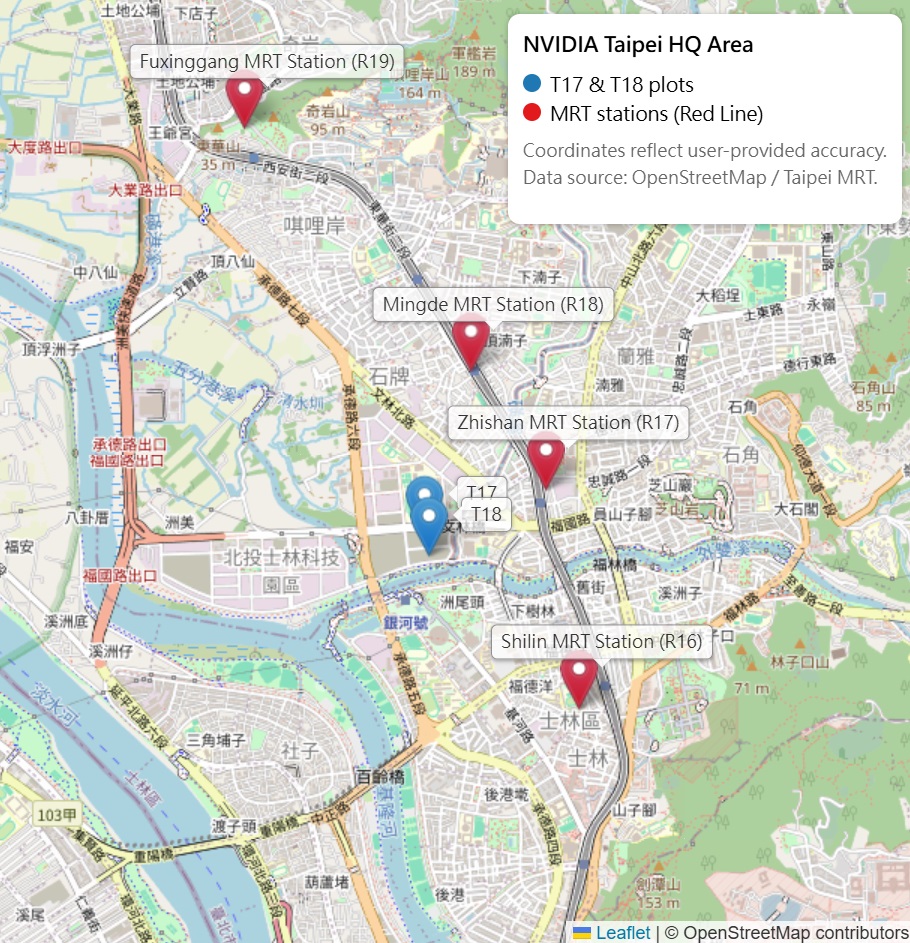
Current locations of Nvidia's planned campus in Taipei.
Political and logistical realities, however, soon intruded. The ownership dispute delayed site acquisition, prompting President Ching-te Lai's administration to designate the project as a national priority, offering subsidies and expedited reviews. Yet by September, talks with Shin Kong remained stalled, highlighting Taiwan's broader dilemma: a booming tech sector constrained by scarce urban land.
Other cities have since entered the competition. New Taipei City has offered potential sites in Xindian and Linkou, both close to Taipei's semiconductor cluster, while Kaohsiung has proposed its Nanzi Industrial Park as a lower-cost alternative with ready-built infrastructure and housing. The MOEA is now reviewing these options as part of its October land audit, aiming to keep the project anchored in northern Taiwan.
For Taiwan, the stakes are significant. A successful deal could generate over 1,000 high-value jobs and reinforce its position as the world's AI hardware hub amid intensifying US-China competition. For Nvidia, the headquarters represents not only an operational base but a symbolic statement of its global reach. With the MOEA racing to deliver site options by October 24, the next two weeks will determine whether Nvidia's Asia-Pacific hub—and a key piece of Taiwan's AI strategy—can take root.
Meanwhile, Nvidia is also advancing plans for a large new R&D campus in Israel—its biggest engineering base outside the US—where it already employs more than 5,000 engineers across seven sites. Announced in July 2025, the multibillion-dollar project seeks land in northern Israel—near Yokne'am, Zichron Yaakov, or the Jezreel Valley—for a 17- to 29-acre site with up to 194,000 square meters of space. The planned "mega-campus," drawing dozens of competing site proposals, builds on Nvidia's 2019 acquisition of Mellanox and its continued office expansion in Tel Aviv.
Although Israel's facility is focused on R&D rather than serving as a regional headquarters, it adds competitive pressure to Taiwan's bid to host Nvidia's first formal overseas base.
For Nvidia, establishing its headquarters in Taiwan brings wide-ranging strategic advantages. It allows the company to integrate more closely with the world's most advanced semiconductor ecosystem—anchored by TSMC, ASE, and a dense network of electronics and AI startups—while benefiting from Taiwan's skilled engineering workforce and robust manufacturing base.
Industry leaders such as Acer founder Stan Shih have argued that Nvidia's arrival could help foster a more open and collaborative innovation culture in Taiwan, strengthening ties between the public and private sectors. With access to cutting-edge facilities and local expertise in AI, packaging, and silicon photonics, Nvidia would be well-positioned to accelerate time-to-market for new technologies and products.
The proposed Beitou–Shilin headquarters would also reinforce Taiwan's growing technology cluster, linking global leaders with local suppliers. Despite offers from India and Singapore, Taiwan's comprehensive industrial base, stable governance, and strong policy support continue to make it Nvidia's most strategic choice in Asia.
If successful, the project could serve as both a landmark of Taiwan's AI ambitions and a cornerstone of Nvidia's global expansion—turning Taipei into a key hub for the next era of intelligent computing.
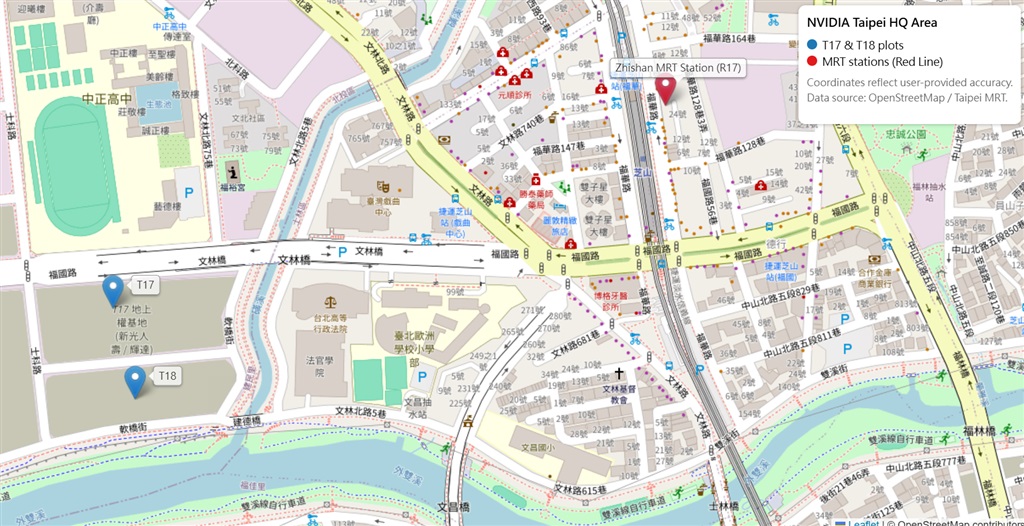
A more detailed look of Nvidia's planned campus
Article edited by Jack Wu