

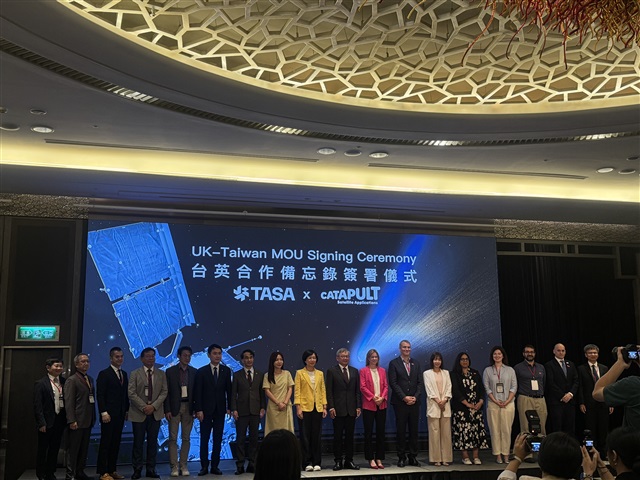
The British Office Taipei and Taiwan Space Agency (TASA) today co-hosted the 2025 UK–Taiwan Space Roundtable, spotlighting growing collaboration between the two partners in satellite applications, navigation, and the broader space economy.
Speaking at the forum, Prof. Adam Amara, Chief Scientist at the UK Space Agency, stressed that space must no longer be regarded as distant or abstract, but as critical infrastructure for resilient societies.
"Resilient societies will increasingly depend on space," one he noted. Instead of viewing LEO investment purely as a cost, we must recognize it as a global market opportunity—one where the UK and Taiwan can work together to build new capabilities and open new business frontiers.
The discussion highlighted the rapid rise of mega constellations and global demand for satellites, ground stations, user terminals, and direct-to-device communications. While the UK excels in innovation, small satellite design, and advanced communications technologies, Taiwan's strengths in high-quality, high-volume mass manufacturing position it as a natural partner to help scale production for a global market projected to involve millions—if not billions—of connected devices.
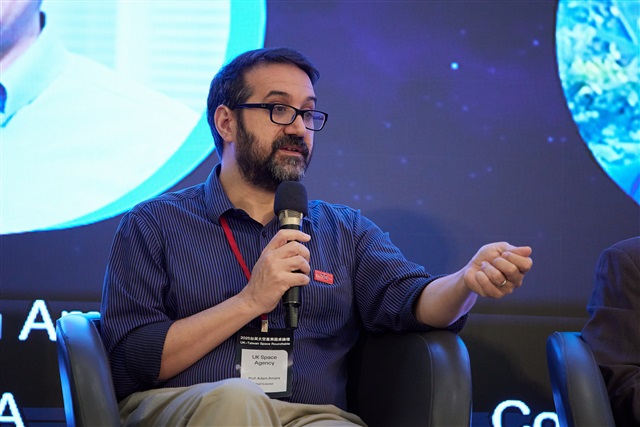
Prof. Adam Amara, Chief Scientist at the UK Space Agency. Credit: Digitimes
He pointed to existing collaborations, such as TASA's FORMOSAT projects and Taiwan's GNSS reflectometry experiments, which build on technologies pioneered in the UK. Opportunities for deeper cooperation include navigation and positioning systems, RF and optical communications, orbital edge computing, and secure satellite networks.
The UK's Space South Central cluster—representing 20% of the national space ecosystem with over 180 companies, including Airbus, BAE Systems, and Surrey Satellite Technology Ltd (SSTL)—is already exploring partnerships with Taiwanese companies. Examples include collaboration between Oxford-based Archangel Lightworks, a laser communications start-up, and potential Taiwanese partners.
Looking ahead, he stressed that LEO infrastructure must be considered "absolutely critical for running a functioning state." Combining UK innovation with Taiwan's industrial capacity could place the two partners at the forefront of the evolving space economy.
"The challenge now is not just to innovate, but to scale," he said. "By marrying British expertise in new space technologies with Taiwan's ability to manufacture at scale, both sides can seize the opportunities of this new space era—turning resilience into growth and market leadership."
Credit: Digtimes
Article edited by Joseph Chen