

Technology not only changes the way people live, but also what they eat. As more people consider going on a plant-based diet as part of the personal endeavor to reduce carbon emissions, the quality of non-animal foods is also improving. However, the population of vegetarians or vegans account for only 2% of the world's total population, according to Jen-yu Huang, CEO and founder of Lypid.
"We are certainly targeting meat eaters because vegetarians are still a minority," Huang said. Huang and Michelle Lee, both obtained their PhDs from Cornell University, co-founded Lypid in 2020, a San Francisco-based foodtech startup that is looking to redefine alternative meat.
Will customers go for alternative meat over real meat if it is just as delicious, and it is even free from debates related to carbon emissions or animal cruelty? Huang said Lypid's goal is simple and clear: they are creating plant-based foods that are similar to real meat in every aspect: the texture, the mouthfeel, even the flavor and the taste.
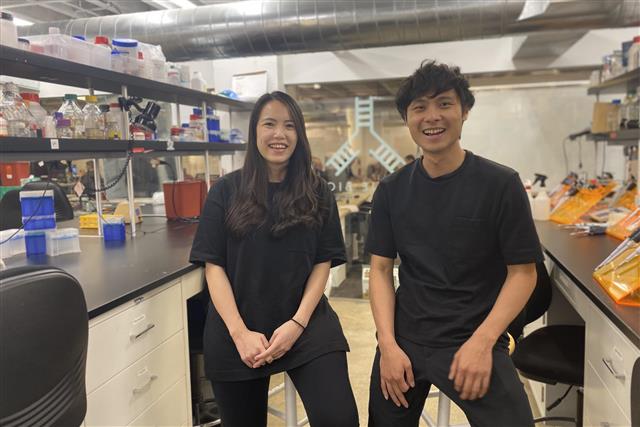
Lypid CTO Michelle Lee and CEO Jen-yu Huang.
Photo: Lypid
Pilot run in Taiwan
Huang and Lee chose to kickstart their first business collaboration in Taiwan - where they were born and raised - in August 2022 with a fast-growing, ubiquitous chain coffee shop: Louisa.
Taiwan is highly vegetarian-friendly. Vegetarian options are easily accessible in convenience stores, fast food restaurants, cafes, bakeries, and grocery stores. It was against such a backdrop that Louisa was eager to launch its first future meat product line including cheese muffin burgers and rice burgers. The Louisa & Lypid campaign shows that alternative meat does not have to be an equivalent to vegan or vegetarian foods. It can be regular burger/sandwich with meat made from plant-based ingredients with much less saturated fat.
Lypid's PhytoFat is the plant-based oil that brings out so much more possibilities for alternative meat, said Huang. Fat is the carrier of flavor and the richness in fat enhances the flavor of wagyu beef.
Traditional alternative meat usually lacks fat because the melting point of plant oils is low, and therefore burns and dries out very quickly. There are ways to add moisture to traditional alternative meat; however, the property of fat is irreplaceable. Huang added that in recent years, the alternative meat industry has shifted focus from the structure of plant-based protein to fat.
With PhytoFat, Louisa's alternative meat patties are greasier, and the greasiness is the key to duplicating the mouthfeel of real meat.
Louisa launched the burgers shortly after Lypid started its first pilot production line in Taiwan. Huang said they had quite little time to plan for the launch, but they pushed through. Now, Lypid is running at full capacity to supply for this project, and this is only the start of the alternative meat revolution.
Lypid is working with Space Bao Taipei to make vegan baos and the vegan meat they use tastes and smells just like real pork. The collaboration is scheduled to hit the market in October 2022 for a month only.
For the future, Lypid looks forward to more partnerships like these in other countries. They are also working with food providers who could benefit from the structuring technology.
More possibilities for alternative meat and non-food applications
Most future meat available in the market are minced meat. Having started also with minced meat, Huang said the minced meat marks Lypid's first milestone, but application of PhytoFat is not limited to that. Lypid's encapsulation technology can even go beyond the food industry.
Huang noted that their next goal is to make plant-based whole cut steak. They are also researching on using the technology to recreate butter with plant-based ingredients. Any recipe that requires fat can potentially substitute animal fat with PhytoFat, including dairy products and confectionaries.
The key difference between PhytoFat and other vegetarian fat substitutes is the melting point. PhytoFat's melting point, which falls between 100 to 200 degrees Celsius depending on the structure, is much higher than common vegetarian oils because of the modified structure.
PhytoFat itself looks like a big chunk of tofu. Primarily vegetarian fat in solid state, it melts a little in hand and has a greasy feeling. Huang said they are able to make customized modifications based on the flavor and taste they want to recreate for different partner restaurants.
Lypid wants to advocate for a more sustainable way of eating. As people turn more conscious of the background of the whole industry of food, it is not too easy to stick to only one specific dieting and break free from all ethical or non-ethical, climatic, health controversies.
PhytoFat provides an opportunity for people to enjoy juicy, fatty meat-like foods and for meat eaters a healthier, more sustainable choice.
Seed funding of US$4 million in March
Lypid closed the latest round of fundraising in March 2022. It is looking to team up with more collaboration facilitators in different countries. Ultimately, Lypid wants to build a collaborative platform for foodtech, Huang added.
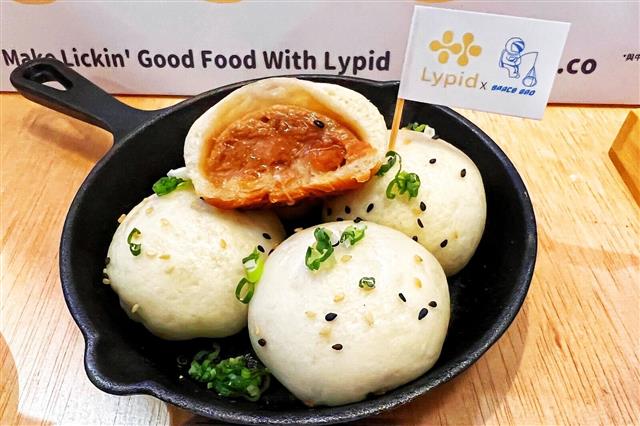
Lypid and Space Bao's alternative meat collaboration
Photo: Lypid