
Ongoing weakness in notebooks will be offset by stronger unit growth of touch-screen tablets - especially smaller-size models with 7- and 8-inch displays - resulting in a 4% increase in IC sales for all types of PC products in 2013, according to IC Insights.
Combined IC sales for standard PCs, tablets and new cloud-computing portables are forecast to reach US$77.6 billion in 2013, compared to US$74.9 billion in 2012 when the total fell 6% from US$79.6 billion in 2011, said IC Insights.
IC sales for keyboard-equipped standard PCs will slip 2% to US$62.5 billion in 2013, following drops of 12% in 2012 and 7% in 2011, IC Insights indicated. Sales for the segment are slumping primarily due to slowing shipments of notebooks, which are being superseded by tablets in consumer computing markets worldwide.
In contrast, IC sales for tablets are forecast to rise 37% to US$14.7 billion in 2013 after climbing 77% in 2012 and 190% in 2011, IC Insights noted. The outlook for tablet IC sales has also been raised with revenues projected to grow by a CAGR of about 25% between 2012 and 2016, reaching US$26.6 billion in the final forecast year.
In addition, IC Insights estimated the average IC content of a tablet at US$77.50. Nearly all tablets today are made with 32-bit microprocessors, which are often similar to application processors found in smartphones, the research firm said.
The vast majority of tablet processors are built with RISC cores licensed from ARM instead of the x86 MPU architecture used in microprocessors sold by Intel and AMD for standard PCs. ARM-based tablet microprocessors have much lower ASPs than x86 MPUs - often 20% or less than the ASPs of PC processors. Most tablet processors are also system-on-chip (SoC) designs with integrated graphics and many system-level functions, which reduce the need for a number of ICs and chipsets that have populated notebook motherboards. Tablets also contain less DRAM memory than standard PCs, but they use NAND flash for internal storage instead of hard-disk drives.
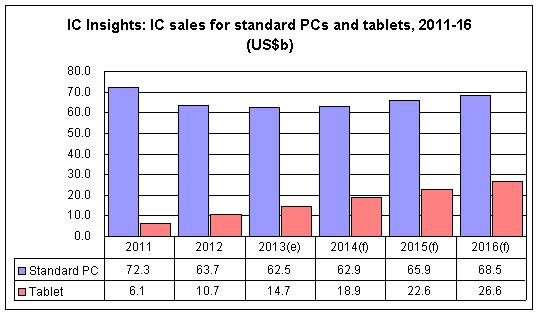
Source: IC Insights, compiled by Digitimes, June 2013