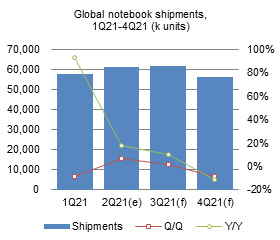
Notebook brands are ramping up shipments to the peak of the year, while the supply-side factors are showing no signs of improvement, resulting in the widening of the supply-demand gaps for panels of certain specs and specific IC chips to more than 20%.
However, as COVID-19 gets contained around the world in the fourth quarter, global demand for notebooks will decrease. Furthermore, with added or substitute capacity coming online, increasing supply and decreasing demand will significantly narrow the supply-demand gaps.
Looking into fourth-quarter 2021, as restrictions get lifted throughout Europe and America, where consumers have been the most actively buying notebooks, and students are returning to school, notebook demand will start to show a downturn. Furthermore, foundries will have added capacity for 8-inch and 12-inch wafers so the supply-demand gaps for notebook components will begin to narrow.

Introduction
Based on the market survey on notebook component shortage Digitimes Research conducted, the supply-demand gaps for panels, IC chips and processors all exceed 10%.
Going into the third quarter of 2021, with notebook brands ramping up shipments to a peak for the year and supply-side factors showing no signs of improvement, the supply-demand gaps for panels of certain specs and specific IC chips will widen to more than 20%. However, as COVID-19 gets contained around the world in the fourth quarter, global demand for notebooks will decrease. Furthermore, with added or substitute capacity coming online, increasing supply and decreasing demand will significantly narrow the supply-demand gaps.
Notebook brands have prepared an ample stock of 11.6-inch panels. Moreover, with notebook shipments to the education market led by Chromebook reaching a peak in second-quarter 2021, orders for 11.6-inch panels have begun to weaken. However, panel demand remains in high gear but only shifts toward 14-inch and 15.6-inch models for use in new consumer and business notebooks.
Timing controllers (T-CON) and display driver ICs (DDI) remain the critical display ICs that are in the worst shortage. With a more than 20% supply-demand gap, T-CON supply is to become even tighter going into the third quarter as some major T-CON suppliers shift part of their capacity to producing other products in the third quarter. On top of that, power outages disrupted foundry production in the second quarter. As to DDIs, Taiwan- and China-based foundries' capacity for large display driver ICs (LDDI) started to ramp up from the second quarter so the supply-demand gap may somewhat narrow beginning third-quarter 2021.
Looking into fourth-quarter 2021, as restrictions get lifted throughout Europe and America, where consumers have been the most actively buying notebooks, and students are returning to school, notebook demand will start to show a downturn. Furthermore, foundries will have added capacity for 8-inch and 12-inch wafers so the supply-demand gaps for notebook components will begin to narrow.
Components in shortages
Component breakdown
Source: Digitimes Research, June 2021
Display modules, IC chips and processors are currently in tighter supply, each having a larger than 10% supply-demand gap.
The shortage of display modules is mainly due to tight supply of upstream ICs and substrates. LCD and rigid PCB are also in short supply with a smaller than 10% gap because of insufficient capacity on the part of glass and PCB manufacturers.
Among ICs used in panels, T-CON chips made on the 40nm node are in the worst shortage.
Following T-CON chips are DDIs and power management ICs (PMIC) made on the 0.1xum nodes.
Due to their small size, IC substrates for panels have lower costs so substrate manufacturers with tight capacity give them lower priority, resulting in a larger than 10% supply-demand gap.
Among IC components, audio codec ICs, USB related ICs and PMICs are in tighter supply.
The production of audio codec ICs is highly concentrated on a few manufacturers and on um process nodes on 8-inch wafers with tight capacity so they suffer the biggest supply-demand gap.
Among USB related ICs, conventional USB 2.0 controller ICs and Type-C power delivery ICs have bigger supply-demand gaps.
Motherboard PMICs including core PMICs controlling CPU power supply and PMICs controlling power supply for other ICs also have a larger than 10% supply-demand gap.
Among processors, GPUs suffer the biggest supply-demand gap, followed by IC substrates and CPUs.
Continuingly growing GPU demand from gaming notebooks and cryptocurrency mining keeps GPU demand in high gear. All of Nvidia's GPU product lines are in serious shortage.
In general, CPUs are not in serious shortage but AMD's high-end and mid-range products exhibit a larger supply-demand gap.
This is because TSMC did not allocate sufficient 7nm capacity for AMD while the coupling IC substrates and Wi-Fi chips are also in very tight supply.
Intel is improving its10nm process yield while having full control over the production of its self-developed Wi-Fi chips. Furthermore, IC substrate and related material suppliers reserve capacity for Intel so Intel could ensure a smooth CPU supply in the second quarter.
Panels
Source: Digitimes Research, June 2021
In general, panels are among the critical notebook components that are currently in shortage. In particular, HD TN panels for use in entry-level Windows notebooks and Chromebooks have a larger supply-demand gap.
The supply-demand gaps for 11.6-inch, 14-inch and 15.6-inch HD TN panels all exceeded 15% in the second quarter. The shortage of 11.6-inch HD TN panels will ease going into the third quarter while that of 14-inch and 15.6-inch HD TN panels will worsen.
The shortage of 11.6-inch HD TN panels was the worst in the second quarter. The year-over-year increase in their costs was also larger compared to the other types of panels. However, the supply-demand gap for 11.6-inch HD TN panels is expected to narrow quarter after quarter in the second half of the year.
The demand coming from education tender projects in mature markets remained strong in the first half of 2021 and reached a peak in the second quarter. The demand was mainly for Chromebooks and Windows notebooks, 90% of which still use 11.6-inch panels.
The order momentum from some vendors for 11.6-inch panels is recently showing signs of slowing down mainly because more than 80% of school children in mature markets already have Internet access devices. With schools in Europe and America reopening, the demand for notebooks to meet online learning needs will mitigate quarter after quarter going into the second half of the year so the supply-demand gap for 11.6-inch HD TN panels is expected to narrow.
The supply-demand gaps for 14-inch and 15.6-inch HD TN panels fell in the range between 15% and 20% in the second quarter. The shortage of 14-inch HD TN panels is expected to worsen in the third quarter.
The supply-demand gap for 14-inch HD TN panels may widen to more than 20% in the third quarter as more new Chromebooks and Windows notebooks use them in the second half of the year.
The supply-demand gap for 15.6-inch HD TN panels will also slightly widen in the third quarter mainly because notebook brands turn from shipping mainstream consumer models to shipping business models.
13.3-inch panels are mostly FHD IPS displays. Their supply shortage will slightly worsen going into the third quarter as notebook brands change their product mix toward mid-range and high-end models.
Panel ICs
Source: Digitimes Research, June 2021
Among IC components for notebooks, T-CON chips are in the worst shortage. DDIs, audio codec ICs and Type-C PD controllers have the second largest supply-demand gap while PMICs have the fifth largest gap.
T-CON chips are mainly supplied by Novatek and Parade Technologies and mostly made on 28nm to 50nm nodes on 12-inch wafers by TSMC or UMC. Their supply-demand gap currently falls in the range between 20% and 25%.
Their gap is expected to widen going into the third quarter mainly as panel demand grows from the second-quarter level while production capacity bottlenecks hinder T-CON supply.
DDIs are mainly supplied by Novatek and Raydium and mostly made on 0.11um to 0.18um nodes on 8-inch wafers by VIS and UMC. Their supply-demand gap currently falls in the range between 15% and 20%.
Their gap is expected to ease in the third quarter mainly as Taiwan- and China-based foundries add capacity for DDIs in the second half of the year.
Realtek supplies over 90% of the audio codec ICs on the market. They are mostly made on UMC's 0.18um node and have a supply-demand gap in the range between 15% and 20%.
As the supply and production of audio codec ICs is so highly concentrated, notebook vendors have difficulty finding alternative sources in the short term so their supply-demand gap will likely widen in the third quarter.
Type-C PD controllers are mainly supplied by TI and Infineon subsidiary Cypress. Both suppliers produce them on their own 28nm to 50nm process lines. The supply-demand gap currently falls in the range between 15% and 20%.
The demand for Type-C PD controllers will continue to rise as shipments of mid-range and high-end consumer notebooks as well as business models ramp up in the third quarter so the shortage will worsen.
Notebook ICs by processing node
Categorizing mainstream ICs based on process nodes and costs will provide an insight into the key factors causing the shortage in notebook IC components.
IC chips made on 0.11um to 0.18um nodes on 8-inch wafers are the most widely used across a variety of applications so their production capacity is also the tightest and their unit costs are lower.
Conventional applications of these IC chips including LDDIs, audio code ICs, PMICs and low-end cameras are for consumer electronics such as notebooks and TVs.
New applications encompass fingerprint on display (FoD) for high-end smartphones, automotive DDIs and a massive number of sensors for industrial or IoT applications.
Soaring demand for notebook components on top of increasing demand from automotive electronics and smart IoT applications results in a serious capacity shortage for IC chips produced on these process nodes. Moreover, DDIs and audio codec ICs for notebooks are given lower priority over the other chips produced on the same process nodes due to their low unit costs.
The capacity supply of 28nm to 55nm nodes mostly on 12-inch wafers also significantly lags behind demand. T-CON chips for notebooks and TVs are among the chips produced on these process nodes with lower costs.
The chips produced on these process nodes mainly include CIS for high-end smartphones, AMOLED driver ICs, FHD TDDI and a massive number of automotive MCUs.
T-CON unit costs generally fall in the range between US$3 and US$4 and are the least priced chips among those produced on these process nodes.
T-CON
Source: Digitimes Research, June 2021
Based on the 20% to 25% supply-demand gap in T-CON chips in the first quarter, after an examination on the positive and negative factors affecting the T-CON shortage after the second quarter, we came to the conclusion that the gap would show little change or worsen moderately in the second quarter. However, it will widen going into the third quarter and gradually ease in the fourth quarter.
In the second quarter, negative factors posed about the same influence as positive factors so the gap showed little change from the prior quarter.
Positive factors include a relatively higher inventory level in the prior quarter and a newcomer display maker adding supply.
About 60 million to 61 million notebook panels were supplied in the first quarter. After their shipments were made for use in end devices, the remaining stock came to about 1-2 million panels.
Newcomer display maker HKC received support from module provider Nation Display in T-CONs and DDIs so it was able to supply several hundred thousand panels to notebook brands in the second quarter.
The 5% to 10% increase in panel demand in the second quarter from the prior quarter was a negative factor.
Going into the third quarter, negative factors are expected to exert a significantly stronger impact than positive factors, widening the supply-demand gap.
Negative factors include increasing notebook display demand and decreasing supply.
Panel demand is expected to further grow 1% to 5% in the third quarter compared to a quarter ago.
Leading T-CON suppliers will give priority to producing T-CON chips for tablet computers for their U.S.-based customers that enjoy growing shipments in the second half of the year. This will worsen the shortage of T-CON chips for notebooks.
Temporary power outages at TSMC's 12-inch fab in Hsinchu in the second quarter affected the 40nm production for notebook T-CON chips. The influence on T-CON supply will manifest in the third quarter.
HKC's added supply of one million panels in the third quarter is a positive factor.
The fourth quarter will see more positive factors and the gap may narrow.
Positive factors include panel demand starting to decline, smartphone capacity being released and UMC's added capacity being used for T-CON production.
As notebook demand is expected to take a downturn with the global COVID-19 situation easing in the fourth quarter, panel demand will exhibit a sequential decline of 5% to 10%.
Smartphone market demand in India and China came short of expectation in the second quarter. The capacity originally allotted for producing smartphones stands a chance of being released for making notebook T-CON chips instead. The benefit will start to manifest in the fourth quarter at the earliest.
UMC's Xiamen plant will have added capacity for 28nm chips on 12-inch wafers coming online in the fourth quarter, to churn out 6,000 wafers per month.
Display driver IC
Source: Digitimes Research, June 2021
Based on the 15% to 20% supply-demand gap in DDIs in the first quarter, after an examination on the positive and negative factors affecting the DDI shortage after the second quarter, we came to the conclusion that the gap would show little change or worsen moderately in the second quarter. It will gradually narrow going into the third quarter and decrease below 10% in the fourth quarter.
In the second quarter, positive factors posed about the same influence as negative factors so the gap showed little change from the prior quarter or moderately narrowed.
Positive factors include a relatively higher inventory level in the prior quarter, a newcomer display maker adding supply and foundries adding capacity. Refer to the previous section for details on the first two factors.
In the second quarter, Powerchip subsidiary Nexchip added a monthly capacity of 5,000 to 10,000 8-inch equivalent wafers producing 0.1xum DDIs on 12-inch wafers. SMIC's monthly capacity will also increase by 3,000 to 4,000 wafers.
Going into the third quarter, positive factors are expected to significantly outweigh negative factors, narrowing the supply-demand gap by 5% compared to the prior quarter.
In the third quarter, aside from HKC being able to supply 1 million panels, Nexchip will additionally output 15,000 8-inch equivalent wafers per month while VIS will add 8,000 8-inch equivalent wafers to its monthly capacity.
Notebook panel demand further climbing 1% to 5% will be a negative factor.
The fourth quarter will only see positive factors and the gap is likely to further narrow by 5% from the prior quarter.
A positive factor is panel demand starting to decline.
In the second quarter, the traditional capacity that was released due to weakening smartphone demand was mainly 28nm to 90nm nodes, which made limited contribution to the supply of DDIs generally produced on the 0.11um to 0.18um nodes.
Wafer foundries
Source: Digitimes Research, June 2021
The 0.11um to 0.18um nodes are currently used to make DDIs, audio codec ICs and various PMICs that are in short supply and are thus among the critical processes that affect notebook IC and other components.
Nexchip, VIS and SMIC all added capacity for these nodes in 2020, which benefited DDI supply first and foremost.
The foundries will add a total of 31,000 to 37,000 8-inch equivalent wafers to their monthly capacity by year-end 2021.
Nexchip's and SMIC's added capacity in 2021 is mainly allocated for LDDI production.
Nexchip, VIS and UMC will add an aggregated total of 31,000 to 41,000 8-inch equivalent wafers to their monthly capacity in 2022.
The added capacity will begin to significantly contribute to PMIC and audio codec IC supply.
Moreover, as the overall notebook demand is expected to decline moderately in 2022 from the 2021 level, an IC supply and demand balance can be reached in the second quarter of 2022 at the earliest or the second half of 2022 at the latest with the demand going down and the supply going up.
Starting 2023, VIS and UMC will undertake another round of capacity increase, together adding 55,000 to 60,000 8-inch equivalent wafers to their month capacity, producing 0.11um to 0.18um chips.
Global notebook shipments
Chart 1: Global notebook shipments and Windows model shipments, 1Q21-4Q21 (k units)

Source: Digitimes Research, June 2021
With the component shortage in each quarter as well as other favorable and unfavorable supply-side and demand-side factors all taken into consideration, notebook shipments are expected to maintain sequential and annual growth in the second and third quarter. However, the growth rate will decline quarter after quarter. Going into the fourth quarter, with the pandemic easing around the globe, students are going back to school and people are adopting an outgoing lifestyle while having social needs. This will squeeze into consumers' notebook budget, sending notebook shipments on a downturn.
Notebook shipments are estimated to grow 6.2% sequentially in the second quarter.
Despite the shortage of small TN panels, Type-C PD controllers and audio codec ICs, on the demand-side, with education tender projects being at a peak and business notebook demand remaining strong, vendors are aggressively trying to bring the supply-demand gap closer. As such, notebook shipments stand a chance of breaking through the 60 million unit mark again.
Notebook shipments are estimated to further grow 1% sequentially in the third quarter.
Sales channels are starting inventory preparation for the high season while notebook brands ramp up order momentum to a historical high. However, the production of critical components including panels and IC chips is already running at full capacity. On top of that, T-CON supply may sustain impact from manufacturers reallocating capacity and earlier power outages. These factors will curtail panel shipments so notebook shipments can only moderately grow from the prior quarter level.
Notebook shipments may take a downturn in the fourth quarter, declining nearly 10% from the prior quarter.
With restrictions being widely lifted in Europe and America and students going back to school, the demand for consumer and education notebooks will weaken despite the high season.
The demand for business notebooks will be supported by the new hybrid work model in the post pandemic era - employers allow a flexible mix of work-from-home and work-on-premise.

