
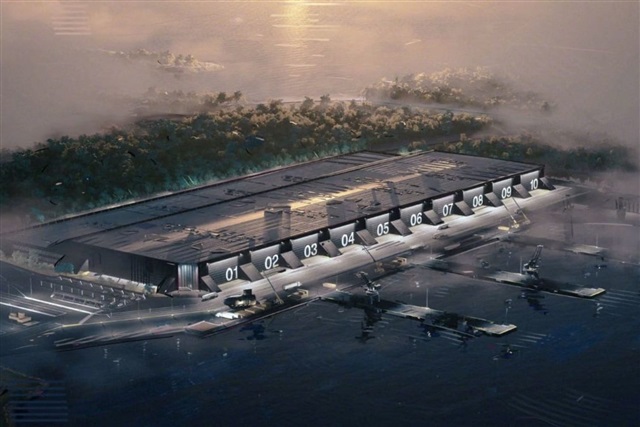
Anduril Industries said it will spend US$3.7 billion to build Arsenal-2, a next-generation software-defined shipyard at Sparrows Point in Baltimore County, Maryland. The US Navy is backing the project with a contract worth up to US$2.9 billion tied to production results, bringing the total commitment to US$6.6 billion as Washington seeks to expand the submarine industrial base.
The facility will occupy about 187 acres (roughly 757,000 square meters) at the Tradepoint Atlantic complex and offer more than 2 million square feet (about 186,000 square meters) of floor space. According to Bloomberg, Reuters, CNBC, Forbes and Yahoo!, the site is scheduled to begin operations in 2030 and is expected to become a major manufacturing hub for submarine components.
Once it reaches full capacity, Arsenal-2 is projected to create more than 3,100 permanent jobs and support over 14,000 direct and indirect jobs. Maryland and Baltimore County also plan to provide tax incentives and workforce training, with local support valued at as much as US$481 million.
Rather than compete directly with General Dynamics' Electric Boat or Huntington Ingalls' Newport News Shipbuilding on full submarine construction, Anduril will first join the Virginia-class supply chain. The company plans to produce torpedo tubes, large modules and hull sections before prime contractors handle final assembly. It has already established early manufacturing capacity in Orange County, California, where it is producing some components and testing processes ahead of the Maryland launch.
Anduril said Arsenal-2 will use its ArsenalOS industrial software as the digital backbone for production, linking manufacturing workflows, assembly sequencing, materials management, quality inspection and documentation. The system will be paired with automation and digital work tools as the company looks to raise output and reduce dependence on a small pool of highly skilled workers. The company said the plant could add about 9 million labor hours and lift overall submarine manufacturing capacity by about 15%.
Article edited by Jerry Chen