
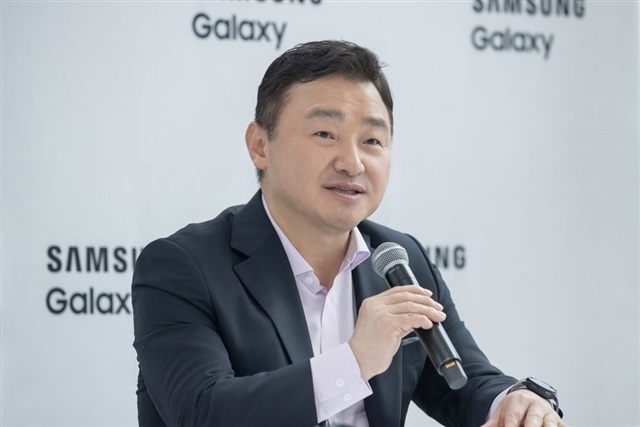
Samsung Electronics's Device eXperience (DX) head Roh Tae-moon personally visited Tokyo on April 1, marking his first trip to Japan this year. Although Apple has long dominated Japan's smartphone market, Samsung has recently seen a resurgence driven by its Galaxy series. Roh's visit signals a strategic push to expand Samsung's market share in Japan.
Industry insiders say Roh's presence in Tokyo symbolizes Samsung's shift from viewing Japan as a "peripheral market" to repositioning it as a core global market of high strategic importance.
According to The Korea Economic Daily, besides reviewing local operations, Roh met with senior executives from major telecom operators including SoftBank to discuss deepening partnerships and market expansion strategies.
The visit by Roh follows a renewed push among Samsung leadership to forge collaborative relationships with Japanese firms, according to Pulse. This is part of a greater trend of executives from major Korean conglomerates seeking Japanese partners in a range of sectors, from semiconductors to battery materials. These partnerships reportedly go beyond simply procurement to include jointly designed technologies and supply chains.
Could AI features spark a turn-around?
Japan has historically been a challenging market for Samsung smartphones due to iPhone's dominant market share, which exceeds 50%. This has created a highly concentrated and stable competitive landscape that has kept Galaxy's market share in single digits.
However, the turning point arrived with the AI smartphone era. Samsung's 2024 launch of the Galaxy S24 series introduced generative AI features that received positive feedback in Japan, boosting brand image and sales performance.
Data from Japanese research firm MM Research Institute (MMRI) shows Samsung rose to third place in both smartphone and overall mobile shipments in Japan in 2025, trailing only Apple and Google, with a market share around 6.2%. This marked the first time since 2020 that Samsung has climbed into the top tier in both these metrics simultaneously. Building on this momentum, Samsung has come to consider Japan a key global strategic market.
In February 2026, Samsung launched the Galaxy S26 series. For the first time, it included Japan among initial release markets, meaning that its devices appeared there about 2–3 months earlier than usual, to meet local consumers' high sensitivity to new devices. The Japanese models are fully equipped with Qualcomm's Snapdragon processors to enhance the product's performance and competitiveness, and to position it as a flagship product.
Restoring the distribution network was also pivotal. In 2025, SoftBank resumed selling Galaxy devices after nearly a decade-long hiatus, completing Samsung's coverage among Japan's three major carriers: NTT Docomo, KDDI, and SoftBank. Given Japan's heavy reliance on carrier-locked sales, this restored channel is viewed as a critical foundation for Samsung's competition against Apple.
Market attention now focuses on whether Samsung can surpass Google to become the leading Android player in Japan. Although Google's Pixel series has rapidly gained market share there recently, becoming a significant competitor beyond iPhones, Samsung aims to differentiate itself through superior hardware specs and deeper AI experiences.
Overall, as AI smartphones become the new center of competition alongside synchronization between distribution channels and products, Japan is gradually shifting from being considered an impenetrable market into one that could see breakthrough success, significantly elevating its role in Samsung's global plans.
Article translated by Lily Hess and edited by Joseph Chen