
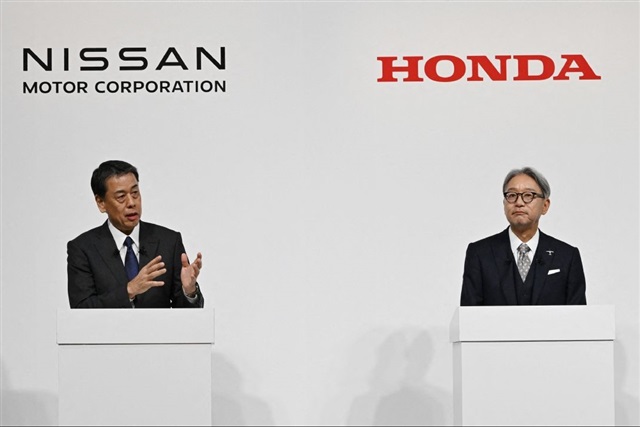
A year ago, the Japanese automotive world watched Honda, the financially robust "second brother," attempt to assert dominance over its smaller sibling Nissan. The high-stakes negotiations, marked by a glaring imbalance of power, ended abruptly and bitterly.
Fast-forward twelve months, and the irony is striking: Honda, having bet aggressively on electric vehicles (EVs), is now mired in a financial quagmire, effectively in the intensive care unit. Nissan, by contrast, has narrowed its operating losses from a market-expected JPY275 billion (approx. US$1.7 billion) to JPY60 billion, signaling that its "Re:Nissan" turnaround is taking hold and that it may finally be emerging from critical condition.
Honda's "all-electric" gamble turns catastrophic
Once celebrated for its fiscal discipline, Honda stunned the market with CEO Toshihiro Mibe's 2026 forecast. Over the next two years, the company expects to record losses totaling JPY2.5 trillion, with this fiscal year alone projected to post a net loss of JPY400-690 billion.
This would mark Honda's first annual net loss since its 1957 listing, a historic low in the company's six-decade history.
The collapse stems from Honda's ultra-aggressive electrification strategy. As Japan's only automaker fully committing to a battery-electric vehicle (BEV) transition, Honda ignored signals of market diversification, pushing forward with costly initiatives:
Market collapse
Sales in China have declined for 25 consecutive months, from a 2021 peak of 1.62 million units to just 650,000 in 2025, a 60% drop over five years. Honda's proprietary EV platforms lag behind local Chinese brands in both cost-effectiveness and software ecosystem.
R&D write-offs
Massive R&D expenditures and emergency halts to three US EV projects, including the joint venture Sony Honda Mobility, have deepened losses.
Budget overruns
Amid this financial hemorrhage, Honda returned to Formula 1 (F1), a costly venture that involves spending hundreds of billions of yen annually on R&D, which further inflamed its losses.
Although Mibe, who has been in office for five years, pledged to forgo 30% of his salary and bonuses over three months in an apology to shareholders, markets are watching to see whether the board accepts this gesture.
Nissan's bold "amputation" strategy
By contrast, Nissan went into survival mode a year ago. CEO Ivan Espinosa's drastic measures have proven effective:
Rapid streamlining
The company shut or sold seven global plants and laid off 20,000 employees, cutting redundant capacity and trimming JPY500 billion in costs.
Localized technology focus
Abandoning traditional corporate pride, Nissan offloaded assets in China to joint venture partner Dongfeng Motor, adopting their chassis and "three-electric" system.
The strategy sharply reduced operating losses. While the company remains in the red, Nissan now has the breathing room to recover.
Toyota: quiet confidence amid chaos
At the end of 2024, Honda and Nissan signed a memorandum of understanding to explore a business integration aimed at EV transformation, seeking to become the world's third-largest automaker behind Toyota and Volkswagen.
Yet by 2025, Nissan's financial crisis forced Honda to propose a subsidiary takeover—rejected outright—while potential collaborations with Mitsubishi Motors stalled. Meanwhile, Taiwan's Foxconn pursued a four-way partnership, but without tangible results.
In just one year, both Honda and Nissan found themselves in critical condition, while Mitsubishi and Foxconn began to move forward.
Honda's financial collapse underscores a stark lesson: in the race toward electrification, technological ambition untethered from supply chain realities can cost trillions. Its JPY2.5 trillion loss stands as a cautionary tale for the entire auto industry.
Among Japanese automakers, the world is still most focused on the leader: Toyota.
Seemingly more conservative in EV decisions, Toyota has avoided the shocks facing its peers, maintaining sales at peak levels. Supply chain sources say Toyota's early groundwork in electronics and electrification has allowed it to remain in full control of market dynamics, combining prudence with agility.
The real test for Toyota may come with the next wave of smart automotive challenges. But for now, its robust financials give it a clear advantage in weathering the evolving landscape.
Article edited by Jack Wu