CONNECT WITH US
Sign out

SEMICON China opens with focus on AI chips and advanced packaging

Staff reporter, Taipei
0

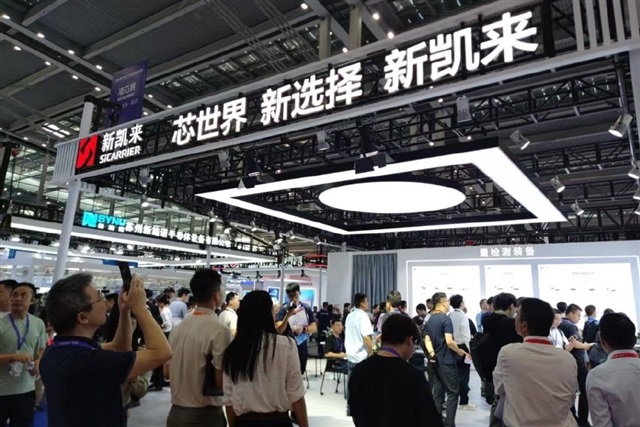
Credit: Shenzhen SiCarrier Technologies

SEMICON China 2026 opened on March 25 in Shanghai, as the global semiconductor industry enters a new expansion cycle fueled by the rapid rise of artificial intelligence.

On the first day, the focus was clear: AI computing infrastructure, advanced packaging, and power semiconductors. Together, they reflect a broader shift in the industry—from isolated technological breakthroughs toward competition defined by system-level integration.

Yet one notable absence drew attention. Shenzhen SiCarrier Technologies, a rising equipment maker backed by Shenzhen state capital and closely associated with Huawei, did not appear at this year's exhibition. The company, which had previously drawn attention with an ambitious product rollout, kept a low profile, prompting speculation about a potential shift in strategy or product timing.

In its absence, attention shifted back to established equipment makers and foundries, whose technological progress and production road maps dominated the event.

AI drives new memory cycle

A day earlier, industry signals had already begun to emerge at the CSTIC, jointly hosted by SEMI and IEEE. The conference was chaired by Peng Bai of Hua Hong Semiconductor and brought together leading technologists to outline the industry's trajectory.

In the memory segment, Zongliang Huo of Yangtze Memory Technologies said AI applications are pushing the global memory market into a "supercycle." As demand for both generative AI and inference grows, data centers are requiring significantly higher bandwidth and storage capacity, placing dual pressure on NAND and solid-state drive performance.

To address this, the company is advancing its Xtacking architecture, which separates memory arrays from peripheral circuitry and reconnects them through hybrid bonding. The approach overcomes the limitations of traditional two-dimensional designs while enabling more flexible scaling in 3D NAND. Industry observers say such architectures are likely to converge with advanced packaging technologies, becoming a cornerstone of heterogeneous integration.

Power chips gain strategic weight

While memory is being reshaped by bandwidth demands, power semiconductors are emerging as critical enablers of energy transition and electric vehicles.

Jiye Yang, Senior Director, TD Integration Division I, HHGrace, said the company has built strengths in both MOSFET and IGBT technologies. Its MOSFET products leverage deep trench superjunction structures to reduce on-resistance, while its IGBT portfolio incorporates a "Super-IGBT" design to balance high current density with lower energy loss.

Manufacturing capacity is also expanding. Hua Hong's 12-inch fab in Wuxi continues to ramp production, targeting automotive and high-end applications. As third-generation semiconductors such as silicon carbide and gallium nitride move closer to large-scale production, power devices are shifting from niche components to strategically critical technologies.

Equipment race centers on hybrid bonding

On the equipment front, competition is increasingly centered on hybrid bonding, a core technology for advanced packaging.

Naura Technology Group used the event to introduce its 12-inch die-to-wafer hybrid bonding system, the Qomola HPD30, underscoring its ambitions in the 3D integration equipment market.

Beyond bonding, Naura also unveiled a next-generation inductively coupled plasma etching system, the NMC612H, targeting advanced logic and memory processes. The system incorporates improvements in bias control and radio-frequency pulse modulation, key capabilities for next-generation chip manufacturing.

Taken together, the developments point to a broader trend: equipment makers are racing to build integrated capabilities that span both front-end manufacturing and back-end packaging, reflecting the increasing convergence of process technologies.

China's expanding role

According to Lily Feng, president of SEMI China, AI infrastructure will be the primary driver of semiconductor industry growth over the next decade.

China, meanwhile, continues to expand its footprint. By 2030, global wafer capacity is expected to grow by nearly 80% compared with 2020 levels, with China's share projected to exceed 30%. The country is also expected to maintain a dominant position in mature process nodes between 22 and 40nm.

China has remained the world's largest semiconductor equipment market for several consecutive years, with domestic supply chain development accelerating and efforts to localize equipment and materials gaining momentum.

A conspicuous absence

Against this backdrop, the absence of Shenzhen SiCarrier Technologies stood out.

The company had previously drawn attention at SEMICON China by announcing plans for a broad portfolio of equipment tools. Its decision not to appear this year has raised questions about whether it is recalibrating its strategy or adjusting its product rollout timeline.

In an industry increasingly defined by speed, integration, and scale, even silence can send a signal.

Article edited by Jack Wu