As the transformation of the auto industry comes into sharper focus, CES in Las Vegas has quietly evolved from a technology showcase into a bellwether for the global car business. In recent years, CES was often jokingly described as a "world-class auto show," dominated by demonstrations of the industry's shift from internal combustion engines to electric drivetrains. However, starting in 2025, the frenzy of brand and component competition began to cool. By CES 2026, the center of gravity had unmistakably shifted.
If the past five years of CES were an exhibition of electrification performance, this year marked something more profound: the moment when cars began to be treated not merely as vehicles, but as physical embodiments of AI.
From specs to software
At CES 2026, range figures and acceleration times — once the core metrics of EV bragging rights — faded into the background. As global demand for EVs slowed and government incentives were recalibrated, automakers redirected their investment toward making autonomous driving practical rather than aspirational.
Ford announced that it would fully integrate AI assistants into its mobile applications by 2026, with plans to achieve "eyes-off" autonomous capability by 2028. Hyundai, for its part, centered its exhibit on a software-led strategy, highlighting its partnership with Boston Dynamics and showcasing the next-generation Atlas humanoid robot — a signal that artificial intelligence is extending seamlessly from factory floors into vehicle cabins.
The shift reflects a growing consensus among automakers: in the post-electrification era, advanced automation and intelligence, not raw performance, will be the primary source of differentiation and pricing power.
Software-defined vehicles come of age
At CES 2026, the idea of the software-defined vehicle (SDV)— long a buzzword — took on the contours of a mature commercial architecture.
Great Wall Motor, which began previewing its Hi4-Z hybrid platform, semi-solid-state batteries, and intelligent driving systems at last year's event, returned this year with fully realized production models. The company showcased vehicles under its WEI, Tank, and other brands, alongside its ASL 2.0 intelligent agent, a full-scenario VLA large model, semi-solid-state battery, hydrogen fuel-cell technology, and advanced hybrid drivetrains.
Geely emphasized its fourth consecutive year of progress in intelligent mobility, unveiling what it described as a mass-production-ready L3 autonomous driving solution, an "ultra-humanlike" smart cockpit, and an AI-driven digital chassis.
Hyundai drew particular attention by unveiling both research and production versions of Boston Dynamics' Atlas humanoid robot, announcing plans to begin mass production in 2028 at its Georgia plant, with a target of 30,000 units annually to handle hazardous and repetitive manufacturing tasks.
In the sensing and perception arena, the Chinese lidar maker Hesai Technology introduced a new generation of L3 automotive-grade sensors, including ultra-long-range and solid-state units. To meet rising demand from advanced driver-assistance systems and robotics, the company plans to double its annual production capacity to four million units in 2026.
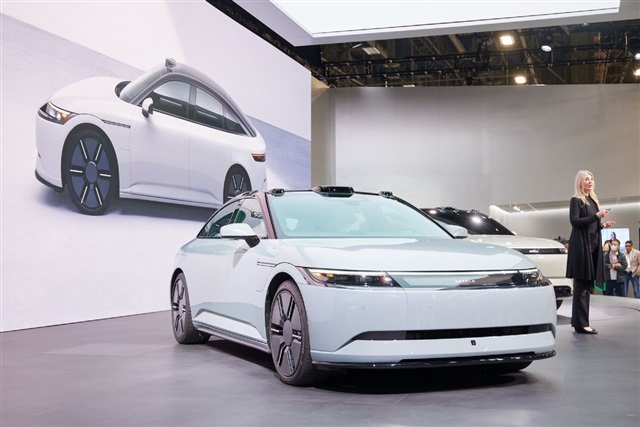
Sony Honda Mobility also made its mark, unveiling the latest iteration of its EV, the Afeela 1, slated for release in the US at the end of 2026. The company framed the car not simply as a mode of transport, but as a redefinition of the relationship between humans and mobility through intelligent driving systems.
Cross-industry convergence and Taiwan's role
CES 2026 also underscored the expanding boundaries of the mobility ecosystem. Advances in electric vertical takeoff and landing (EVTOL) aircraft and drone technology pointed toward the emergence of three-dimensional transportation, while solid-state batteries moved closer to scaled commercialization, including through partnerships such as that between ProLogium and the engineering firm FEV.
Taiwanese companies emerged as critical enablers of this transition. Firms including FIH Mobile, AUO, and Kinpo showcased end-to-end solutions spanning high-performance computing, displays, and intelligent cockpits, reinforcing Taiwan's role as a backbone of the global semiconductor and information-technology supply chain underpinning smart mobility.
In the second half of the auto industry's transformation, the contest is no longer about horsepower, but brainpower.
As artificial intelligence becomes deeply embedded, the automobile is evolving from a means of transport into an intelligent terminal — one that senses, reasons, and proactively serves its users. This shift, from hardware to software and from energy to intelligence, is poised to reshape how people move over the next five years.
Article translated by Elaine Chen and edited by Jack Wu