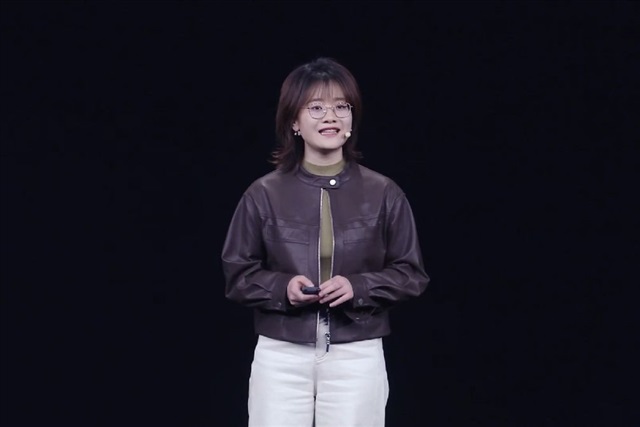
At the recent "Human X Car X Home" partner conference, Xiaomi's MiMo model team leader Luo Fuli introduced the open-source MiMo-V2-Flash model, designed to boost agent execution capabilities as foundational technology within Xiaomi's interconnected device ecosystem.
In her first public speech on MiMo-V2-Flash, Luo emphasized that true intelligence entails interacting with the physical world rather than solely processing language. Drawing a parallel with biological evolution, she described existing LLMs as practicing a form of reverse evolution by prioritizing language before physical-world reasoning and sensory integration, which limits their genuine comprehension of complex environments.
Luo revealed the model's three development priorities: enhancing code and tool invocation, enabling collaborative agent reasoning with high bandwidth, and utilizing more stable reinforcement learning for post-training improvements. MiMo-V2-Flash employs a Mixture of Experts (MoE) architecture with hybrid attention mechanisms, combining sliding windows and global attention to optimize performance against computational costs. The model contains 309 billion parameters, of which 15 billion are active during inference, allowing it to process up to 256,000 tokens at a rate of 150 tokens per second.
Benchmark results position MiMo-V2-Flash close to DeepSeek-V3.2 in performance but at half the cost. In the AIME 2025 math competition, it matched Google Gemini 3 Pro and OpenAI GPT-5 High, outperforming DeepSeek-V3.2. It also exceeded DeepSeek-V3.2 in the GPQA-Diamond science knowledge test, performing comparably to GPT-5 High, though slightly behind Google Gemini 3 Pro.
On the path to artificial general intelligence (AGI), Luo argued that success hinges more on inferring the world's operational logic in physically consistent and temporally coherent ways than on isolated model techniques. She also noted that Xiaomi's competitive advantage lies in a scientific research culture and translating models into practical products rather than relying on raw computing power or data volume.
Looking ahead, Xiaomi plans to integrate the MiMo model fully across its automobile, smartphone, and AIoT product lines. This strategy aims to embed advanced AI capabilities directly into end-user devices, reinforcing Xiaomi's human-car-home ecosystem ambitions.
Article translated by Jingyue Hsiao and edited by Jack Wu