
This week's most-read stories traced the AI boom across the stack, from supernodes and next-generation memory to liquid cooling, solar power, telecom services and PCB demand. Below are the most-read DIGITIMES stories from the week of August 10-16, 2026.
Taiwan Mobile takes control of Systex to challenge ICT rivals
Taiwan Mobile will raise its stake in Systex from 11.86% to more than 50%, gaining control of the IT services provider to strengthen its position in AI, cloud, cybersecurity, and enterprise ICT. Systex serves 40,000+ customers across 24 countries and generated NT$43.9 billion (approx. US$1.47 billion) in revenue in 2025, giving Taiwan Mobile a stronger platform to compete with Chunghwa Telecom and Far EasTone.
China's AI supernode build-out turns more chips into more computing power
China's computing-network expansion is accelerating around AI supernodes, with 15th Five-Year Plan investment potentially reaching CNY4 trillion (US$593 billion). MIIT says intelligent-computing capacity hit 2,185 EFLOPS in 1H26, up 177% year-over-year, while Guohai Securities forecasts the domestic supernode market will surge from CNY88.9 billion in 2026 to CNY1.109 trillion in 2028.
By combining more AI accelerators with high-speed interconnects and system-level optimisation, Chinese vendors aim to offset weaker single-chip performance and accelerate domestic AI chip adoption.
OCI rides AI, space solar boom as SpaceX deepens polysilicon ties
OCI Holdings is gaining from its rare position as a non-China polysilicon supplier, with 1H26 revenue up 11.1% to KRW1.92 trillion (US$1.36 billion) and its 2028–2029 Malaysian polysilicon and Vietnamese wafer capacity already sold out. The company plans to double polysilicon capacity to 70,000 tonnes and raise wafer capacity to 11.5 GW by 2029, while a reported KRW1 trillion, 3–5 year SpaceX supply deal could extend its growth from US AI data-center solar demand into space applications.
Gelsinger calls HBM 'lousy', SK Hynix says it's not memory's final answer
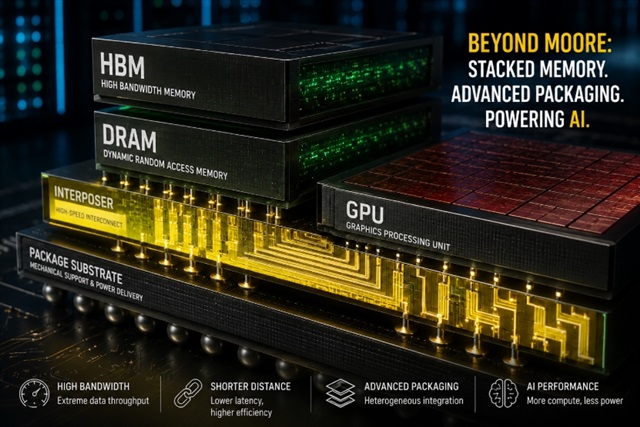
Former Intel CEO Pat Gelsinger called HBM "lousy," citing heat, efficiency and bandwidth limits, while SK Hynix vice president Hoshik Kim agreed it is not the final answer to AI's memory bottleneck, though still the best option today. Intel is exploring ZAM and XBM, Nvidia is expanding on-chip SRAM, and industry attention is shifting toward co-designed GPU, memory, packaging and interconnect architectures beyond HBM.
Apple turns to China memory, testing Washington's limits
Apple is testing CXMT DRAM for iPhones and MacBooks and has discussed using the chips in China-market devices, potentially with White House backing. Counterpoint estimates CXMT reached 8% of global DRAM revenue in 1Q26, up from 3% a year earlier, with revenue rising more than 700%, giving Apple another supply option as AI demand tightens memory availability and prices, but US export controls and CXMT's Pentagon-linked status make deeper cooperation politically sensitive.
Asia Vital Components sees AI servers accelerating liquid cooling
Asia Vital Components (AVC) expects AI server demand to strengthen in 2H26, with liquid-cooling penetration reaching 50% by 2027 as Nvidia Vera Rubin and ASIC deployments expand. The company plans NT$15 billion in 2026 capex, will raise Vietnam liquid-cooling capacity by 50%, and reported 2Q revenue of NT$49.12 billion, net profit of NT$9.57 billion, and a record 32.57% gross margin.
Tripod posts record margins on server, memory demand
Tripod Technology posted record 2Q26 revenue of NT$24.86 billion and net profit of NT$3.89 billion, with gross margin topping 30% for the first time at 30.09%, supported by strong server and memory PCB demand. Server and networking products reached 42.2% of sales, while July revenue hit a record NT$9.82 billion; the company plans more than NT$10 billion in 2026 capex to expand capacity in Vietnam and China.
Article edited by Levi Li