As global healthcare systems evolve, preventive medicine and digital health technologies are becoming key drivers of medical innovation. Aging populations, rising healthcare costs, and increasing chronic diseases are accelerating the transition from treatment-oriented care toward preventive, personalized, and data-driven health management.
Within this transformation, Traditional Chinese Medicine (TCM) is being re-examined beyond its historical and cultural role. Increasingly, TCM is discussed in the context of systems-based healthcare, lifestyle regulation, and long-term health management. Its emphasis on prevention, adaptation, and holistic regulation reflects growing global interest in healthcare models that focus on maintaining balance and improving overall well-being.
TCM has traditionally emphasized the dynamic relationship between human health and environmental changes. Practices such as seasonal adaptation, sleep regulation, dietary management, and stress balance share conceptual similarities with modern healthcare research in areas including circadian rhythms, lifestyle medicine, and preventive care.
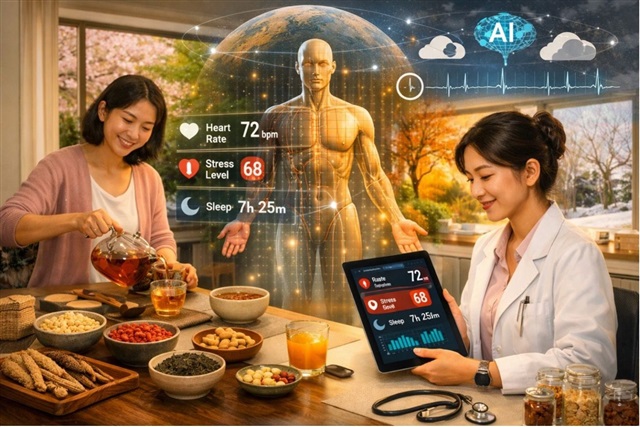
Meanwhile, advances in digital technologies are reshaping healthcare delivery. Wearable devices, mobile health platforms, and artificial intelligence (AI)-based analytics now enable continuous monitoring of physiological indicators, including heart rate variability, sleep patterns, activity levels, and stress-related signals. These technologies create new opportunities to connect traditional health concepts with modern data-driven healthcare systems.
The integration of TCM with digital innovation has become an emerging interdisciplinary field. AI-assisted diagnosis, wearable health monitoring, smart herbal medicine production, digital supply chains, and biotechnology applications are opening new pathways for the modernization of traditional medicine.
This article series explores the evolving role of TCM in modern healthcare, covering preventive health, lifestyle management, wearable technologies, AI applications, herbal biotechnology, smart agriculture, and the globalization of traditional medicine.
Taiwan’s development in biotechnology, information technology, precision agriculture, and healthcare innovation provides a unique foundation for advancing this integration. Emerging research in plant-derived biomaterials, intelligent cultivation systems, and herbal medicine applications demonstrates the potential of combining traditional knowledge with modern science and engineering.
The modernization of TCM does not mean replacing traditional practices with technology. Instead, it represents a process of reinterpretation—using scientific validation and digital tools to enhance understanding, application, and global communication of traditional healthcare concepts.
Challenges remain, including standardization, clinical validation, regulatory frameworks, and data integration. However, as healthcare continues to move toward predictive, personalized, and continuously monitored models, TCM may contribute valuable perspectives on preventive care, holistic health management, and system-oriented healthcare thinking.
The convergence of traditional medicine and digital innovation will continue to shape new possibilities for the future of global healthcare.