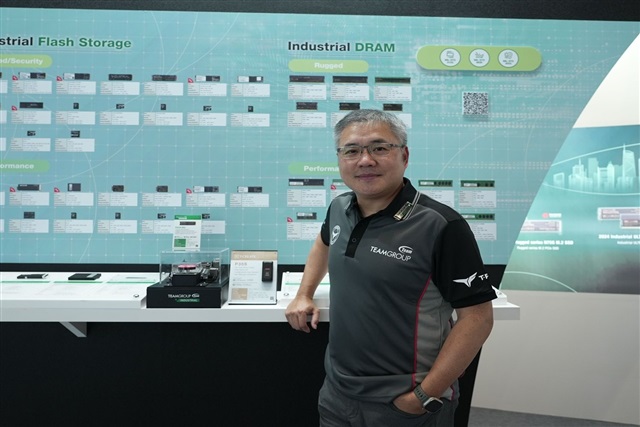
As the AI computing race accelerates and semiconductor manufacturing capacity is increasingly redirected toward advanced memory, the memory industry is shifting from price-driven competition to a battle over resource allocation and supply security. The rapid expansion of high-bandwidth memory (HBM) production continues to consume advanced fabrication capacity, constraining the supply of conventional memory products and creating persistent shortages across the market. This concentration of high-end production has widened the supply-demand gap, driving the average selling prices of certain premium memory products to levels eight to ten times higher than previous norms.
Against this backdrop, TEAMGROUP General Manager Gerry Chen warned that the industry could face a period of unprecedented scarcity by 2027. He described the situation as one where "even customers willing to accept higher prices may still face supply risks," potentially echoing the severe chip shortages seen during 2021–2022. Chen noted that even buyers willing to pay premium prices could face significant procurement challenges if they lack long-term strategic relationships with original chip manufacturers, leaving them highly vulnerable to supply disruptions.
In response, TEAMGROUP initiated a strategic transformation in 2025, redirecting 80% of its resources from the consumer segment toward long-lifecycle, high-reliability applications. The company is now focused on mission-critical sectors, including industrial automation, enterprise infrastructure, defense, and healthcare, while also expanding into military-grade storage and high-density computing applications. Leveraging three decades of partnerships with leading global suppliers and its extensive experience in IPC design-in collaboration, TEAMGROUP has strengthened supply-chain resilience and enhanced supply assurance amid ongoing market volatility, positioning itself as a trusted enabler of secure and reliable AI infrastructure.
Building supply chain resilience amid persistent memory shortage
Chen emphasized that the exponential growth of AI-driven demand is outpacing semiconductor capacity expansion, a process that typically requires three to three-and-a-half years to complete. As a result, supply constraints in DRAM and SSD markets are becoming a structural challenge rather than a cyclical phenomenon. In this environment, competitive advantage will increasingly depend on supply assurance, allocation capabilities, and long-term supplier relationships rather than price alone.
Leveraging decades-long partnerships with leading memory manufacturers and extensive IPC expertise, TEAMGROUP has established a stable supply framework for industrial PCs and other long-lifecycle applications requiring seven to ten years of product availability. The company works closely with customers to identify alternative component sources, optimize system configurations, and mitigate demand distortion and bullwhip effects across the supply chain. These capabilities have strengthened resilience for customers in mission-critical industries such as automotive, healthcare, and defense.
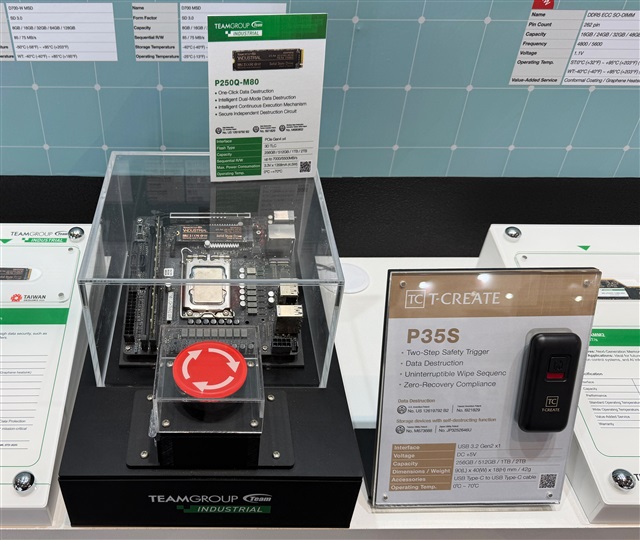
T-CREATE EXPERT P35S & TEAMGROUP INDUSTRIAL P250Q secure data in defense & finance. Credit:TEAMGROUP
TEAMGROUP's portfolio spans commercial-grade storage solutions for general confidential data protection, as well as industrial-grade products engineered for deployment in aircraft, naval vessels, unmanned systems, and other high-reliability platforms. The company has showcased these solutions at major industry events, including Embedded World and Japan IT Week.
Physical destruction technology enables one-click data destruction
The T-CREATE EXPERT P35S, recipient of the 2026 COMPUTEX Best Choice Award, exemplifies TEAMGROUP's philosophy that "physical destruction is the ultimate safeguard." According to Chen, true data security lies in the complete physical destruction of storage media rather than relying solely on software-based deletion methods.
When activated, the SSD's built-in boost chip instantly releases a high-voltage current that physically breaks down the insulation layer of the NAND flash ICs, permanently destroying the storage medium within 2.4 seconds and making data recovery extremely difficult. For everyday protection, AES-256 encryption provides a first line of defense, creating a comprehensive security framework that integrates both hardware- and software-based safeguards.
The design is engineered to eliminate any possibility of residual data. Its proprietary circuit architecture uses a zoned sequential-conduction mechanism, enabling high-voltage current to destroy memory chips in a controlled chain reaction. TEAMGROUP's patented "power-resume destruction" technology further ensures destruction integrity by automatically completing the process when power is restored if an interruption occurs during the destruction sequence.
To prevent accidental activation, the device incorporates a two-stage fail-safe button requiring deliberate user action. The technology also supports remote activation through 4G/5G networks, radio communications, or SMS commands, allowing data destruction to be triggered from several kilometers away. This capability helps prevent sensitive information from being compromised even if a device is lost, stolen, or captured.
The patented technology is currently available in two products: the T-CREATE EXPERT P35S, a portable secure storage device, and the industrial-grade TEAMGROUP INDUSTRIAL P250Q-M80 M.2 high-speed SSD, designed for classified computing environments, financial institutions, and defense applications. Together, they provide a robust cybersecurity safeguard for the defense, finance, and R&D sectors.
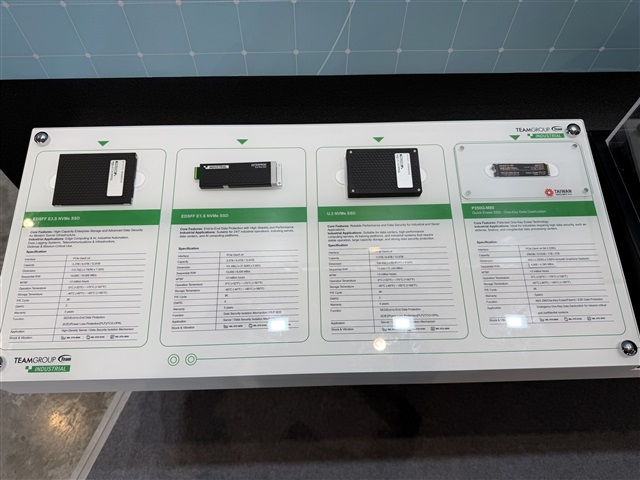
TEAMGROUP showcases a variety of enterprise-grade SSDs at COMPUTEX. Credit: TEAMGROUP
Advanced specs pave the way for agentic AI
Looking ahead to the convergence of AI and physical robotics, Chen noted that technology ultimately serves human needs. As AI systems continue to collect and process vast amounts of behavioral, operational, and contextual data, demand for on-premises storage is expected to grow significantly.
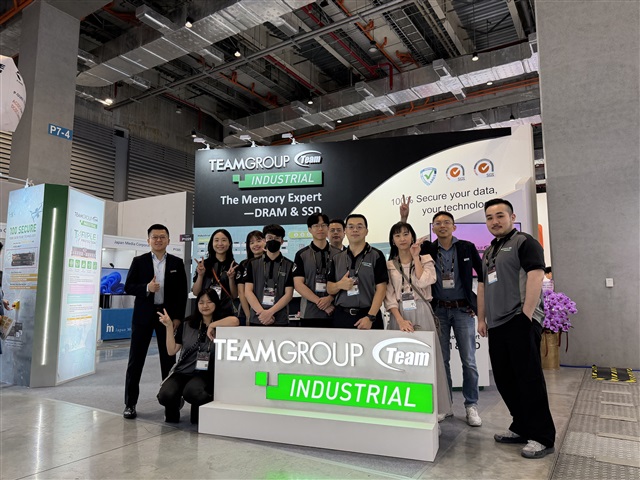
TEAMGROUP keeps data stable in harsh settings & inspires young teams to innovate. Credit: TEAMGROUP
One example is the emerging long-term care robotics market. These systems must not only deliver healthcare-related capabilities but also retain medical records and behavioral data over extended periods. Such requirements place stringent demands on SSD endurance, reliability, and long-term stability, underscoring the importance of local data storage. Similarly, enterprises are increasingly reluctant to move highly sensitive information—including financial data, proprietary business models, and operational intelligence—to the cloud. As a result, agentic AI systems capable of autonomous decision-making within on-premises environments are gaining strategic importance.
To support next-generation AI applications, TEAMGROUP has become one of the industry's early innovators in LPCAMM2 and SOCAMM2 memory technologies. LPCAMM2 enables LPDDR memory, traditionally soldered directly onto notebook motherboards, to become modular and upgradeable, while SOCAMM2 introduces a compact, low-power architecture designed for AI servers and advanced computing platforms, offering an alternative to conventional RDIMM. Together, these technologies offer greater flexibility, serviceability, and power efficiency for future AI systems.
Beyond supplying low-power memory components, TEAMGROUP has evolved into a comprehensive solution provider, helping customers maintain data integrity and system stability in demanding operating environments characterized by vibration, thermal challenges, and continuous workloads. At the same time, the company encourages its young talent to pursue bold innovation while investing in next-generation DDR6 R&D, laying the groundwork for future AI infrastructure and intelligent edge computing applications.
Amid the ongoing memory supercycle, TEAMGROUP has demonstrated strategic resilience and innovation beyond the role of a traditional module manufacturer. By combining supply-chain expertise, advanced physical-level security technologies, and next-generation memory architectures, the company aims to help customers safeguard critical digital assets while preparing for the next phase of AI-driven transformation.
For more information, please visit.