
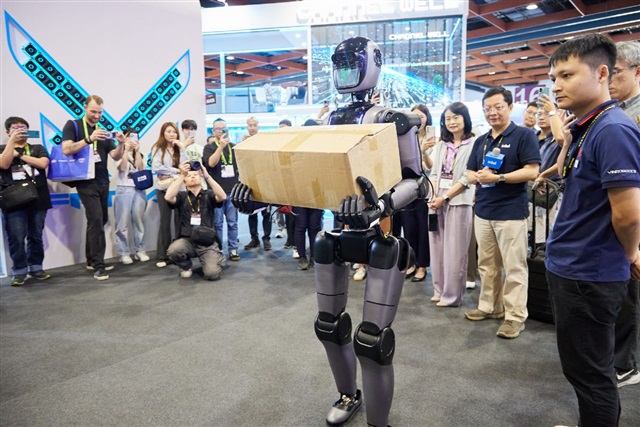
Humanoid robots are attracting global interest, and COMPUTEX 2026 has opened its first robotics zone. Yet Taiwanese suppliers are focusing on physical AI, including AI computing platforms, edge AI, and application solutions. This reflects Taiwan's strengths in ICT and semiconductors, as well as the hurdles facing commercial humanoid robots worldwide.
Taiwanese companies are increasingly seen as more likely to target AI infrastructure and critical components than to launch full humanoid robot brands. Industry observers said this approach aligns better with the island's manufacturing base and its established role in electronics supply chains, rather than pursuing a high-risk push into a still-immature consumer and industrial robot market.
The caution comes as humanoid robots remain at an early, capital-intensive stage, with business models still uncertain. Industry sources said the companies most aggressively developing full humanoid systems globally — including Tesla Inc., Figure AI, Agility Robotics, and Boston Dynamics — are typically supported by deep capital-market funding. By contrast, Taiwanese firms tend to prioritize profitability and cash flow, making them less inclined to place long-term bets on an unproven sector.
Commercialization also depends on whether humanoid robots can reliably solve problems and carry out tasks, but that challenge remains substantial. Industry players said the "brain" of these machines — meaning the AI models and decision-making systems — has advanced faster than the hardware, which still lags in practical execution.
Hardware hurdles
Multiple terminal-application developers said the hardware side continues to face structural instability, heat dissipation, durability, reliability, and gait-control precision problems. These issues remain major barriers to real-world deployment.
One immediate challenge is that humanoid robots have very limited internal space, which makes joint cooling difficult and reduces operating efficiency. Another is that poor movement precision can directly weaken recognition and task execution performance. Even as vision-language-action models improve robots' ability to recognize and act, positional deviations after movement can sharply reduce overall performance.
The "cerebellum" problem
Industry players said the hardest problems now sit at the "cerebellum" level, where systems handle balance, arm and leg coordination, and walking stability. If a robot cannot move reliably, it cannot consistently reach target positions, which then affects sensing and manipulation. Much of that lower-level motion-control know-how remains under the control of robot original equipment manufacturers and is not always shared fully with system integrators, adding another layer of difficulty to humanoid robot development.
Article translated by Jingyue Hsiao and edited by Jerry Chen