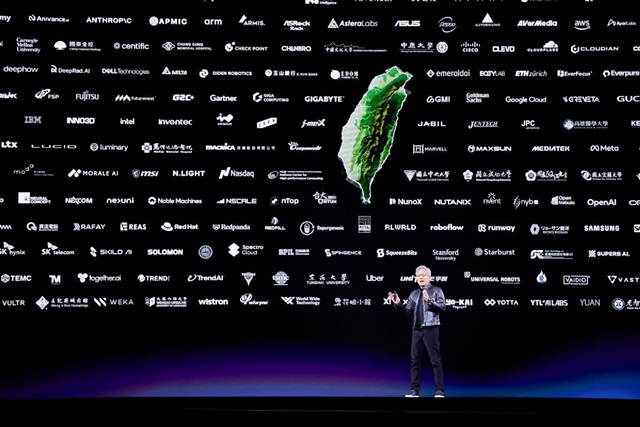
Computex 2026 has ended, with the spotlight again firmly on Nvidia CEO Jensen Huang. From his arrival in Taiwan on May 23, Huang spent two weeks meeting key industry figures, attending Nvidia developer events, GTC Taipei, and a Computex tour, and once again hosting his "trillion-dollar banquet."
Against the backdrop of the industry shifting toward agentic AI and physical AI, Nvidia's 2026 strategy blueprint centers on ramping the Vera Rubin platform, the rise of the standalone Vera CPU, and RTX Spark's push into the AI PC market.
Each Vera Rubin system contains nearly 2 million components and requires 100-150 Taiwanese supply-chain partners to build it. While the Grace Blackwell platform remains in full mass production, Vera Rubin is also ramping up.
Estimates show Rubin GPU shipments are still targeted at 1.5-2 million units, with chip-side output set to ramp by the end of the second quarter 2026 and system mass production concentrated by the end of the third quarter. Foxconn, Quanta, Wistron, Inventec, and Pegatron all showcased related rack systems at Computex.
Market estimates put Vera Rubin NVL72 shipments in 2026 at about 5,000-10,000 racks, below the roughly 60,000-70,000 GB300 racks expected, but volumes are forecast to expand quarter by quarter from 2027. A single Vera Rubin NVL72 rack is priced at about US$8 million, above the roughly US$3 million-plus level of GB300, lifting the value of cooling, power supply, PCB, optical communications, switches, and rack systems as well. Supply-chain sources said Nvidia's products have evolved from a single GPU into a complete AI infrastructure system, sharply increasing complexity and making Taiwan's supply chain more critical than ever.
Vera Rubin uses a 3nm process and CoWoS advanced packaging, and as Rubin GPU, Vera CPU, and networking chips ramp, TSMC capacity is expected to stay tight. As AI chips grow larger and more power-hungry, advanced packaging is increasingly becoming the key factor determining product competitiveness.
Optical communications have also become a major upgrade focus. Nvidia's Spectrum-X Photonics architecture signals that AI data centers are entering the optical networking era. Supply-chain partners are now positioned for a boom.
Huang also renewed his "token to revenue" concept, saying future AI data centers will shift from cost centers to revenue centers. As AI agents begin to take part in enterprise workflows, every token could translate into real business value. Companies will no longer be buying just GPUs, but a complete AI factory that requires system-level design, with "computing power equals revenue" becoming the new logic.
This year's Computex also redefined AI PCs. Huang said PCs of the future will not just run applications, but serve as platforms for AI agents, fundamentally reshaping human-machine interaction. As a result, the RTX Spark platform developed with MediaTek will challenge Apple in the short term and, over the medium to long term, aims to capture the front door to the AI era and compete with Google's end-to-end ecosystem.
Article translated by Charlene Chen and edited by Jack Wu