
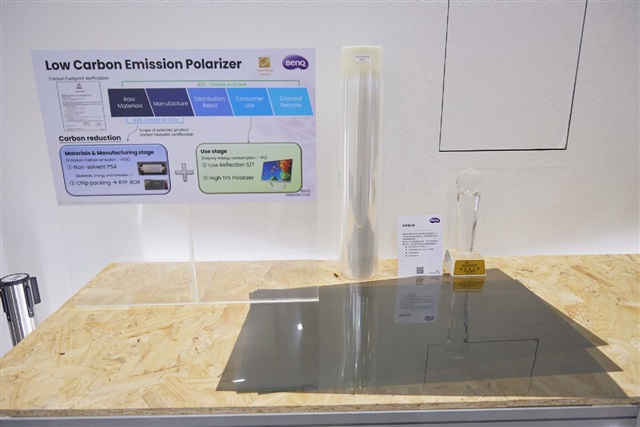
Growing pressure from capacity expansion in China, price competition, and compressed profit margins for traditional display applications has prompted Taiwan-based polarizer manufacturers to accelerate their transformation. Companies including BenQ Materials, Cheng Mei Materials Technology (CMMT), and Optimax Technology are diversifying their roles across medical, semiconductor materials, and automotive applications. Their objective is to mitigate industry risk and obtain a second growth curve.
BenQ Materials
In addition to its core display business, BenQ Materials has clearly extended its transformation focus into the medical field and semiconductor materials, primarily through cross-industry technology integration, expanding from material molecular design to end applications, and continuously enhancing material value.
Due to early customer inventory buildup and fewer working days in February, BenQ Materials reported consolidated revenue of NT$1.606 billion (approx. US$51 million) in March, up 19.92% month-on-month and down 3.14% year-over-year, marking a 12-month high. Cumulative consolidated revenue for the first quarter of 2026 reached approximately NT$4.546 billion, up 5% quarter-on-quarter and down 0.75% year-over-year.
Because of exchange rates, BenQ Materials' medical business grew only 5% in 2025, falling short of expectations. However, as professional medical products gradually enter the supply chains of major international companies and consumer medical products maintain steady growth, the outlook for the first half of 2026 is optimistic. The company estimates that the medical business could account for nearly 40% of total revenue in 2026, with a medium- to long-term target of exceeding 50% within 3-5 years.
In the semiconductor materials field, BenQ is supplying cleaning brush rollers used in chemical mechanical planarization (CMP) processes and already shipping to wafer fabs. It is also actively developing wafer grinding tapes and UV release tapes, which are currently in customer validation and may begin shipments as early as the end of 2026. Although semiconductor materials currently account for a small share of revenue, they are expected to become a key development direction.

Source: compiled by DIGITIMES Asia, April 2026
CMMT
On the other hand, CMMT's transformation strategy is heavily focused on the semiconductor sector. Leveraging its polarizer technology, it has expanded into packaging application film materials, with tangible results already emerging, including semiconductor tape shipments that officially began in the first quarter of 2026.
For advanced packaging materials, CMMT is investing capital to upgrade existing facilities and introduce new production lines. It recently allocated up to NT$664 million to procure equipment from Tzai Yuan Enterprise, while simultaneously advancing a NT$2.2 billion capital expenditure plan and a NT$1.25 billion cash capital increase, formally launching its semiconductor business expansion plan.
CMMT expects the new production lines to begin operations in the fourth quarter of 2027, with expanded operations anticipated in 2028. The company aims to drive accelerated revenue and profit growth through semiconductor business development. This is a sign that CMMT's transformation strategy has entered the implementation phase, demonstrating its commitment to tangible investment.
However, CMF's polarizer business remains under pressure. March consolidated revenue was NT$612 million, up 18% month-on-month but down 23.8% year-on-year. First-quarter revenue reached NT$1.822 billion, down 19% quarter-on-quarter and 13.8% year-on-year.
Nevertheless, losses have improved. CMMT reported a net loss after tax of NT$14 million in March, with a loss per share of NT$0.02, narrowing by nearly 90% compared to February. For the first quarter of 2026, net loss after tax was NT$163 million, with a loss per share of NT$0.29, improving from a loss per share of NT$0.49 in the fourth quarter of 2025.
This indicates that its strategies of consolidating production lines and adjusting product structure are gradually taking effect. Although CMMT remains in a loss position in the first quarter of 2026, the significant reduction in losses, combined with initial contributions from its semiconductor business, suggests it is approaching a turning point.

Source: compiled by DIGITIMES Asia, April 2026
Optimax Technology
Among Taiwan's three major polarizer makers, Optimax entered the automotive market the earliest. Automotive polarizers currently account for as much as 80% of its revenue, and it holds approximately 8% of the global market share. Due to higher gross margins and relatively stable demand for automotive products, the company is less affected by economic cycles, making this segment a key pillar of its operations.
Building on this foundation, Optimax is further expanding into niche applications, including AR/VR glasses, head-up displays (HUD), polarized sunglasses, and privacy protection films. It is also investing in emerging fields through strategic investments, including cybersecurity chips and plasma-based medical aesthetics products, in an effort to establish a second growth curve.
Overall, while Taiwan's three major polarizer manufacturers are at different stages of transformation, a common trend is emerging: increasing the share of high-value products, entering long-term stable sectors such as automotive applications, and expanding into high-barrier fields such as semiconductors and medical industries to reshape their industrial positioning.

Source: compiled by DIGITIMES Asia, April 2026
Article translated by Emily Kuo and edited by Jack Wu