
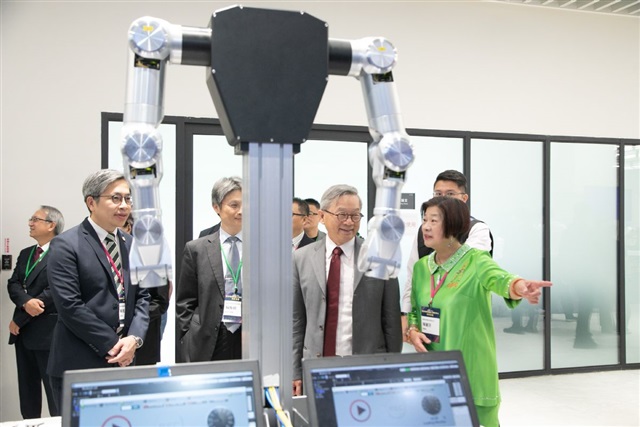
Taiwan has formally inaugurated its first national-level robotics hub. The National Center for AI Robotics, established under the National Institutes of Applied Research, is a strategic bet on converting academic research into globally competitive companies. The center is expected to anchor the island's push to build a world-class intelligent robotics industry.
Chasing the next Unitree or Boston Dynamics
The mission is clear: cultivate a new generation of "Made in Taiwan" robotics start-ups. The benchmark is high. Policymakers and industry leaders will be watching to see whether Taiwan can produce companies on par with China's Unitree Robotics or the US's Boston Dynamics.
Forget humanoids — Taiwan bets on function first
Officials are quick to stress that the center will not be locked into any single technological direction. The US and China are pouring resources into humanoid robots. Taiwan, at least for now, is taking a different route. Early efforts will center on "functional robots" — machines built for specific, real-world applications.
From supply chain giant to innovation leader
Speaking at the inauguration, Cheng-wen Wu, head of the National Science and Technology Council, framed the center as part of a broader economic shift. For decades, Taiwan relied on global demand rather than domestic scale. It built strength as a trusted supplier, producing "hidden champions" — niche but indispensable players — across electronics, machinery, and chemicals. That model, Wu argued, is no longer enough. Taiwan must step out from behind the scenes. The path forward lies in connecting academia, industry, and research institutes to spin out start-ups — without encroaching on the turf of existing contract manufacturing clients.
Breaking academia's risk-averse culture
Wu also identified a cultural hurdle. Taiwan's academic ecosystem, he said, has long mirrored its contract manufacturing base — cautious, incremental, and risk-averse. The robotics center is designed to break that mold. It will give researchers the infrastructure to pursue high-risk, high-reward ideas while keeping their ties to industry intact.
No fixed playbook, just real-world needs
The government has set a target of at least three robotics start-ups in the coming years. Wen-Yu Su, the center's director, said there will be no fixed playbook. Development will be driven by real industrial and societal needs — not the latest hype cycle. Robotics will not settle into a single dominant form, Su noted. Needs span home care, semiconductor manufacturing, and precision industrial tasks. No single platform will take over. In a rapidly aging society like Taiwan's, care and service robots will take precedence over entertainment machines.
Elder care leads the charge
That outlook is already shaping priorities. The center is targeting food service and elder care first. Use cases include helping older adults eat, move between rooms, and transition safely between beds and bathrooms. Assisted bathing and other complex tasks are on the longer-term horizon.
Filling the gaps industry won't touch
Not every application will attract private investment. Robots for deep-sea exploration or hazardous lab environments face steep technical hurdles and thin commercial demand. Su said the center is prepared to step in where the private sector falls short — absorbing risks that high costs and small markets make unattractive to business.
A southern corridor takes shape
The initiative fits into a broader regional build-out. A robotics corridor is forming in southern Taiwan, anchored at Shalun and linked to sites in Liujia and Liuying. Shalun handles system integration and research. Liujia takes on high-risk testing and validation. Liuying focuses on mass production. Together, they form an end-to-end pipeline from lab to market.
Out of the shadows
For Taiwan, the stakes go beyond a single research program. This is a concerted push to reposition the island in the global technology economy — stepping out of the supply chain shadows and into the front ranks of next-generation innovation.
Article translated by Elaine Chen and edited by Jerry Chen