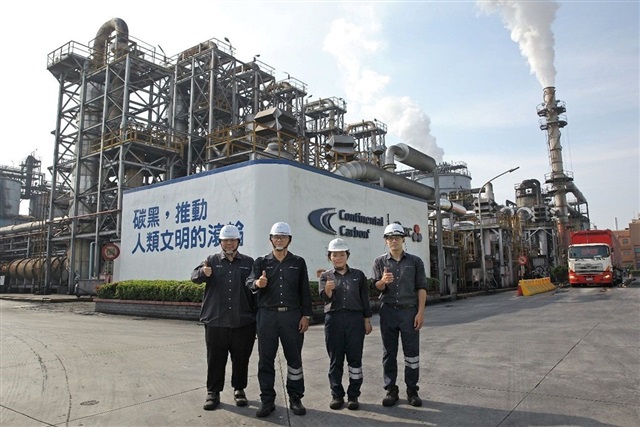
Carbon black is a critical functional material underpinning the performance of tires and industrial rubber products. Its production involves a high-intensity, continuous operational model where any unscheduled downtime leads to increased defective or off-grade products, wasted energy, and significant instability across the entire production line.
As Taiwan's only specialized carbon black manufacturer, Linyuan Advanced Materials Technology Co. Ltd – a core production site within the global network of Continental Carbon – has long prioritized real-time monitoring and predictive maintenance. Recently, the company deployed a comprehensive suite of ASUS AI-driven Predictive Maintenance and Health Management (AISPHM) solutions. This strategic move aims to gain advanced visibility into equipment status without disrupting production pace, thereby driving a robust digital transformation in maintenance operations.
Historically, Linyuan Advanced relied on manual inspections and basic digital tools for vibration diagnosis. However, as production scales expanded and environmental constraints intensified, traditional architectures struggled with necessary immediacy, continuity, and comprehensiveness.
Hsieh-Ho Tsai, Deputy Director of the Plant Manager's Office, noted that in brownfield factory environments, the construction costs and cabling complexity for wired fixed sensor systems are prohibitively high. This necessitated a search for a more flexible, scalable technical pathway to achieve comprehensive coverage.
Empowering Maintenance Transformation for High-Intensity Processes via Scalable, On-Premise Edge AI
Addressing these challenges, Linyuan Advanced implemented the ASUS AISPHM solution. Leveraging a robust three-tier architecture comprising wireless sensing, edge computing, and AI modeling, the company systematically reconstructed its maintenance protocols. This established a complete loop evolving from real-time sensing to predictive analytics, laying a deployable and scalable foundation for smart maintenance in high-intensity continuous manufacturing.
"During the evaluation phase, we prioritized the unique requirements of petrochemical material processing, specifically the need for long-term stability, uninterrupted operation," said Tsai. "Crucially, operational technology, or OT, data must remain on-premise. With equipment anomaly interpretation requiring accumulated domain expertise, key deciding factors included the vendor's capacity to provide responsive, local technical support, and the system's ability to allow continuous fine-tuning and expansion aligned with actual production dynamics.”
After weighing critical factors such as cybersecurity governance, system stability, and long-term trust, Linyuan Advanced selected ASUS. With its deep-rooted experience in industrial and enterprise markets, ASUS offered a mature, autonomous technology solution with responsive local R&D support. The brand's reputation for reliability provided the assurance of a stable, sustainable partnership, securing the role of ASUS and the wider ASUS group as the trusted technology partner for this smart transformation.
The deployed ASUS AISPHM solution encompasses three core layers: sensing, computing, and analysis. At the frontend, ASUS AISSENS wireless vibration sensors capture real-time equipment status. The intermediate layer utilizes the ASUS PE2100U industrial computer for on-site data aggregation and edge analysis. Finally, the backend AISPHM platform performs equipment health assessments, long-term trend comparisons, and anomaly alerts, forming a one-stop, integrated, and continuously evolving predictive maintenance ecosystem.
A standout feature of the ASUS system is the high flexibility of its AI models. Designed for carbon black production – and in particular, powder transport – the ASUS system allows for granular parameter adjustments based on actual operating conditions. Such precision significantly enhances anomaly detection accuracy.
According to Tsai: "Carbon black production is a high-intensity, continuous process inherently accompanied by persistent vibration disturbances. This makes context-aware AI vital; without integrating this specific process knowledge, false positives would be inevitable".
The ASUS solution enables model fine-tuning for individual units based on specific RPM, bearing models, and structural parameters. Beyond the software's inherent flexibility, these AI models are fine-tuned by certified vibration analysts to verify baseline modeling and anomaly interpretation. Furthermore, remote technical support ensured that any initial parameter calibration or connectivity issues were resolved in real-time, rapidly stabilizing the overall system.
Before full-scale expansion, ASUS provided sensors and a trial system for a pilot program, while Linyuan Advanced deployed its own WiFi network to test the solution on critical assets. The results verified stable, lossless data transmission. By combining this data with Linyuan's existing operational expertise, the team successfully established a vibration anomaly detection model tailored specifically to the carbon black plant, laying a solid empirical foundation for large-scale deployment.
Following successful validation, Linyuan Advanced leveraged government resources to expand the rollout. The initial target extends vibration monitoring to 100 sets of rotating equipment. The deployment strategy adopts a unit-by-unit expansion while simultaneously building the database. Currently, 20 critical assets are live with real-time transmission, and this systematic approach is gradually accumulating a high-value database of equipment health, creating a high-value data asset through scale.
From Operation to Governance: Establishing a Scalable Roadmap for Maintenance Evolution
In practical operation, the system architecture comprises four layers: Front-end Sensing, On-site Transmission, Backend Server, and Monitoring Analysis. Sensors measure multi-axial vibration spectrum and surface temperatures of rotating equipment such as fans and pumps. Data is transmitted via gateways and industrial WiFi, overcoming cabling challenges and construction costs.
The backend industrial computer performs full-spectrum analysis to build a historical vibration database. The AI prognostic mechanism utilizes the stable state following annual overhauls as a baseline model, continuously comparing it against real-time waveforms. Upon detecting anomalies, the system triggers alerts, allowing staff to verify with manual measurements and schedule planned maintenance, thereby significantly mitigating unplanned shutdown risks.
Regarding digital governance, Linyuan Advanced maintains a strict on-premise OT architecture. All critical data is processed within the plant, adhering to group cybersecurity protocols and zone-based management to ensure absolute data sovereignty and risk control. Looking ahead, Tsai positions the Taiwan site as the primary validation hub. Once operational procedures and engineering capabilities are fully mature, the company plans to evaluate expanding this standardized, replicable smart maintenance architecture to overseas plants in the US, India, and Turkey. Given the homogeneity of process conditions across these sites, this global rollout is expected to further fortify the group's overall operational resilience.
Tsai emphasizes that smart maintenance is a continuously evolving journey, not a one-time implementation. Building on the foundation of vibration monitoring, future roadmap items include integrating Generative AI analysis modules. These will automate reporting, helping engineering teams simply query equipment history and accelerate decision-making.
Additionally, the company plans to implement video AI to create an intelligent environment, health, and safety (AIEHS) management platform, specifically targeting access control, personal protective equipment (PPE) compliance, and high-risk behavior detection, prioritizing scenarios that deliver tangible safety value.
Linyuan Advanced places a high premium on system scalability and long-term upgrade flexibility – hence its choice of ASUS equipment to power its evolution. The goal is to extend analysis dimensions as the platform matures, avoiding redundant investments or the need to rebuild from scratch. When smart maintenance successfully integrates equipment, data, processes, and personnel capabilities, it transforms from a mere supporting tool into a core governance capability underpinning process stability and operational resilience.

Credit: ASUS

Credit: ASUS