CONNECT WITH US
Sign out

Nvidia CEO sees digital twins driving robot surge in next decade

, Houston
0

Credit: DIGITIMES

Nvidia CEO Jensen Huang recently highlighted that the next ten years will mark a critical period of accelerated development for robotics technology. He stated that the key to deploying humanoid robots effectively in factories lies in the deep integration of AI with digital twin technology.

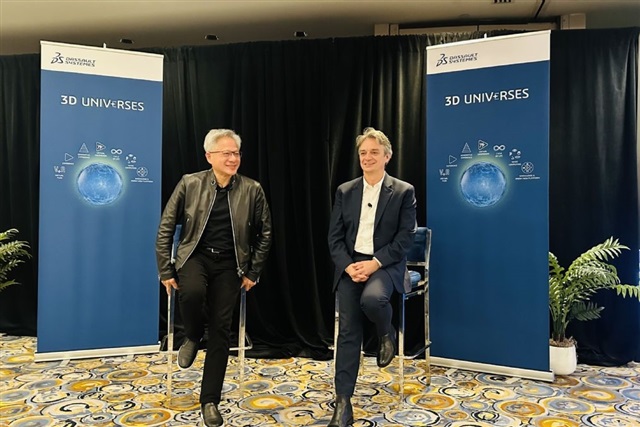
Huang spoke at Dassault Systemes' annual conference, engaging in dialogue with CEO Pascal Daloz. In a media interview following the event, he shared insights on the booming field of physical AI and humanoid robot advancement.

He described robotics evolution as moving along a spectrum from highly specialized systems toward highly general-purpose machines. Currently, many industrial robots are designed for specific tasks such as warehouse handling or assembly operations. Humanoid robots represent the ultimate form of "general-purpose" robots.

With maturing capabilities in perception, planning, and reasoning, future robots will not only interpret their environments but also understand task logic and autonomously execute multi-step procedures.

Huang noted that today's AI can integrate multiple sensing modalities—including cameras, ultrasound, LiDAR, and radar—enabling precise environmental awareness. Localization and path planning technologies have also reached high levels of maturity.

More importantly, the latest generation of robots is gaining reasoning abilities, understanding causal relationships like "to retrieve an item, one must first open the drawer," then sequentially performing actions such as opening the drawer, picking up the object, and closing it. This shift marks progress from mere command execution toward genuine task comprehension.

However, hardware and AI alone are insufficient for humanoid robots to truly enter factories and collaborate with humans.

Huang stressed the necessity of virtualizing the entire manufacturing environment—including human behavior patterns, factory spaces, equipment, and logistics between processes—to build comprehensive 3D digital twins capable of simulating real-world scenarios.

Only through repeated testing and optimization within these virtual environments can optimal human-machine collaboration models be precisely designed before deployment back into physical factories.

Previously, creating digital models of manufacturing sites was prohibitively expensive, posing a major barrier to smart manufacturing adoption. Now, AI combined with point cloud data and image reconstruction techniques can automatically generate virtual twins of factories and equipment, significantly lowering entry thresholds.

This innovation accelerates humanoid robot deployment and enables integration of data from diverse equipment vendors and system suppliers, ultimately allowing unified orchestration and coordination via a single platform.

The industry generally expects humanoid robots to initially deliver value in manufacturing, logistics, and warehousing by addressing labor shortages and enhancing production line flexibility. Over time, as their general capabilities improve, applications will expand across more physical industries.

Huang stated that the coming decade will be a golden era for "physical AI." The ability to establish highly realistic digital twins and achieve seamless virtual-physical integration will determine companies' competitive standing in the humanoid robot age.

Article translated by Charlene Chen and edited by Joseph Chen