

CONNECT WITH US
Sign out

CES 2026: Nvidia's Alpamayo promises smarter, safer autonomous driving

, Las Vegas
0

Credit: DIGITIMES

On the eve of CES 2026, Nvidia CEO Jensen Huang unveiled the company's Alpamayo series of open AI models, simulation tools, and datasets, signaling what he called a new era in autonomous vehicle development.

Tackling the long-tail problem

Huang emphasized that self-driving cars must operate safely across an extremely diverse and complex range of driving conditions. The most difficult challenge, he said, lies in rare but highly intricate long-tail scenarios — edge cases that occur infrequently but can have outsized consequences when they do. For years, these scenarios have been among the most stubborn obstacles to fully autonomous driving.

Traditional autonomous driving architectures often separate perception from planning, limiting their ability to adapt when confronted with novel or unusual traffic situations. Even recent advances in end-to-end learning fall short of addressing long-tail cases, which require models capable of causal reasoning to make safe decisions when conditions fall outside prior training data.

Reasoning like humans

The Alpamayo series is designed specifically to tackle this challenge. Its core is a Vision-Language-Action (VLA) model with chain-of-thought reasoning, enabling decision-making processes that resemble human thinking. By analyzing rare or unprecedented situations step by step, Alpamayo helps vehicles make more explainable and reliable driving decisions. Nvidia's Halos safety system provides overarching technical support, strengthening trust in the AI-driven vehicle.

Huang described the moment as the ChatGPT moment for physical AI, noting that machines are beginning to understand their environment, reason about it, and take action in the real world. Self-driving taxis, he said, are among the earliest applications poised to benefit.

With Alpamayo's reasoning capabilities, autonomous vehicles can navigate rare scenarios, operate safely in highly complex environments, and clearly communicate the logic behind their decisions — essential steps toward scalable, dependable autonomous driving.

Eight years in the making

Reflecting on Nvidia's journey, Huang noted that the company began investing in software-defined vehicles eight years ago. Over time, it became clear that enabling cars to navigate autonomously while guiding the industry into the future would require an integrated technology stack spanning chips, software, AI models, and development tools.

Looking ahead, Huang projected that roads worldwide will eventually host up to one billion AI-powered vehicles. Drivers may choose to take the wheel, but every vehicle will be equipped with autonomous capabilities. "Without question," he said, "this will be one of the largest robotics industries in human history." Deep involvement in the space, he added, allows Nvidia to develop computing chips closely aligned with real-world applications.

Building the ecosystem

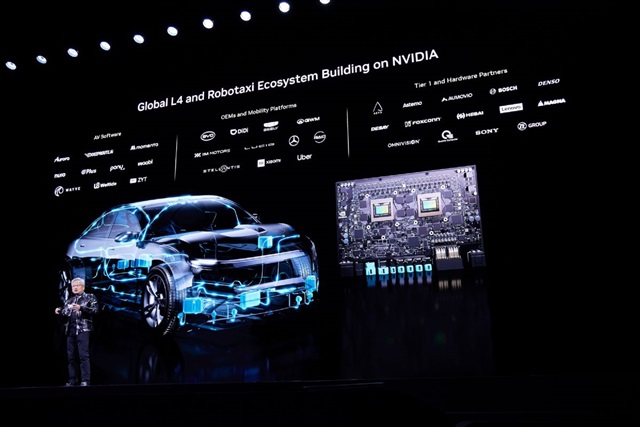
Huang also highlighted key partners in the autonomous-driving supply chain, including Bosch, Denso, Lenovo, OmniVision, Sony, and Taiwanese firms Foxconn and Quanta. Quanta Vice Chairman C. C. Leung also attended the keynote in person to show support.

In a closely watched collaboration, Foxconn recently announced a partnership with Nvidia, Stellantis, and Uber to advance the development and global deployment of Level 4 autonomous vehicles, focusing on robotaxi applications. Foxconn is responsible for high-performance computing, sensor integration, and electronic control systems; Nvidia provides the DRIVE AGX Thor vehicle computer platform and DRIVE AV AI-assisted driving software; Stellantis contributes the vehicle platforms; and Uber brings its global mobility network to the partnership.

Together, Huang said, these efforts aim to make autonomous driving safer, smarter, and more scalable — turning what has long been a technical aspiration into a practical reality.

Article translated by Elaine Chen and edited by Jerry Chen