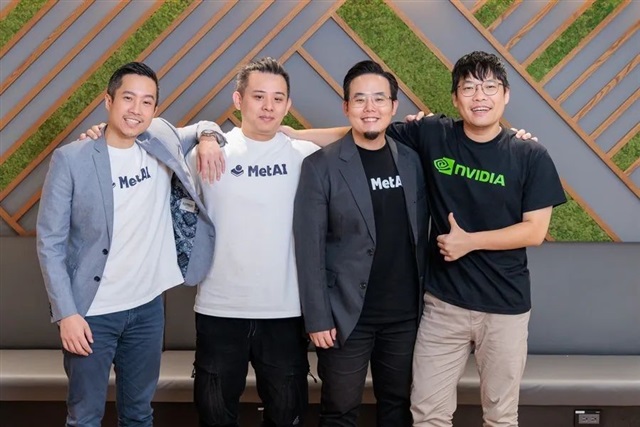
In recent years, digital twin technology has quickly gained traction across industries. With the rapid maturation of AI and big data analytics, enterprises can now build highly accurate, real-time synchronized virtual models, enabling predictive maintenance, process optimization, and other benefits that were once difficult to realize. MetAI, invited by Taiwan Tech Arena (TTA) to join CES 2026, will showcase its proprietary AI - and 3D-driven MetGen digital twin platform, formally signaling its intent to capture opportunities in the US smart warehousing sector.
MetAI co-founder and CEO Daniel Yu noted that the US is home to some of the world's largest warehousing market, driven by digitalization efforts from major retailers such as Amazon, Walmart, and Costco. As such, the US has become MetAI's primary target for overseas expansion. "We are honored to receive TTA's invitation to exhibit at CES 2026," Yu said, expressing appreciation for TTA's comprehensive support - from pre-show preparation and customer matchmaking to presentation guidance - which has strengthened the company's confidence in entering the US market.
AI fused with 3D technology : Digital twins generated in minutes
Founded in 2023, MetAI focuses on developing MetGen, the first AI-native, domain-specific generative platform designed for real-to-sim and sim-to-real integration. By leveraging its proprietary AI and 3D synthesis architecture, MetGen automatically converts traditional CAD and 2D design files into SimReady (simulation-ready) 3D digital twin environments. The platform also incorporates AI, 3D simulation, physics modeling, and automation control logic, enabling users in warehousing, advanced manufacturing, semiconductors, and automation equipment to design, validate, and simulate workflows in a virtual environment before real-world deployment.
MetAI further supports the creation of large-scale, high-fidelity synthetic datasets within the digital twin environment, giving AI models access to virtually unlimited training material. This capability accelerates production-line design and product development, while enabling enterprises to derive optimized strategies in simulation before applying them in real operations.
By integrating NVIDIA Omniverse with MetAI's proprietary generative models, complex digital twin environments that once required months or even years to build can now be automatically generated in minutes, effectively resolving one of the industry's most persistent adoption barriers: excessively long deployment timelines. The company currently focuses on three key application areas - smart warehousing, semiconductors, and data centers - and completed a US$4 million seed round in 2025, backed by leading investors including Kenmec Mechanical and NVIDIA, making it one of the few Taiwan startups to receive a direct strategic investment from NVIDIA.
According to Yu, traditional digital twin development relies heavily on manual data processing, resulting in implementation cycles that may stretch across several months or even longer than a year. Even with newer solutions emerging, model inaccuracies often lead to costly revisions. "MetAI combines AI with 3D generation to directly interpret 2D blueprints such as CAD or BIM files and automatically construct complete 3D twin environments," Yu explained.
This approach reduces the typical modeling workload - from hundreds or thousands of hours - to just a few minutes, while delivering high consistency and zero structural error. It enables companies to rapidly plan production lines, build virtual sandboxes for robot training or logistics flow optimization, and significantly boost deployment efficiency.
Establishing a US headquarters to capture smart warehousing and advanced manufacturing opportunities
Despite being a relatively young company, MetAI has quickly secured partnerships with several high-profile enterprises, thanks to the uniqueness and technical depth of its solutions. In addition to working with TSMC, MetAI is collaborating with Kenmec to fully reconstruct the Chief Global Logistics's smart logistics center into a virtual environment, creating a highly realistic digital twin featuring physics-accurate modeling, executable control logic, and AI-driven optimization capabilities.
According to Yu, the rise of AI has prompted Taiwanese startups to shift their mindset - no longer focusing solely on the domestic market but aiming directly at the world's largest and most innovation-driven arenas. "The US has exceptionally strong demand for smart warehousing solutions. We are actively preparing to establish our US team and headquarters, which will include a local team, customer support, and a technical service center. This will place us closer to key customers and significantly enhance our ability to execute in the North American market," Yu said.
Yu added that MetAI will continue to strengthen its real-to-sim and sim-to-real capabilities, while expanding integration with a broader ecosystem of automation hardware. The company aims to build an end-to-end twin platform that spans design, simulation, and deployment. Ultimately, MetAI seeks to enable enterprises to advance smart warehousing and smart factory transformations at minimal cost and with maximum speed.
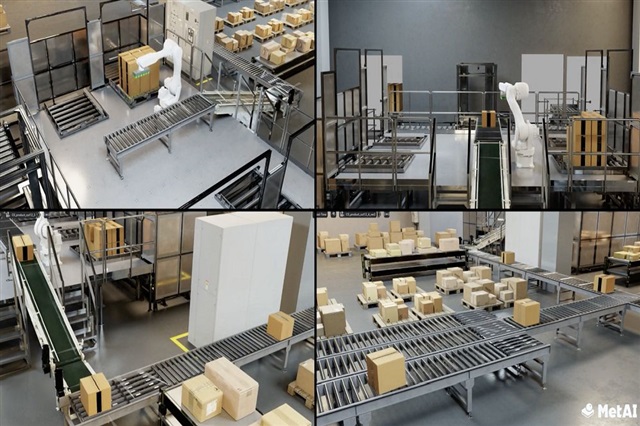
MetAI partners with Kenmec to build a high-fidelity virtual smart logistics center. Credit: MetAI