Taipei
As generative AI, software-defined vehicles, and intelligent automation accelerate in parallel, semiconductors are shifting from component suppliers to a critical foundation for intelligent systems in the physical world. At the recent 2025 NXP Technology Summit held in Taipei, NXP had focused on three major application pillars, AI, IIoT, and automotive electronics, working closely with Taiwan industry partners to bring smart technologies into real-world deployments.
NXP as a System Platform Enabler Building a New Foundation for Smart Applications with AI × Edge × SDV
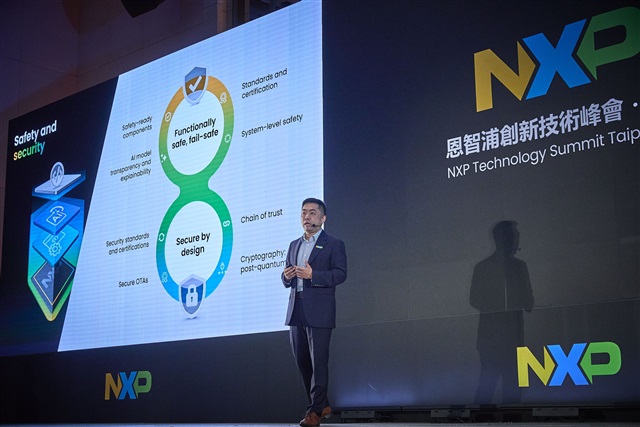
Robert Li, Executive Vice President and General Manager of BL Greater China for NXP Semiconductors, noted in his keynote that the semiconductor industry follows a ten-year growth cycle, from PCs and smartphones to the current wave driven by automation, cloud computing, and Edge AI.By 2030, the market is expected to reach USD1.3 trillion. As data generated by edge devices continues to surge, sending everything back to the cloud would create bottlenecks in bandwidth, energy consumption, and latency, making real-time decision-making difficult. As a result, AI must move from the cloud to the edge.
He further pointed out that AI is evolving from perceptual and generative stages toward a new era of Agentic AI and Physical AI, with applications in factories, autonomous driving, robotics, and energy systems at scale. To address this shift, NXP has transformed from a chip supplier into a system-level platform and ecosystem provider, integrating compute, connectivity, power, and security architectures. Through key acquisitions such as TTTech Auto, Aviva Link, and Kinara, NXP has strengthened its SDV(software-defined vehicles) and Edge AI capabilities while deepening Taiwan's strategic role in global R&D and application deployment.
Stefan Poledna, CEO and CTO of TTTech Auto, stated that after joining NXP, TTTech Auto can more efficiently drive SDVs from concept to production-ready, system-level implementation. With more than a decade of experience in automotive software, system integration, and functional safety, the company has built a team of nearly one thousand engineers. Its software has been deployed in over five million vehicles, with more than sixteen million project instances under ongoing development, serving major automakers across Europe and Asia.
Its capabilities span SDV core software, functional safety and cybersecurity services, as well as hardware reference designs supporting heterogeneous multi-chip architectures. These are deeply integrated with NXP automotive platforms to enhance overall system scalability. Based on this architectural approach, TTTech Auto has contributed its technical strengths to the NXP CoreRide system-level platform.
As generative AI, intelligent automation, and vehicle electrification continue to advance, global computing is shifting from the cloud back toward edge nodes closer to real-world environments, driving devices from being merely connected toward becoming autonomous. Luca Difalco, Senior Vice President of Global Channel Sales and Industrial Solutions at NXP Semiconductors, noted that the industry is moving from smart devices to autonomous intelligent edge systems with sensing, reasoning, and action capabilities. Where early devices relied on cloud-based decision-making, today's systems can perform AI inference at the edge under low power conditions and respond in real time, enabling truly deployable intelligent applications.
In this context, he explained that NXP's core mission is not to expand cloud computing power, but to build Intelligent Nodes that can be deployed at scale, allowing AI to be realized in vehicles, factories, buildings, and healthcare environments. The value of AI lies not in model size, but in whether edge systems can perform timely inference and take the right actions. However, Edge AI involves sensing, power, security, connectivity, and data management, making integration far more complex than traditional embedded design.
To address this, NXP adopts a modular, stackable architecture to simplify complexity and has established a tiered hardware platform spanning MCX and S32K MCUs to i.MX MPUs, gateways, zonal, and central compute, combined with Kinara NPUs for smooth scalability based on performance needs. On the software side, NXP provides a unified development workflow through eIQ and Time Series Studio, enabling even non-AI specialists to deploy models quickly, while building trusted AI foundations with Root of Trust, Secure OTA, post-quantum cryptography, and AI bias detection.
Industrial IoT and Smart Mobility Tracks Reveal the Complete Path to AI Deployment
Beyond the keynotes, the summit featured two major tracks, Smart Industrial and IoT and Smart Mobility, led by NXP technical experts. These sessions comprehensively showcased NXP's technology roadmap across edge computing, connectivity, security, and AI, linking industrial, IoT, and automotive applications and illustrating the full evolution of future intelligent systems from perception to inference and action.
The Smart Industrial and IoT track began by outlining how the industrial market is rapidly shifting from automation toward software-defined systems. Equipment now requires real-time computing, reliable connectivity, and higher energy efficiency to support the long-term evolution of smart factories and intelligent infrastructure. The NXP team further analyzed its MCU, MPU, connectivity, and AI NPU portfolio, demonstrating how scalable modular architectures reduce integration complexity and enable developers to move from design to deployment in shorter timeframes.
In AI applications, NXP showcased practical deployments of generative and autonomous AI in industrial control equipment and IoT nodes, enabling devices to collect data, perform inference, and make on-site decisions without relying on the cloud. Experts also introduced next-generation intelligent power solutions that improve system efficiency and operational reliability, along with NXP's latest wireless connectivity technologies that ensure stable communication in high-noise, large-scale industrial networks. Applications span medical devices, smart buildings, humanoid robots, and industrial automation, all centered on edge computing, sensor fusion, and high-reliability connectivity.
Finally, the team presented a comprehensive Edge Lock security strategy, providing protection from system boot to data exchange, covering OTA updates, helping enterprises maintain long-term trusted security foundations while scaling IoT deployments.
In the Smart Mobility track, NXP brought together experts in automotive electronics, connectivity, and AI to provide an in-depth analysis of smart mobility trends and system architectures. The session began with market insights into the acceleration of vehicle electrification, electronics integration, and software-defined vehicles, followed by NXP's holistic solutions across sensing, control, connectivity, and security.
New-generation automotive platforms such as S32K5 and CoreRide were then introduced, highlighting how scalable architectures, functional safety, and software reusability support rapid SDV iteration. As AI continues to penetrate in-vehicle edge nodes, experts demonstrated edge inference applications in driver monitoring, environmental perception, and behavioral decision-making, and explained how i.MX processors combined with wireless connectivity are advancing in-vehicle infotainment and intelligent cockpits.
To address vehicle connectivity and high-speed data exchange demands, the session also explored the latest automotive Ethernet roadmaps and the high bandwidth and low latency advantages enabled by NXP's 10Gbps Ethernet switches. On electrification, X-in-1 integration solutions and 48V power conversion technologies were presented, underscoring the importance of efficient power management in future EV architectures. Overall, the track covered computing, connectivity, AI, security, and power architectures in a comprehensive manner, defining NXP's core position and forward-looking vision within the smart mobility ecosystem.
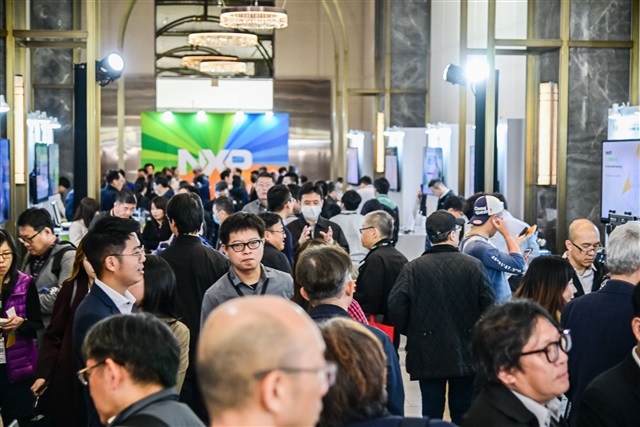
In addition to keynote and technical sessions, the summit featured more than seventy technology showcases from NXP, ecosystem partners, and sponsors, helping customers understand market trends while gaining deeper insight into how NXP enables the real-world deployment of advanced technologies.
In summary, NXP demonstrated how edge intelligence moves from concept to large-scale deployment through comprehensive computing platforms, trusted security architectures, and cross-industry application examples. Whether in industrial IoT, smart mobility, or emerging autonomous systems, the key lies in bringing AI into real-world environments with higher efficiency, lower power consumption, and greater predictability. As Taiwan's influence across technology and ecosystem value chains continues to grow, NXP will keep working closely with local partners to drive the next phase of global edge intelligence adoption.
Credit: NXP