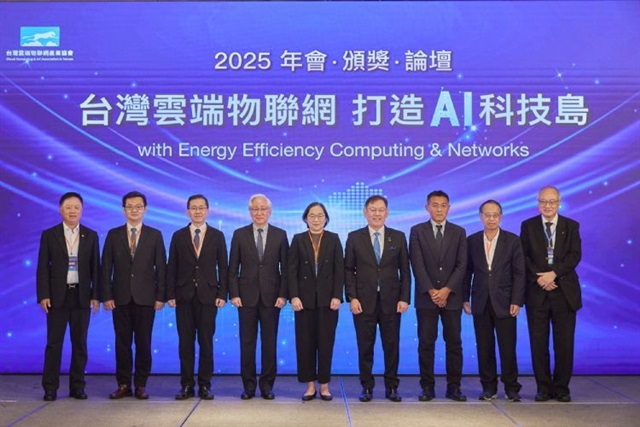
The Cloud Computing & IoT Association in Taiwan (CIAT) held its 2025 annual member meeting on December 17, 2025, unveiling a forward-looking strategy for the next wave of technological momentum. The association expressed optimism about the global surge in artificial intelligence (AI), focusing future efforts on two key areas
First, the rapid increase in computing power demand has made power efficiency and data transmission major challenges. Second, from an application perspective, AI is evolving toward Physical AI, which integrates AI into physical systems and is expected to become the next star industry.
In addition to revealing future plans, the meeting invited international experts to share insights on emerging trends. Among them was Katsuhiko Kawazoe, chairman of the IOWN Global Forum and chief executive fellow at Japan's NTT, who discussed global communication network applications and opportunities.
Amid the global boom in intelligent robot applications, CIAT also invited industry leaders such as Clement Lin, chairman of Nexcom; Zhongyong Jia, general manager of Chunghwa Telecom's Network Technology Branch; and representatives from NTT East to jointly explore the implementation of humanoid robots. They shared experiences on cross-domain supply chain collaboration. Robot manufacturers, including Syscom, Techman Robot, Nexcom, Yo-Kai Express, HatsuMuv, Kenmec, and Aurotek, showcased their achievements at the event.
With the rise of the global AI wave, Taiwan holds a critical position in the AI server and cloud data center supply chains. CIAT noted that many of its core members have become essential forces supporting Taiwan's digital competitiveness.
Reflecting on the past year's accomplishments, the association actively engaged in international cooperation and advanced technology deployment, including participation in the IOWN Global Forum and deepening ties with global partners like NTT. It also collaborated with the Ministry of Digital Affairs (MODA) to promote AI action plans, data circulation, and cybersecurity enhancement policies, ensuring Taiwan maintains a pivotal role in global competition.
CIAT stated that Taiwan's complete and resilient AI server and semiconductor supply chains make it a vital partner in the global AI ecosystem. Looking ahead, the association will continue to focus on two main strategic areas amid the ongoing AI wave. Given the rapidly growing AI computing power demands, power efficiency and data transmission remain significant challenges. This will drive CIAT to concentrate more on developing energy-efficient computing, all-optical networks, and advanced optical communication technologies, while introducing cutting-edge communication architectures such as the IOWN concept through international exchanges.
Secondly, AI applications are advancing toward "Physical AI," where AI serves as the brain, integrating sensing, computing, mechanical structures, and communications into intelligent robots. This sector is regarded as the next leading industry. Currently, CIAT has consolidated industry resources by establishing the "Humanoid Robotics Special Interest Group (SIG)" and co-initiating the "Taiwan AI Robot Alliance" alongside six major public associations in Taiwan, accelerating technology commercialization and supply chain collaboration.
Article translated by Charlene Chen and edited by Jack Wu