
Among the various components that are used in LCD TV panels, backlight units (BLUs) are considered the most important. Thus, to further drive down their production costs, panel makers are trying to develop new ways in making the BLU cheaper.
Currently, BLUs account for approximately 30% of the material costs in LCD TVs. In contrast to the 21.5% for a 17-inch LCD monitor, there is still significant room for additional BLU cost reductions.
Substitution for BEF or DBEF
The BLU of LCD TVs are of two different structures – (1) Two lower diffuser films and one DBEF (dual brightness enhancement film). (2) One upper and lower diffuser film and one BEF (brightness enhancement film). In addition to searching for suppliers that offer cheaper BLUs, a more effective method for panel makers is employing less expensive materials in the BLU.
Within the BLU structure, DBEF and BEF films are considered the two most expensive components. Although the two play an important role in enhancing the lighting properties, their high price tag has prompted panel makers to search for other replacements. For instance, the current 32-inch LCD TV uses two diffuser films and one DBEF film for its BLU. If it is replaced with an upper and lower diffuser film, along with one BEF film, the overall material cost can be reduced by US$9. Thus, if the more expensive materials can be replaced with cheaper alternatives, further panel costdowns can be accomplished.
Panel makers are also considering using three diffuser films to replace DBEF or BEF films. However, by doing so, it will decrease the brightness of the panel. For example, if a 32-inch TV uses 16 cold cathode fluorescent lamps (CCFLs), coupled with three diffuser films, the brightness level of the panel will only reach 400 nits, which is lower than the current requirement of 500-550nits for LCD TVs. With a lower brightness level, the contrast ratio cannot be adequately presented. However, if panel makers can enhance the contrast level and color performance, a lower brightness level can become more acceptable in the future.
Intense competition in optical film industry
As more players have entered the optical film industry, competition has become extremely intense. 3M, who used to have a significant control in the supply of prisms, are already being challenged by other manufacturers, such as SKC, Efun, Kodak and General Electric (GE). Eternal Chemical, Shinkong Synthetic Fibers Corporation and other Taiwanese chemical manufacturers are also trying to roll out such products as well. In the diffuser film business, key suppliers such as Japan based Keiwa, Tsujiden and Kimoto are affected by the competitive pricing strategies of Korea's SKC and Taiwan's Exploit over the past year. Although the quality, specifications and supply may not be as stable for the newcomers, once they establish a foothold in the panel maker's supply chain, their gap with the original manufacturer will be narrowed. All in all, further price cuts are expected, as competition in the optical film industry grows increasingly fierce. For BLU makers, this will ultimately equal to more production cost reduction.
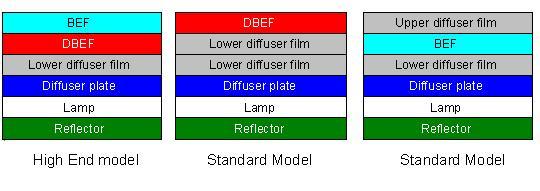
Structure for LCD TV-use BLU
Source: WitsView, compiled by DigiTimes, December 2006.
Article translated by Emily Chuang and edited by Carrie Yu