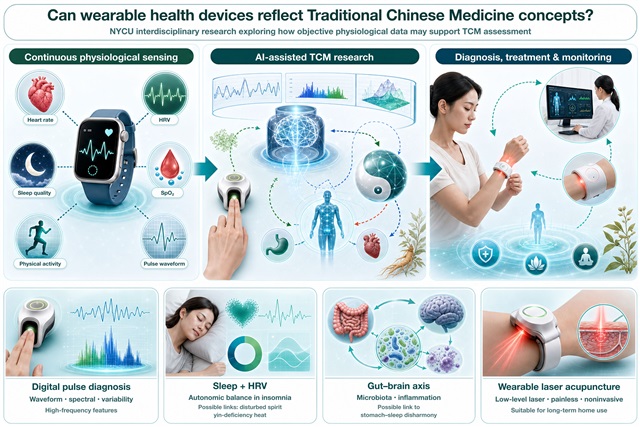
With the rapid advancement of artificial intelligence (AI) and digital healthcare technologies, wearable health devices have become important tools for modern health management. Smartwatches, heart rate monitors, and sleep-tracking systems can continuously collect physiological data, including heart rate, heart rate variability (HRV), sleep quality, blood oxygen saturation, and physical activity. Researchers are increasingly exploring whether these objective measurements can reflect traditional Chinese medicine (TCM) concepts such as qi and blood circulation, yin-yang balance, and organ function, thereby providing quantitative support for TCM diagnosis.
NYMU (AI-generated)
The Department of Traditional Chinese Medicine and the Institute of Traditional Medicine at National Yang Ming Chiao Tung University (NYCU) have actively promoted the modernization and scientific validation of TCM. By integrating biomedical engineering, artificial intelligence, physiological signal analysis, and sleep medicine, researchers aim to transform traditional diagnostic methods into objective and measurable tools. One major research focus is the digitalization of pulse diagnosis. Using advanced sensors, pulse waveform analysis, and machine-learning algorithms, pulse characteristics can be quantified in terms of spectral, variability, and high-frequency signal features, thereby improving the objectivity and reproducibility of TCM assessment.
Sleep medicine provides an illustrative example. In TCM, the concept that "the heart governs the mind" suggests that sleep quality is closely related to the balance of qi, blood, and yin-yang. In modern medicine, HRV is widely used to evaluate autonomic nervous system function and stress regulation. Studies have shown that patients with insomnia often exhibit reduced parasympathetic activity and increased sympathetic activation. These findings may correspond to TCM patterns such as "disturbed spirit" or "yin deficiency with excessive heat." Likewise, the TCM theory that "disharmony of the stomach leads to poor sleep" may be linked to the gut-brain axis, intestinal microbiota, and inflammatory responses identified in contemporary biomedical research.
Beyond diagnosis and health assessment, wearable technologies may also contribute to TCM treatment. Wearable laser acupuncture devices combine low-level laser technology with wearable systems to provide continuous, noninvasive stimulation of specific acupoints. Compared with traditional needle acupuncture, these devices are painless, safe, and suitable for long-term home use. When integrated with physiological monitoring and AI-driven analysis, they may enable a comprehensive system for diagnosis, treatment, and real-time health monitoring.
By emphasizing evidence-based medicine and interdisciplinary collaboration, NYCU is advancing the integration of traditional medicine with modern science. Wearable health technologies may serve as an important bridge between TCM theories and contemporary medicine, facilitating the development of precision health and integrative medicine in the future.