

Multilayer ceramic capacitor (MLCC) prices for AI servers have continued to climb, while prices for general-purpose components used in consumer appliances have dropped sharply. The split in the market has opened more room for Chinese suppliers in midrange and general-purpose categories as major manufacturers shift capacity toward higher-value products.
According to Money Today, citing industry sources, spot prices for consumer MLCCs at Shenzhen's Huaqiangbei electronics market have fallen to about one-third of their peak two months ago. The market is a key trading hub where short-term supply and demand changes are quickly reflected in pricing.
The earlier rally was driven largely by speculation. As major manufacturers expanded output of high-spec MLCCs for AI applications, the market feared shortages in general-purpose parts, prompting distributors to stockpile inventory and push prices sharply higher. For one representative general-purpose product, pricing rose from about CNY5 per 1,000 units (approx. US$0.75) in the second quarter of 2026 to CNY30 at the end of June, before easing back to about CNY10 as consumer demand failed to keep up.
AI server components have moved in the opposite direction. Sources in China's distribution channel said some high-capacity MLCC products climbed from about CNY80 per 1,000 units to CNY350, while some high-spec parts rose as much as 5x from early 2026. Manufacturer prices were also reported to have increased by 15% to 35%.
According to Yonhap and News1, citing TrendForce, Samsung Electro-Mechanics is expected to raise prices for consumer X5R products supplied to OEM and ODM customers by 25% to 30% in the fourth quarter of 2026. Edaily also reported that Hewlett-Packard, Asus, Acer, Quanta Cloud Technology, and Pegatron have begun supplier qualification and factory visits for Chinese MLCC makers including Chaozhou Three-Circle Group and Guangdong Viiyong Electronic Technology.
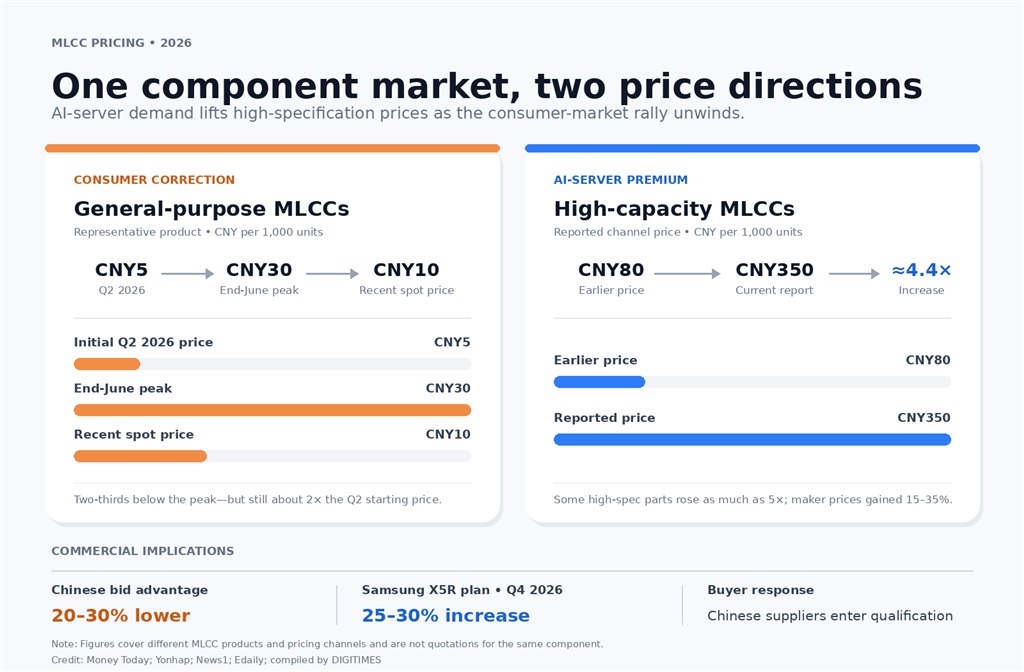
Credit: Money Today; Yonhap; News1; Edaily; compiled by DIGITIMES
Article edited by Ysi Chen