
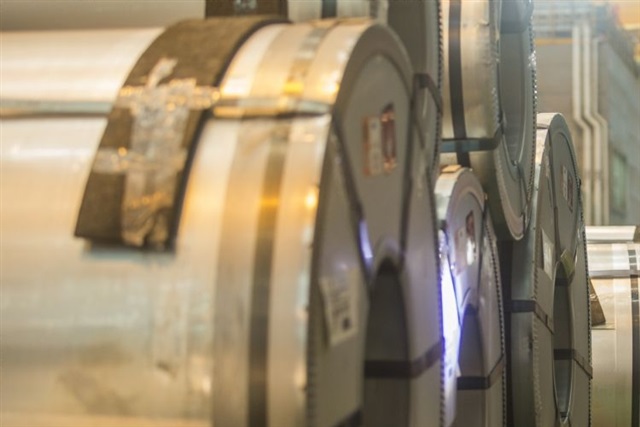
Taiwan's largest steelmaker China Steel (CSC) is actively expanding its high-recycled-content steel products, as the global automotive industry accelerates its transition toward net-zero emissions and electrification, boosting demand for low-carbon materials worldwide. The move allows the company to move beyond general industrial applications into automotive sheet metal, electric vehicle (EV) motors, high-strength fasteners, and vehicle body structures.
Orders for CSC's high-recycled-content steel products have grown year by year, reaching 83,000 metric tons for full-year 2025, up 68% from a year earlier. As of the end of August 2026, orders had reached nearly 74,000 metric tons, an increase of about 50% from the same period in 2025.
CSC said it is focusing on three key areas—innovative material design, process optimization, and third-party verification—and continues to introduce high-recycled-content technology into automotive steel. The company aims to increase the proportion of recycled material while maintaining steel performance and stable quality, giving downstream customers more low-carbon material options and helping the automotive supply chain respond to green transformation needs.
Since 2021, CSC has gradually developed high-recycled-content steel products such as hot-rolled, cold-rolled, galvanized, electrical steel, and wire rods, with recycled content (RC) ranging from 12% to 90%. Compared with non-RC steel, greenhouse gas emissions from RC30, RC60, and RC90 products—with recycled-material content of 30%, 60%, and 90%, respectively—can be reduced by about 15%, 40%, and 76%, respectively. This shows that increasing the use of recycled material not only reduces the consumption of natural resources but also translates into measurable carbon-reduction benefits.
Boosting high-recycled-content steel in automotive
In automotive sheet metal applications, CSC said it has successfully mass-produced interstitial-free (IF) RC30 automotive steel. IF steel offers good ductility, formability, and surface quality, making it suitable for automotive inner and outer panels as well as complex components, but it also has stringent requirements for steel cleanliness.
By adjusting steelmaking conditions, refining techniques, and data controls, CSC has raised the proportion of RC in its IF steel to 30% while maintaining product quality. The products received resource recycling green product certification in 2025 from Taiwan's Ministry of Economic Affairs (MOEA).
In response to the EV boom, CSC has also extended its high-recycled-content technology to RC30 electrical steel coils. Electrical steel is a key material for EV motor cores, and its magnetic properties directly affect motor efficiency.
CSC said that through raw material selection and process optimization, it has maintained the required electromagnetic performance while increasing the ratio of recycled material. The product received the MOEA's resource recycling green product certification in 2026. Compared with conventional steel products, the proportion of scrap steel used has increased by about 20%, equivalent to reducing carbon emissions by about 0.3 metric tons per metric ton of steel.
Additionally, development and verification of SCM435 RC60 wire rod for high-strength fasteners have been completed. The product can be used in high-load fastening components such as automotive bolts, while maintaining machinability and durability, enhancing the low-carbon competitiveness of Taiwan's fastener industry.
For high-strength automotive structural steel, HX420LAD-grade RC60 steel has also achieved stable supply capability. The steel maintains its strength and processing requirements while increasing recycled content, bringing recycled materials into the high-value-added automotive structural components market.
Article translated by Eifeh Strom and edited by Ysi Chen