
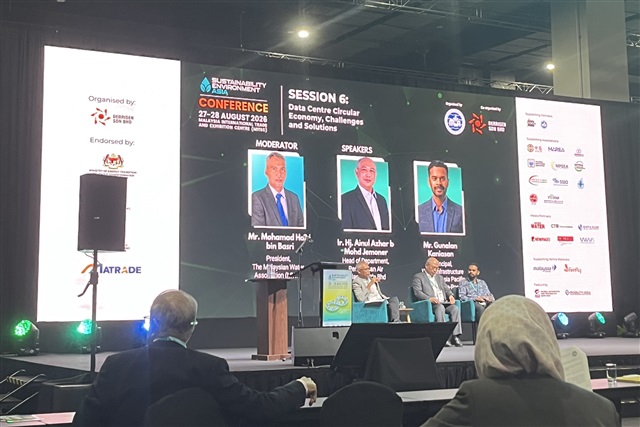
At the Sustainability Environment Asia Conference 2026, Gunalan Kaniasan, principal for water resources in Asia-Pacific and Japan (APJC) at AWS, outlined strategies for water sustainability across the Asia-Pacific region. As data center demand grows, AWS is actively collaborating with governments and utilities to introduce recycled-water alternatives, navigate regulatory barriers, and test water-credit mechanisms.
In Hong Kong, where Kaniasan said regulations had historically required that only potable water could be used for cooling operations, AWS took a proactive stance. By presenting a proposal and partnering with the local government, AWS established a pioneering pilot project to test the use of treated sewage water in cooling towers. Similarly, in Malaysia, AWS signed a groundbreaking long-term contract with water utilities providers, including Indah Water Konsortium (IWK), with support from SPAN. This initiative makes recycled water available to the industry ahead of finalized guidelines and regulations.
Meanwhile, in Indonesia, AWS has piloted a "sustainable water credit" program that has been operational for a year and a half. Designed similarly to carbon credits, this program solves the logistical challenge posed by the distance between reclaimed-water sources and industrial facilities. Rather than incurring substantial capex to build 40- to 50-kilometer pipelines, companies can continue utilizing potable water locally while funding a third party to buy and use reclaimed water in its operations. AWS then purchases these certificates to offset its water footprint, a scaling mechanism it hopes to expand to Malaysia. Looking toward 2030, AWS intends to utilize indirect reclaimed water systems, directing capex toward building treatment plants for other industries rather than constructing long pipelines.
While Singapore data centers already utilize recycled water, expanding these initiatives region-wide requires strong public-private alignment. Kaniasan highlighted a mismatch in development timelines, noting that while hyperscaler data centers are built in 18 to 24 months, national water infrastructure typically requires three to five years to construct. To bridge this gap, AWS is calling for clear, fast-moving regulations and dedicated industrial zones where sustainable water infrastructure is co-located with high-demand industries. AWS remains open to collaborations across the region to drive these essential water sustainability pilots forward.
Article edited by Ysi Chen
