
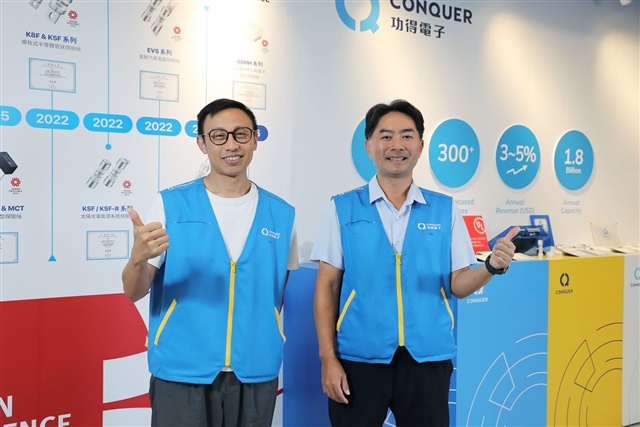
As the power demands for AI servers and racks continue to rise, data center power architectures are moving toward higher voltages and greater power densities. Ryan Chiu, Vice President of Conquer Electronics, noted that the rapid expansion of AI infrastructure is not only reshaping server and power system designs, but also raising the bar for circuit safety and long-term reliability.
Ben Sung, Field Application Engineer (FAE) in Conquer's Sales and Marketing Division, explained that conventional AC/54V DC power architectures are increasingly constrained by rising power demands. As a result, the industry is moving toward high-voltage DC (HVDC) architectures, including ±400V and 800V systems. By increasing voltage, these architectures can reduce current and transmission losses, but they also place greater demands on circuit protection components. Fuses must therefore deliver higher DC voltage ratings, greater DC interrupting capability, lower demand loss, and enhanced reliability.
Approaching its 50th anniversary, Conquer is extending its nearly five decades of expertise in circuit protection to emerging applications such as AI data centers and high-power power supplies. In response to the evolving power architecture landscape, the company continues to invest in the development of next-generation fuse technologies, expanding its high-power product portfolio while strengthening partnerships with customers across the AI and power infrastructure markets.
Designing fuses for high-voltage, high-current, and high-temperature environments requires careful consideration of multiple factors, including materials, fuse-element structure, arc suppression, thermal management, and long-term aging. Sung noted that, depending on the application, fuses can be deployed at the output of power supplies, at the input and output of battery backup units (BBU) and power capacitance shelf (PCS), and at the output of power distribution units (PDU).
Unlike circuit breakers or electronic protection devices, fuses require no external power or control. In high-voltage DC systems, they can rapidly and safely interrupt current in the event of a short circuit, even when fault currents reach several thousands of amperes, while working alongside other protection components to provide multiple layers of circuit protection.
At the same time, the limited space inside AI servers requires fuses to withstand higher voltages and currents in increasingly compact form factors. This makes miniaturization, high current-carrying capacity, high interrupting capacity, and long-term reliability key considerations in fuse design.
To address these requirements, Conquer Electronics incorporates simulation software early in the R&D process to analyze fuse-element characteristics, thermal stress distribution, and structural performance. By identifying temperature-rise and heat-dissipation risks before physical prototyping, and combining simulation with material testing, the company can streamline the product development process.
The ACF and KBF series are examples of Conquer’s high-performance fuse solutions. Both offer a breaking capacity of up to 30kA, with the ACF measuring 7×32mm and the KBF measuring 10×32mm. The compact designs address the demands of high-power systems for space efficiency, high current-carrying capacity, and reliable circuit interruption.
As AI product development cycles become shorter, Conquer is also engaging with customers earlier in the design process, helping them select the appropriate fuse base on operating voltage, current, ambient temperature, and available space. When standard products cannot meet specific requirements, the company can proceed with customized development.
Chiu noted that customers today look beyond specifications and pricing, placing increasing emphasis on join development and speed to market. With UL and TÜV witnessed laboratories, Conquer can help shorten the safety certification process for customized products, bringing simulation, prototyping, validation, certification, and mass production into closer alignment with customer project timelines.
This end-to-end capability, spanning R&D, testing, and mass production, is backed by nearly five decades of technical expertise at Conquer Electronics. Founded in 1977, the company has developed products for a wide range of markets, including household appliances, 3C electronics, mobile devices, and compact power supplies. Chiu stated that the firm's long-standing expertise in materials, manufacturing processes, testing, safety certifications, and automated mass production provides a strong foundation for expanding into high-power applications such as AI data centers.
In materials and structural design, for example, Conquer has developed a patented alloy wire and integrated terminal design to replace conventional lead-based soldering. This approach reduces the risk of material fatigue caused by prolonged exposure to high temperatures while also reducing the use of hazardous substances.
Chiu noted that when global customers evaluate suppliers, they look beyond product performance to factors such as joint development capabilities, certification lead times, mass production capacity, and supply reliability. In recent years, Conquer has invested in smart manufacturing and digitalized supply chain management. The company uses robotic process automation (RPA) to manage orders and has implemented ERP systems that connect its internal manufacturing execution system (MES) with customers'material requirements planning (MRP) systems, improving production scheduling and delivery visibility.
ESG considerations are also integrated into Conquer’s daily operations and product development. The company has implemented energy management and greenhouse gas inventory systems, undergoes annual third-party audits, and regularly publishes sustainability reports. On the R&D side, product miniaturization and integrated structural designs help reduce material and energy consumption.
Chiu said Conquer has long embraced the business principles of “Integrity and Quality, Excellence and Innovation, and Resource Conservation.” The principle of “Resource Conservation” extends beyond operations to product design and sustainable business practices. This R&D approach, centered on reliability and resource efficiency, is also becoming an important foundation for Conquer’s expansion into a broader range of high-power applications.
As high-power applications continue to expand, circuit protection requirements vary across industries. Chiu noted that AI data centers place a strong emphasis on heat dissipation within space-constrained environments and long-term thermal stability. Electric vehicles (EV) must withstand driving vibrations, extreme temperatures, and material fatigue while meeting stringent automotive-grade requirements. Energy storage systems, which are often installed outdoors for extended periods, place greater emphasis on weather resistance, reliability through frequent charge and discharge cycles, and long service life.
Looking ahead to the next 50 years, Chiu said Conquer Electronics will remain focused on its core mission of “providing circuit safety” and evolve into a “co-creation partner for circuit safety,” working alongside customers to solve challenges and expanding its collaboration across AI, energy storage systems, EVs, and other high-power applications.
At the same time, Conquer will continue to build long-term trust through its commitment to “Integrity and Quality,” serving as a reliable supply chain partner for customers worldwide as they address increasingly stringent reliability requirements. Guided by its principle of “Resource Conservation," the company will also continue to reduce energy and material consumption throughout technology and product development. Circuit safety, supply chain resilience, and sustainable operations will serve as the three strategic pillars guiding Conquer’s next stage of growth.
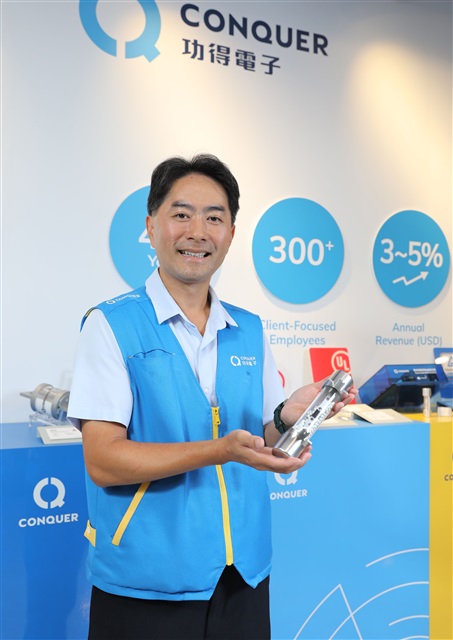
Conquer VP Ryan Chiu says 50 years of circuit protection expertise now covers AI, EVs, and LEOS.Credit: DIGITIMES