

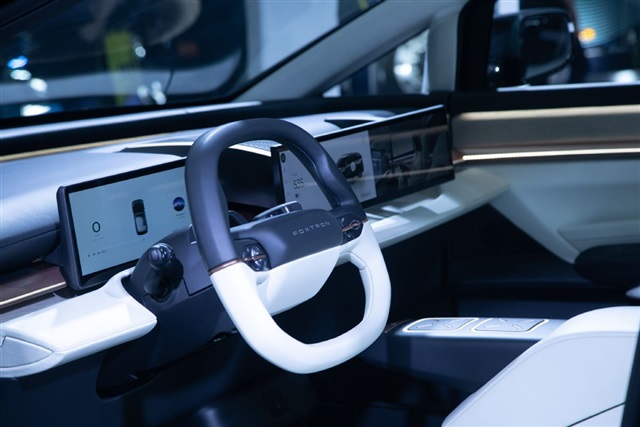
As the global electric vehicle (EV) market enters a growth adjustment phase, the auto industry is shifting from "electrification" toward "intelligence," while AI agents move rapidly from the cloud to end devices. Qualcomm says the end devices with which future AI agents will mainly interact include about 6 billion smartphones, 2 billion AI wearables, 2 billion PCs, and 500 million connected cars, underscoring how vehicles are becoming a key gateway to AI services.
Against this backdrop, Sam Shen, secretary-general of the Taiwan Advanced Automotive Technology Development Association (TADA), said at the COMPUTEX 2026 forum that the auto industry is moving from software-defined vehicles (SDV) toward AI-defined vehicles (AIDV). Even if not every new car will be electrified, every new car will continue to move toward greater intelligence, driving demand for in-vehicle chips, high-performance computing (HPC) platforms, AI software, and automotive electronics. This is set to create new cross-industry opportunities for Taiwan's ICT and semiconductor sectors.
Electrification slows as intelligence drives growth
Over the past few years, the global EV market grew quickly on the back of policy subsidies, fuel-price swings, and the energy transition. But as the market matures and incentives fade, EV sales growth has begun to slow.
That has not stopped demand for smarter vehicles. Instead, it has become the next stage of growth and competition for automakers.
Shen said that while the global auto market is not seeing explosive overall growth, passenger cars, commercial vehicles, motorcycles, and other new types of vehicles are all becoming intelligent. That means every new vehicle will continue to require more semiconductors, sensors, HPC platforms, and software services.
At the same time, the rapid adoption of AI, 5G, and digital technologies is changing how the automotive supply chain works. The closed development model centered on automakers and Tier 1 suppliers is gradually giving way to cross-industry collaboration. This elevates the role of IT, semiconductor, and software companies and gives Taiwan's long-standing ICT and electronics manufacturing strengths a chance to extend into the global auto supply chain.
From SDV to AIDV
Shen said the next stage of automotive intelligence is no longer just SDV, but AIDV.
SDV has largely focused on expanding and optimizing vehicle functions through over-the-air (OTA) updates. AIDV goes further by embedding AI into a vehicle's perception, understanding, decision-making, and interaction processes, allowing the car to deliver more proactive and personalized responses based on user needs, the in-cabin and external environment, and real-time situations.
In other words, SDV emphasizes continuously defining and upgrading vehicle functions through software, while AIDV brings AI deeper into human-machine interaction, task coordination, and service workflows, reshaping the overall in-car experience.
As generative AI matures, AI is evolving toward agentic AI, moving beyond answering questions and generating content toward understanding context, planning workflows, executing tasks, and helping users get things done rather than simply providing answers.
In Mercedes-Benz's in-vehicle AI agent demo, users can express needs in natural language, and the system combines personal preferences, real-time traffic conditions, and vehicle status to help plan navigation, find destinations, or carry out certain vehicle control functions. Meanwhile, smart parking features offered by some automakers are also beginning to combine voice, gestures, and environmental sensing, allowing AI to move beyond passively receiving commands and instead help complete tasks according to their context.
As a result, future in-car voice assistants will no longer be just a single-function entry point. They will increasingly connect navigation, entertainment, vehicle control, personalized services, and driving assistance, becoming an important interface for integrating human-machine interaction and services in AIDV.
AI agents move beyond the cabin
Beyond smart cockpits and in-car AI agents, AI applications are also expanding outward from a single vehicle to cover vehicle-to-vehicle communications, interaction with road environments, and intelligent charging infrastructure. This will make AIDVs part of a broader smart transportation and energy system.
Shen said future automotive AI agents will not only need to interact with drivers and passengers, but may also exchange information and coordinate tasks with other vehicles, roadside infrastructure, and charging services. As different AI agents begin to talk to one another, how to calculate and exchange the tokens required for AI services, and how to build corresponding token business and service models, will become an emerging commercial issue in automotive AI.
AI will also extend across the full vehicle lifecycle, from design and manufacturing to quality inspection, after-sales repairs, and predictive maintenance. Because repair and maintenance costs are relatively high after a vehicle is sold, these processes are also among the most promising application areas for AI agents.
Taiwan sees a cross-industry opening
As the auto industry moves from SDV toward AIDV, AI is evolving from a single-function add-on into a core capability that redefines vehicle interaction, services, and product architecture. How to seize the cross-industry opportunities created by automotive intelligence will be a key factor for Taiwan's ICT and semiconductor supply chains as they enter the next phase of the global auto market.
Shen said the auto industry has more than 100 years of history, while the ICT sector has developed for about 40 to 50 years. Now the two industries are becoming more closely linked through the drive for automotive intelligence.
That opportunity comes not only from electrification, but also from AI and digital technologies increasingly penetrating vehicle products, services, and business models.
Article translated by Lily Hess and edited by Jerry Chen
