
By now, it's common knowledge that artificial intelligence has sped up coding and is now replacing junior software engineers. But can you really trust the code that AI produces?
The answer is a clear no. Programmers are still needed to review the code for bugs of all sorts. Maybe the code hallucinates, meaning that it has the right syntax and looks plausible but attempts to, for example, import a library that doesn't exist. Maybe there are functional bugs, where the code simply produces the wrong result because of a faulty algorithm and these are just the simple errors.
Moreover, companies are naturally hesitant to release sensitive or proprietary information, such as customer data, to an AI coding tool.
Inferara wants to solve these problems. It wants to give you code on which you can rely, free from any vulnerabilities, and it does this by reformulating the code into mathematical notation. This is all done on the user's own computing infrastructure, so that no code or data is ever shared externally.
Georgii Plotnikov is the CEO and CTO of Inferara. Originally from Russia, Plotnikov had been working as a software developer for a decade after graduating from university. Roughly five years ago, he started learning more about static code analysis, which can be likened to a real-time spell-checker for code: it is, essentially, early detection for any bugs or security vulnerabilities in the code.
He started developing an idea for a new way to turn static code analysis into a mathematics problem at the end of 2023. Around the same time, he started to explore where he could settle down and legally incorporate his company. Plotnikov decided on Japan, sent his business plan and other documents to the country,s government, and after being awarded a startup visa, moved there in the summer of 2024. (Inferara is a relatively young company, incorporated only in October 2024.)
Unlike many AI companies, which focus on their product and want to get them out to market as quickly as possible, Inferara is proud to call itself a research-first company. Its main product is not the code checker but rather Inference, which he describes as "a programming language that uses mathematics to ensure code works exactly as intended".
This is also known as formal verification, and being formally verified gives programmers and users an additional layer of assurance that, for instance, cryptographic protocols will keep data secure, or that compilers for programming languages will not make mistakes. It's also important for mission-critical processes, such as those in automated (driver-less) driving systems, financial systems, energy plant controls, and medical devices.
In a nutshell, formal verification examines all possible states that the (usually finite number of) variables or parameters can take, in order to ensure that the logic is sound. In contrast, simply testing the system with common values that the variables might take might not reach all possible states, especially as the number of variables increases, and it will definitely not reach all possible states when there are an infinite number of variables (or values that the variables can take).
Mathematical proofs can group variables together and reduce the total number of states that need to be explored. They can even use mathematical induction to verify an infinitely large number of states.
Traditionally, programmers have needed a sophisticated understanding of mathematical logic to manually perform formal verification. Inferara's Inference programming language performs formal verification as one codes (or as AI codes) and makes it possible for even those with no understanding of mathematical logic to guarantee their code's fidelity.
Inference's diagnostics are also developed so that both humans and AI coding agents can interpret them and, thus, use them to improve the code's reliability.
Inference builds upon and improves the user experience of using Rocq, a piece of software that can assist in mathematical proofs. Plotnikov says that Inference sets itself apart by working what appears to be slowly. Instead of writing code as quickly as possible, it continually checks the code's correctness as it is being generated. This takes more time but, in the end, is more cost-effective, since it requires fewer calls to AI later on. Plotnikov likens this to the slower, more rational and conscious system of thinking described in Daniel Kahneman's bestselling book Thinking, Fast and Slow.
Inferara has now taken the next step beyond Inference: It has created Vibe Checker, an operating system that can encapsulate the entire AI-led code-development process. In addition to its own desktop AI agent, Vibe Checker is compatible with the existing, widely-used coding agents of Claude Code, Gemini, and Codex.
Most companies currently using AI-assisted coding typically do so via the cloud (i.e., off-premises). Although the code and data is stored under the programmer's domain, all that information traverses multiple external barriers when being run. Vibe Checker provides its own gateway, comprising its own server and the user’s own cloud computing security model (also known as bring-your-own-encryption, bring-your-own-key, or BYOK).
Vibe Checker's most data-secure services will host everything on users' own infrastructure, and is appropriate for those users who have the resources to buy their own hardware. There is total data sovereignty: no data ever leaves the user's infrastructure, nothing is ever uploaded to Inferara's servers, and everything can be run even without internet access. An audit trail also logs every action taken by a coding agent.
Vibe Checker does more than just check code. It's a multifunctional checker, or task-agnostic, and can audit any AI-generated system for functional errors and security vulnerabilities. Law firms can use it to summarise case files and contracts; researchers and policy analysts can use it to verify their database queries; finance departments can check their tax filings; hospital clinicians can manage their patient records; and banks and insurers can double-check their regulatory submissions.
Privacy is essential in all of these aforementioned applications, and Vibe Checker enables on-premise analysis with links and citations referring back to the original source of the information – in other words, no hallucinations.
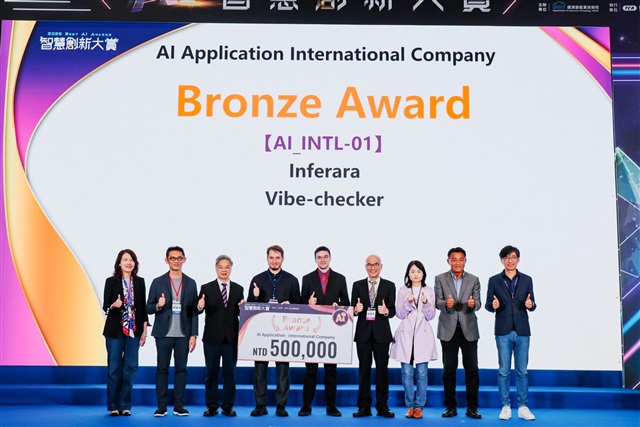
Plotnikov says that Inferara will clearly benefit from the 500,000 NTD prize money from the Best AI Awards. However, the most important reward is the valuable feedback from those working in the industry, telling them that what they are doing makes sense and has commercial value.
The award will also help Inferara get its name out and allow them to approach and demonstrate their technology to potential partners; in fact, Inferara is currently in discussions with several companies in Taiwan. In particular, they are interested in working with Taiwan's semiconductor and chip industry, which can provide the hardware supply chain for their product.
In the next few months, they plan to deploy Vibe Checker to several companies who will serve as beta-testers, including several Taiwanese companies. They also intend to establish a legal entity in Taiwan, and have plans to work with the Centre of Industry Accelerator and Patent Strategy (IAPS) at the National Yang Ming Chiao Tung University.
The Best AI Awards celebrate global excellence in artificial intelligence and IC design, welcoming submissions from innovative companies and brilliant student teams. Following the success of the 2026 edition—advised by the MOEA, organized by DoIT, and executed by TCA—the prestigious competition is officially transitioning into an annual tradition.
Offering substantial grand prizes and unmatched industry exposure, the countdown to Best AI Awards 2027 has already begun. Details on the next submission cycle, prize tiers, and eligibility rules will be released soon. Connect with us on LinkedIn for the latest official updates and application alerts.