Unisplendour has reset its leadership as H3C, its core ICT subsidiary, enters a tougher phase in China's AI infrastructure buildout. Demand for servers, cloud systems, and computing networks is rising, but US chip controls continue to restrict China's high-end AI server supply chain.
The company said on June 29 that chairman Yu Yingtao had resigned for personal reasons from his roles as chairman, director, and head of the board's sustainability committee. Yu will no longer hold any position at Unisplendour or its subsidiaries. The board appointed Li Tao as chairman, while CEO Wang Hongtao will also become the company's legal representative.
H3C separately said Yu had formally stepped down as its president and chief executive on June 26, with Wang taking over the role. The company said Wang would lead H3C's operations, strategic planning, business execution, and market development.

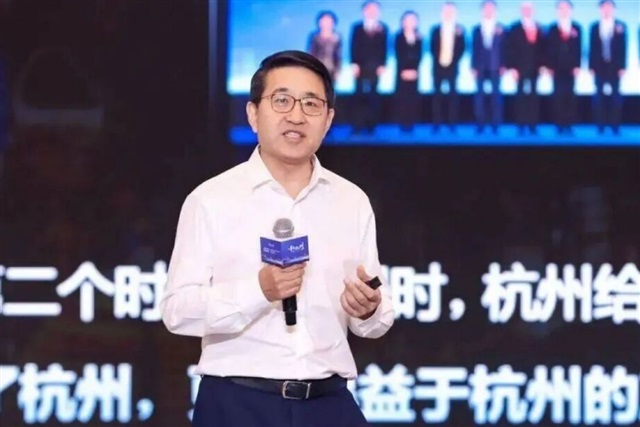
Unisplendour former chairman Yu Yingtao. Credit: Unisplendour
H3C moves beyond the HPE era
Unisplendour, the ICT platform under Tsinghua Unigroup, owns 87.98% of H3C, its main operating entity. H3C sells switches, routers, servers, storage and cloud solutions, mainly to government, enterprise and large data center customers.
Yu, a former China Unicom executive, joined Tsinghua Unigroup in 2015, when Unisplendour was preparing to acquire control of H3C from Hewlett Packard Enterprise. H3C, originally formed from Huawei and 3Com's joint venture H3C Technologies, came under Unisplendour control in 2016 after a US$2.35 billion deal for a 51% stake.
Under Yu, H3C's revenue grew from CNY13.9 billion (US$1.92 billion) in 2016 to about CNY76 billion in 2025, while net profit attributable to the parent rose from CNY900 million to CNY3.15 billion, according to company data cited by East Money and International Financial News. Its portfolio also expanded from communications technology and traditional IT into a full-stack system covering computing, networking, storage, cloud, security and operations.
Yu's exit follows the completion of HPE's withdrawal from H3C's shareholding structure. After a series of stake purchases, Unisplendour said in May 2026 that HPE Cayman no longer held H3C shares, raising Unisplendour's holding through Unisplendour International to 87.98%.
H3C said the transfer of HPE's final stake marked a "fundamental transformation" of its shareholder structure, adding that a new board was now in place as the company moved into its next stage. EET China reported that Unisplendour's board said Yu's resignation would not affect normal board operations or production.
AI demand lifts H3C, but competition stays tight
H3C remains Unisplendour's main revenue engine. Unisplendour reported 2025 revenue of CNY96.75 billion, up 22.43% from a year earlier, with H3C contributing about CNY75.98 billion. Growth was driven by government and enterprise digitalization projects and rising AI computing investment.
In the first quarter of 2026, H3C revenue rose 45.08% year-on-year to CNY22.19 billion, while net profit increased 28.16% to CNY949 million, according to company data cited by East Money and International Financial News.
H3C's server position, however, remains measured. IDC's latest 2025 view of China's server market places vendors such as Inspur and Lenovo in the first tier, with H3C in the second tier. Across total servers, including x86 and AI servers, H3C's share is estimated at about 15% to 20%, with shipments still shaped largely by project-based demand.
In AI servers, H3C is benefiting from generative AI and model training demand among government, enterprise and cloud customers. But competition is concentrated, with Huawei and Inspur also chasing major projects. H3C remains stronger in complete systems and integration than in full control of the high-end AI hardware stack.
The company has also felt demand pressure before. In 2023, an internal letter from Yu reportedly told employees that mid- to senior-level staff would see salary cuts of about 10% to 20% because of slowing demand and cost adjustments. H3C did not offer further public comment at the time.
New chief faces AI upside and chip limits
Wang Hongtao takes over H3C at a more complex moment for China's AI infrastructure market. Like Yu, Wang comes from China's telecom system. He joined Tsinghua Unigroup in 2016 and has long worked on computing networks, cloud computing and digital infrastructure businesses.
The transition came just weeks after Yu told H3C's NAVIGATE 2026 summit that talks across the AI supply chain had left the industry with both excitement and anxiety. That tension now defines H3C's next stage.
China's AI buildout is creating stronger demand for servers, storage, networking, and cloud infrastructure. But US export controls on high-performance computing and AI chips, tightened since 2022, continue to restrict Chinese access to high-end processors and pressure the domestic AI server supply chain.
For Unisplendour and H3C, the opportunity is clear: AI computing investment is expanding, and government and enterprise customers remain central to China's digital infrastructure spending. The harder task for Wang is to move H3C beyond project-led growth and second-tier server positioning while navigating tougher competition, ownership transition and external chip constraints.
Article edited by Jerry Chen