

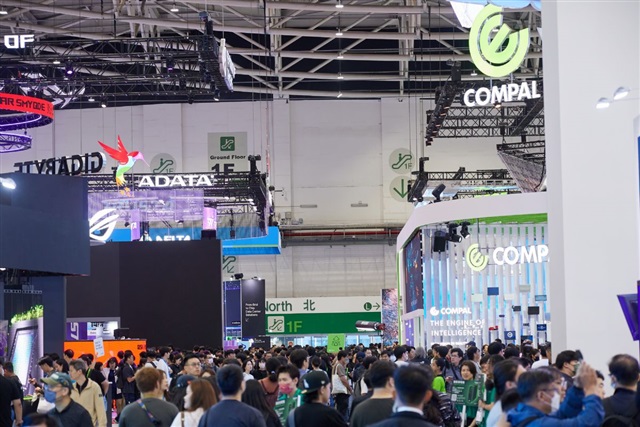
One of the clearest shifts at COMPUTEX 2026 was that suppliers across the AI supply chain were no longer talking only about GPUs. The conversation has moved toward how CPUs, GPUs, DPUs, and networking operate together. In other words, the next phase of AI cluster competition will not be defined simply by stacking more GPUs, but by whole-system optimization.
Before COMPUTEX 2026 officially opened, AMD CEO Lisa Su arrived in Taiwan ahead of the show. In addition to visiting TSMC and holding a supply chain meeting, she announced closer cooperation with Taiwan suppliers and more than US$10 billion in investment to expand AMD's AI infrastructure and advanced packaging footprint.
Su said the AI boom is only around the third inning, with a long way to go before maturity. Future data centers, she said, will enter an era of CPU-GPU co-computing, with the CPU-to-GPU ratio moving from around 1:4 toward 1:1.
AMD also unveiled its MI450 Helios rack-scale platform for the first time, directly positioning it against Nvidia's Rubin architecture. The company also announced cooperation with SPIL and Powertech Technology on Elevated Fanout Bridge (EFB) advanced packaging technology, a move seen as an effort to build a second supply route beyond CoWoS.
Su did not attend COMPUTEX itself, choosing instead to visit Taiwan ahead of the show. The trip drew market attention, but its larger significance went beyond the investment announcement — it again confirmed Taiwan's central role in the global AI supply chain.
AMD and Intel put CPUs back in the AI spotlight
Intel CEO Lip-Bu Tan was another closely watched figure at COMPUTEX. In his keynote, Tan said Intel is undertaking a 5- to 10-year rebuilding effort aimed at regaining CPU leadership. Since taking over as CEO, he said his priorities have been improving Intel's balance sheet, strengthening its financial position, recruiting talent, and raising organizational efficiency. With those foundational reforms gradually taking shape, the company will next focus on product competitiveness and operational growth.
Beyond CPUs, Intel Foundry, custom ASICs, and AI platforms will become important growth engines for the company.
Tan also highlighted the CPU demand created by Agentic AI. He said that over the past four weeks, he had received calls from many corporate CEOs who delivered essentially the same message: "I need more CPUs."
Tan argued that the future CPU-to-GPU ratio may not remain at 1:1, and that CPU demand could even exceed GPU demand. Intel also showcased progress on Xeon 6 and its 18A process, while announcing deeper ASIC cooperation with customers including Google and Ericsson. The goal is to reposition Intel from a CPU company into a broader computing group spanning CPUs, foundry services, ASICs, and AI platforms.
Nvidia builds an Asian AI ecosystem
For Nvidia CEO Jensen Huang, the most notable moves included the formal launch of RTX Spark and the first full disclosure of Nvidia's new Taiwan headquarters. Huang described Taiwan as "the center of the AI revolution."
Huang said Nvidia invested about US$10 billion to US$15 billion a year in Taiwan five years ago. That figure has now reached US$100 billion and is expected to move toward US$150 billion, marking nearly tenfold growth within a few years. The reason, he said, is that key links — including chip manufacturing, advanced packaging, system integration, and AI supercomputer construction — are almost all concentrated in Taiwan.
After ending his Taiwan visit, Huang traveled to South Korea to meet senior executives from SK Hynix, LG Group, and Hyundai Motor Group. The trip echoed Nvidia's high-profile Taiwan supply chain gathering and aimed to deepen cooperation in sixth-generation high-bandwidth memory (HBM4), AI data centers, autonomous vehicles, robotics, and Physical AI.
From Taiwan to South Korea, Huang is seeking to build an Asian AI ecosystem spanning chips, packaging, memory, systems, robotics, and end applications. That points to the most important industrial message from COMPUTEX 2026: competition in the AI era is no longer a battle over a single chip, but a battle over ecosystems.
The next AI contest is system-wide
From Nvidia's push behind Vera Rubin, Vera CPU, and RTX Spark, to AMD's US$10 billion-plus commitment to Taiwan's supply chain, and Intel's call for a CPU revival through a 5- to 10-year rebuilding plan, COMPUTEX 2026 made the next direction of the AI industry clear.
The next stage will not be only about GPU performance. It will be a broader contest across CPUs, ASICs, memory, advanced packaging, optical communications, power, cooling, software platforms, and AI ecosystems.
Industry sources said that as Agentic AI and Physical AI move into enterprises, PCs, autonomous vehicles, and robotics, the companies able to integrate supply chains, control platforms, and build ecosystems will have the best chance of leading the next AI cycle. That is also why Huang has been traveling globally while tightening Nvidia's grip on Taiwan, South Korean suppliers, and strategic customers.
Article translated by Levi Li and edited by Jerry Chen
