CONNECT WITH US
Sign out

AI cooling demand is pushing server pumps into sharper focus

, Taipei
0

Credit: DIGITIMES

As AI pushes liquid cooling into mainstream server thermal design, suppliers are widening their focus beyond Nvidia's benchmark thermal designs. Industry players say pumps are emerging as a key lever for improving cooling efficiency, alongside flow rate and fluid speed.

At Computex 2026, Asia Vital Components (AVC) devoted an area to "High Performance Pump Solution," highlighting multiple pumps, including a CDU paired with pumps for server liquid cooling, and micro pumps. Industry sources said micro pumps are used beyond notebooks, and could also be adopted in servers as water-cooling control becomes more diverse and complex.

Ching-Hang Shen, chairman of AVC, also said after a recent shareholders' meeting that leadership in the AI era is not only about scale, but also about matching customers well and continuing to advance technology and materials. He pointed to vertical integration of key components, including the pump used in CDUs, as part of that effort.

Pump capacity becomes a bigger issue

The focus on pumps reflects growing pressure across the liquid-cooling supply chain. According to Kaori Heat Treatment, which develops and manufactures CDUs and manifolds, the thermal design power of Nvidia's Vera Rubin architecture is expected to rise sharply. Kaori said the VR-series manifold has a larger pipe diameter than the current GB series, and the top ball valve has been expanded from 1 inch to 2 inches, doubling in size.

Industry players said higher coolant flow speed and volume are needed to improve liquid-cooling performance, making the pump that drives circulation all the more important. Higher flow and speed also increase pressure inside the pipes, adding to the challenge for a server supply chain already dealing with leakage issues.

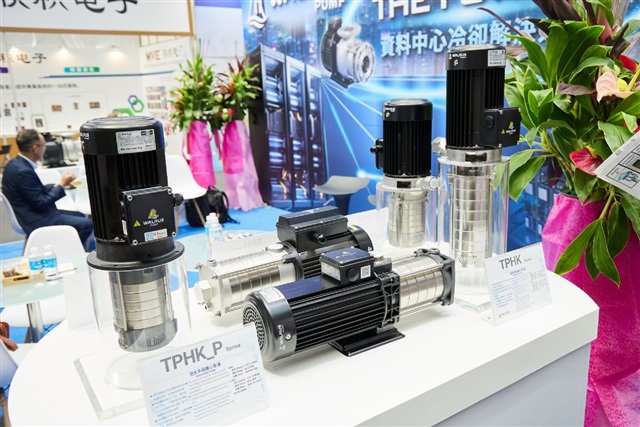
Walrus Pump, a leading domestic pump brand, has in recent years been working with server partners on technology pumps. Its technology pump for In Row CDUs is already in mass production, with water throughput reaching 75T, and another 75T model is in sample testing. A Walrus-related source said customer demand for higher flow continues to rise, and the company is moving toward 90T.

Walrus Pump began as a maker of residential pressure pumps. More than 60% of its revenue now comes from residential pumps, while industrial pumps account for more than 30%. The company had originally expected technology pumps for servers to make up 10% of revenue by year-end, but that share had already reached 7% in the first four months of 2026, raising the possibility of an upward revision if shipments continue to increase.

Walrus Pump sees more server demand

Walrus Pump said customer inquiries have continued to rise as AI drives liquid cooling into mainstream server thermal design, with interest coming from thermal module makers, system vendors, and server assemblers. In response, the company has developed and mass-produced pumps for In Row CDUs, and also created multiple pumps for In Rack CDUs and immersion cooling.

Chief financial officer Teng-hsi Chang said the pump for in-rack CDUs is currently in sample testing and is expected to move into mass production after approval in 2027. He added that as AI shifts from training to inference, in-rack CDUs are expected to outnumber in-row CDUs, which should further support the company's technology pump business.

Asked whether thermal module makers' push into pump development and design would affect Walrus Pump's future, Chang said pump design involves mechanical parts and motors, areas where Walrus has built deep expertise over many years. He said the company also works with thermal module makers, and the growing number of players focusing solely on pumps underscores the component's rising importance.

Article translated by Jingyue Hsiao and edited by Jack Wu