Intel CEO Lip-Bu Tan opened his Computex 2026 keynote in Taipei on June 2 with a personal note that set him apart from every Intel CEO before him.

Fourteen months into the role, Tan told the audience he had climbed Elephant Mountain — all 1,000 steps — before the show. He then noted, with characteristic directness, that he is likely the first Intel CEO who speaks Mandarin.
"A couple of customers and very important partners in Taiwan told me that Lip-Bu is also very unusual — if a CEO can drink liquor with us," he said, drawing laughter from the audience. "But anyway, I'm part of this community."
The remark captured something real. Tan has cultivated deep personal ties with Taiwan's technology community over decades, and his fluency — both linguistic and cultural — with the island's industry figures is unlike anything Intel has had at the CEO level before.

Credit: Digitimes
For an audience that has watched Intel struggle through years of missed cycles and leadership instability, the signal was pointed: this is not a CEO managing Taiwan from a distance.
Tan acknowledged the scale of the turnaround task directly. "Execution has always been at the top of my list," he said. "We had to bring focus back to the core. At our heart, Intel is an engineering company, and that's what I decided from day one. I have all the engineering report to me."
He said customers and partners have already seen a shift in how Intel shows up. "We are just getting started. Stay tuned. We have a journey in front of us. The opportunity ahead is enormous, and our job is to stay focused, execute, and deliver."
The Perplexity demo
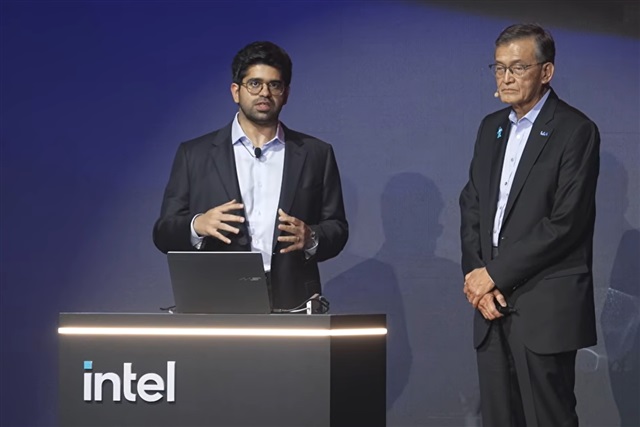
The keynote's most unusual moment came when Tan invited Perplexity AI founder and CEO Aravind Srinivas on stage — introducing him as a close friend — to demonstrate a live integration between Perplexity's AI operating system and Intel's Core Ultra Series 3 chip.
Srinivas presented Perplexity Computer, an AI operating system that orchestrates up to 20 different AI models across tools and files in a single system. The demo scenario involved a private equity associate working on a confidential leveraged buyout — code-named Project Falcon — with sensitive deal materials including an NDA, financial models, whiteboard diagrams, and bilingual transcripts. The premise was straightforward: these files should never leave the device.

Credit: Digitimes
Running on Intel's Core Ultra Series 3, the local model classified the materials, determined what was sensitive, and kept confidential files on-device while routing non-sensitive research tasks to cloud-based models. The output was a consolidated research report generated by agents working across both local and cloud computing.
"All your local device models will take care of the private files, and the server-side models will take care of other things through hybrid inference orchestration," Srinivas said. "The future is more compute in the data center and more compute on the local machine. This is the architecture we both believe in."
Tan framed the collaboration around three drivers: privacy, cost, and performance. "Hybrid agentic inference is how we maximize token value per watt per user," Srinivas added.

Credit: Digitimes
A keynote full of friends
The Perplexity appearance reflected a broader keynote style that stood out at Computex. Tan brought a total of 11 guests into his presentation — seven on stage in person and four via video — spanning AI software, enterprise technology, healthcare, manufacturing, and finance.
Live on stage, Tan welcomed Aravind Srinivas of Perplexity, Rodrigo Liang of SambaNova, Robert Smith of Vista Equity Partners, and Jerry Xiao of Foxconn, among others. Via video, he featured Dr. Joseph Wu, head of cardiology at Stanford and founder and CEO of Greenstone Biosciences, Toshiaki Tokunaga of Hitachi, and Roland Busch of Siemens.
The format — part product keynote, part reunion — was a deliberate departure from the scripted, slide-heavy presentations typical of major chip company events. For a CEO trying to signal that Intel is rebuilding relationships across the industry after years of drift, the guest list itself was part of the message.
Article edited by Jack Wu