

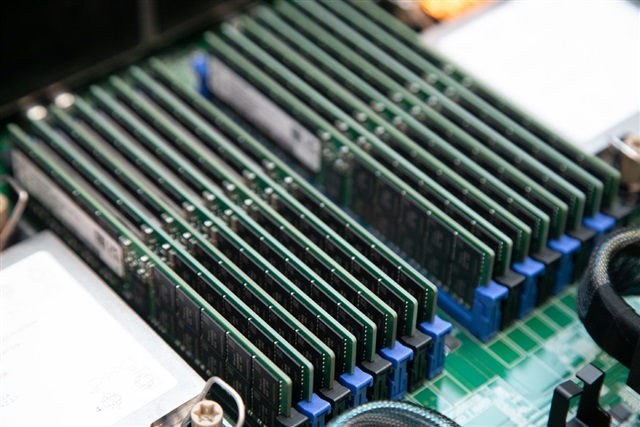
The memory industry cycle is on the upswing, driven by strong customer orders, rising OSAT prices, and high capacity utilization rates. Memory OSAT companies reported a surprisingly robust first quarter of 2026 despite the usual seasonal slowdown. With DRAM demand remaining strong and upstream substrate material costs increasing, market watchers expect key raw material price hikes to become a trend. Continued healthy customer demand should further boost OSAT capacity utilization, supporting revenue growth into the second quarter of 2026.
ChipMOS sets a monthly record in 1Q26
ChipMOS recently announced preliminary earnings showing February 2026 revenue at NT$2.144 billion (US$68.3 million), up 22.2% year-over-year, while net profit after tax soared 15.33x from the same period last year to NT$86 million, with earnings per share (EPS) of NT$0.12.
Including January's results, cumulative EPS for the first two months reached NT$0.36. March revenue hit NT$2.5 billion, a 23.1% increase year-over-year and a monthly record high. First-quarter 2026 revenue totaled NT$6.936 billion, up about 6.4% quarter-over-quarter and 25.4% year-over-year. The market estimates that quarterly profits will also show double-digit growth both quarter-over-quarter and year-over-year.
Market expectations point to steady growth in memory shipments, with ChipMOS' 2026 revenue forecast to climb each quarter and approach double-digit annual growth, alongside strong profitability.
Utilization surges as driver IC prices stabilize
ChipMOS noted that compared to a quieter first quarter of 2025, which was marked by pricing pressure on driver ICs, the significant profit growth in January–February 2026 stems primarily from higher utilization rates. While utilization hovered around 50% in the same period last year, recent figures rose to 70–80% despite fewer working days, driven by strong customer shipment demand — clearly boosting operating profits. Driver IC prices have since stabilized, helping improve overall gross margins.
Examining product lines, memory shipments outperformed driver ICs overall. DRAM customers operate their own production lines; although contract prices increased, this did not dampen shipment demand, making DRAM the strongest growth driver across all product lines. NAND flash saw some shipment adjustments due to certain module customers' inventory control, while NOR flash maintained stable momentum amid broadening applications. Utilization rates across all product lines are expected to continue rising in the second quarter of 2026.
ChipMOS chairman Shih-Jye Cheng expressed optimism for 2026 operations relative to 2025, noting that although the first quarter was affected by fewer working days, the second half should outperform the first. New capital expenditures come with three-year guaranteed contracts signed with customers, indicating their willingness to pay higher prices for supply stability.
Tight packaging capacity and BT substrate hikes pressure costs in 2Q26
The memory OSAT supply chain has been raising packaging-related prices since late 2025 through early 2026 to reflect cost pressures in a timely manner and maintain profitability.
Packaging capacity remains tight across the board, while raw materials, utilities, and labor costs continue to rise. Upstream material shortages combined with surging memory demand have pushed BT substrate prices up for several consecutive quarters. Related OSAT players do not rule out further cost pass-through discussions with customers in the second quarter of 2026.
Powertech eyes record semiconductor market in 2026
Powertech Technology posted near two-year-high profits in the fourth quarter of 2025. Although its first-quarter 2026 profit slightly declined quarter-over-quarter, consolidated revenue still grew 37.6% year-over-year to NT$21.31 billion, maintaining a "seasonally strong" performance. The company expects to sustain high double-digit annual growth in the second quarter of 2026.
Powertech projects global semiconductor sales to grow 26.3% in 2026, reaching a record US$975 billion. Logic chip sales are expected to rise 32.1% to US$390.8 billion, while memory chips will grow 39.4% to US$294.81 billion.
Optimistic about overall shipment growth in 2026, Powertech anticipates gains not only in logic chip OSAT but also a solid recovery in memory chip OSAT, with DRAM and NAND flash outperforming previous years and growth momentum accelerating.
Article translated by Charlene Chen and edited by Jerry Chen