

CONNECT WITH US
Sign out

China's humanoid robot half-marathon highlights rapid advances in autonomy and system integration

Staff reporter, Taipei
0

Credit: AFP

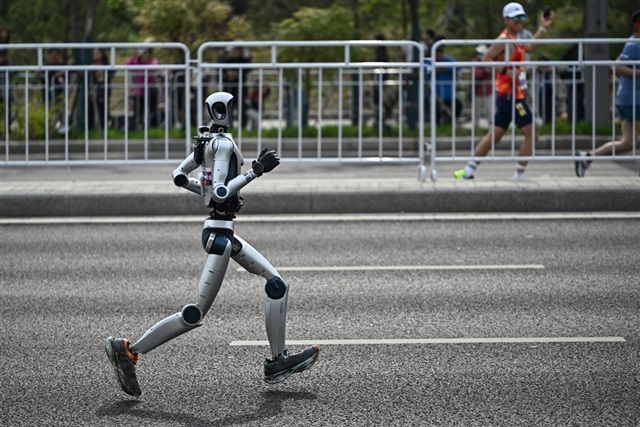
A humanoid robot half-marathon held in Beijing's Yizhuang development zone on April 19, 2026, has highlighted the rapid evolution of robotics technology, with autonomous machines demonstrating major gains in speed, stability, and decision-making compared with the previous year.

The event featured more than 100 teams and over 300 humanoid robots competing on a 21-kilometer course designed to test endurance, agility, and real-time navigation under complex conditions, including slopes, tight turns, and obstacle zones. Organizers and industry observers described the race as both a competitive sporting event and a large-scale stress test for embodied AI systems.

The top three positions were dominated by robots developed under smartphone maker Honor's robotics efforts, marking a notable industry highlight. The winning robot, "Lightning," completed the course in 50 minutes and 26 seconds using autonomous navigation, a time that surpasses the human men's half-marathon benchmark. Two other Honor-affiliated entries finished second and third, both within an hour of each other, underscoring the company's strong performance in system integration and robotics optimization.

Compared with the inaugural 2025 edition, when most robots required more than two hours to finish, and many failed to complete the course due to falls or mechanical instability, this year's results reflected a significant leap in reliability and speed. Nearly all leading participants completed the race, with the fastest group breaking the one-hour barrier for the first time.

A key focus of the competition was autonomous operation. Organizers reported that roughly 40% of participating robots ran fully independently, without continuous human remote control, relying instead on onboard sensors, vision systems, and AI-based mapping for real-time localization, path planning, and obstacle avoidance.

Performance improvements were also evident in motion control systems, often described in the industry as the "cerebellum" of humanoid robots. Robots demonstrated more human-like running gaits, with improved balance control, smoother stride transitions, and better coordination of hip and joint movements, resulting in greater stability over long distances.

Hardware advances played a similarly important role. Industry experts noted improvements in energy density through the adoption of semi-solid-state batteries, enhanced thermal management via liquid-cooling systems, and more durable integrated joint structures designed for sustained high-load movement. Rapid battery-swapping systems were also deployed in some designs, enabling full replacement in around 10 seconds and allowing continuous operation during the race.

An additional practical innovation observed during the event was the use of specialized running footwear for robots. Many teams equipped their machines with carbon-fiber or composite soles to improve traction and reduce vibration stress on mechanical joints, helping maintain stability across uneven terrain and long-duration running.

From a broader industry perspective, the race brought together participants from 13 provinces and 76 institutions, including major technology companies, reflecting growing commercial interest in humanoid robotics. Analysts view such competitions as critical real-world testing environments where weaknesses in software algorithms, mechanical endurance, and system coordination are exposed under extreme operational conditions.

Experts at the event noted that the performance gains across "brain, cerebellum, and body" systems of humanoid robots indicate accelerating convergence between AI perception, motion control, and hardware engineering. As humanoid robots move closer to industrial and logistics applications, events like this are increasingly seen as precursors to broader deployment beyond laboratory and prototype settings.

Article translated by Jingyue Hsiao and edited by Jack Wu
