
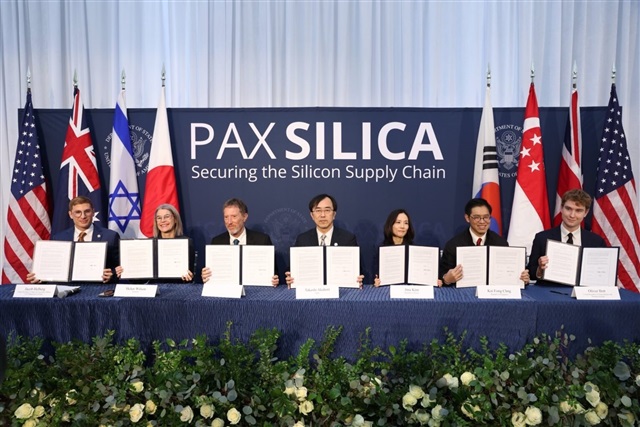
The Trump administration set up a US$250 million fund intended to grow out of its "Pax Silica" initiative launched in December 2025, aimed at supporting global supply chains for semiconductors, artificial intelligence (AI), and critical minerals, according to the New York Times. The fund represents the first step in a voluntary consortium that could attract up to US$1 trillion in investments from allies, including Singapore, the United Arab Emirates (UAE), Qatar, Sweden, Japan, South Korea, Israel, Britain, and Australia, with the US committing US$250 million.
Jacob Helberg, Under Secretary of State for Economic Affairs, said that the fund will serve as a catalyst, a credible call to action for partners around the world to put serious capital behind shared strategic objectives, according to the Chosun Daily. He emphasized the geopolitical urgency, referring to the war in Iran and disruptions in the Strait of Hormuz as a reminder of how single bottlenecks can threaten global economies.
Securing 21st-century supply chains
The initiative builds on the broader Pax Silica program, which aims to create a secure and resilient supply chain for semiconductors and AI infrastructure. The US Department of State (DOS) describes Pax Silica as a strategic framework for 21st-century economic security. Helberg says that "if the 20th century ran on oil and steel, the 21st century runs on compute and the minerals that feed it." The program encourages cooperation across allied countries to ensure critical energy, manufacturing, and mineral resources remain in trusted hands.
The Latin roots of the term highlight its mission: Pax, meaning "peace," and silica, a fundamental mineral for semiconductors. Together, Pax Silica conveys the vision of a "peace through silicon" approach; reducing excessive dependencies and fostering trusted partnerships to secure technology and economic stability.
Consortium structure and investment strategy
The fund will operate as a voluntary consortium of sovereign wealth funds and institutional investors, with Japan's SoftBank and Singapore's Temasek expected to participate. According to the New York Times, the consortium is designed to allow joint investment in strategic projects spanning AI, advanced manufacturing, semiconductors, logistics, and energy infrastructure, with an emphasis on trust-based collaboration rather than bureaucratic oversight.
Helberg told the Chosun Daily that the fund will act as a foundation for a technological ecosystem among allies and is intended to prevent supply chain bottlenecks and vulnerabilities, particularly in competition with China. He described the initiative as "one of the most significant direct supports from the US government for industrial investments by allies," and highlighted the importance of attracting real capital toward shared strategic objectives.
Global dependencies and risks
The initiative comes amid growing concerns about US reliance on Taiwan for semiconductors, disruptions in rare earth mineral exports from China, and the increasing geopolitical significance of AI technologies. By pooling investments and aligning strategies among trusted partners, Pax Silica seeks to ensure that the infrastructure, minerals, and technology assets intertwined in the global AI and semiconductor supply chains remain secure and resilient.
According to the US DOS, the program also emphasizes fair market practices, the protection of sensitive technologies, and the deployment of secure information networks, including fiber optic cables, data centers, and AI platforms, to reinforce both economic and national security. Pax Silica represents a bold, cross-border effort to merge technological advancement with strategic economic planning, signaling a new era in alliance-based industrial investment and global supply chain security.
Article edited by Jack Wu