
As major battery manufacturers accelerate the commercialization of solid-state batteries (SSBs), South Korea's battery materials industry is also speeding up product development and production, targeting the emerging demand. Efforts now span multiple areas, including cathode and anode materials, SSBs, and key raw materials. Observations from the show floor at InterBattery 2026 indicate that South Korean materials suppliers are advancing toward mass commercialization through cross-company collaboration and vertical integration.
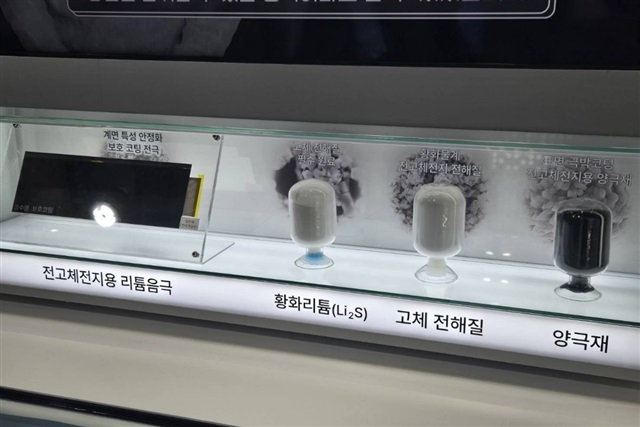
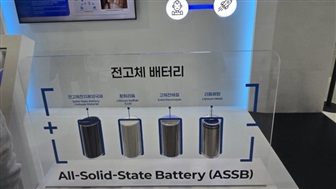
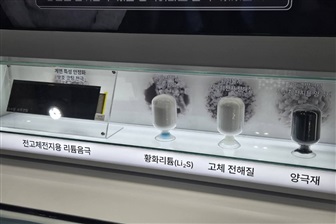
Pohang Iron and Steel Company (Posco) Future M showcased a range of products for solid-state batteries at the exhibition, including lithium sulfide, solid electrolytes, and cathode materials. Development of its cathode materials is nearly complete, with pilot-scale production already underway at tens to hundreds of kilograms. The company expects to move into mass production processes by the end of 2026.
Credit: DIGITIMES
Most cathodes for solid-state batteries currently correspond to sulfide solid electrolytes (SSEs). While cathode chemistry still largely relies on Nickel Cobalt Manganese (NCM) systems, a key challenge is preventing direct contact between cathode materials and SSEs. Conventional cathodes typically use a dry process, whereas SSB cathodes adopt wet coating techniques to form an extremely uniform and thin coating layer below 30 nanometers.
In December 2025, Posco Future M signed an MOU for technology collaboration with US SSB developer Factorial Energy. The company is currently supplying sample materials to Factorial for performance optimization and evaluation. A vehicle-grade prototype is expected to be completed by the end of 2026, followed by automotive testing. Industry observers noted that beyond the materials themselves, performance and yield differences in solid-state batteries depend heavily on coating design and process control capabilities.
Credit: DIGITIMES
For lithium sulfide raw materials, Posco Holdings has also completed development and is preparing for mass production using a high-temperature reduction process based on lithium sulfate. The company is combining this technology with investments in lithium resources to strengthen vertical integration advantages.
On the other hand, EcoPro Innovation is pursuing a chemical synthesis approach. Using high-purity lithium hydroxide as a base, the company produces lithium sulfide through reactions with hydrogen sulfide, emphasizing precision processing and purity advantages. Mass production preparations are already underway. The broader EcoPro group has established a comprehensive value chain spanning cathode materials, solid electrolytes, and battery recycling, highlighting cost advantages from integrated operations. Its primary partner in the SSB segment is Samsung SDI.

Credit: DIGITIMES
Industry insiders at the event explained that while SSBs eliminate the risk of fire, they generally face slower charging speeds. With liquid electrolytes, ions move quickly like in a fluid medium, but in solid-state systems, ion movement encounters greater resistance. Current R&D efforts, therefore, focus on strengthening electrode material design to enable faster charging and higher power output.
Overall, cost and production stability remain the biggest barriers to the commercialization of SSBs. Although both companies are building comprehensive material portfolios for the technology, production remains at small-scale pilot stages. The pace and scale of mass production in 2027 will largely depend on testing results from battery manufacturers and OEMs, while material suppliers will continue providing samples and participating in validation processes.
Article edited by Jack Wu