

Taiwan has introduced an initiative to strengthen its air defense system by integrating US-made and domestically produced missiles and radars into a networked kill chain that it calls the "Taiwan Shield," or "Taiwan Dome." Such a program has drawn attention to the strategic value of integrated battle command systems (IBCS). Currently, proposals from US companies, Northrop Grumman and Anduril Industries, are under consideration by Taiwan's National Chung-Shan Institute of Science & Technology (NCSIST).
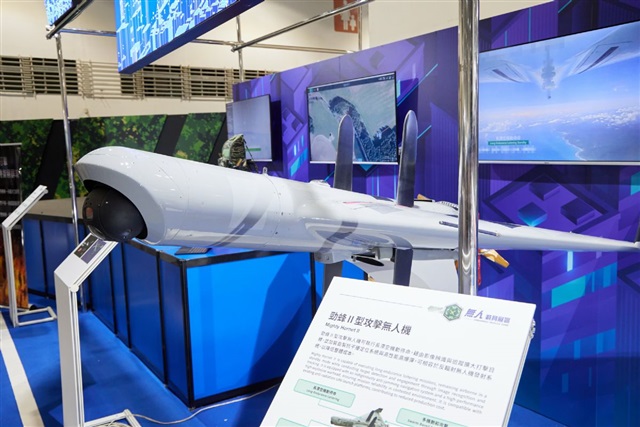
Anduril maintains close cooperation with Taiwan through its Lattice AI command-and-control platform. NCSIST recently announced that its Mighty Hornet drones will fully integrate the Lattice platform to enhance cross-service battlefield resource management and improve overall decision-making efficiency in asymmetric warfare.
The Ministry of National Defense's recent special procurement projects reveal a dramatic increase in unmanned vehicle acquisitions—from 50,000 units previously proposed by the Armaments Bureau to 200,000 units—highlighting the growing importance of unmanned systems and signaling a strategic shift toward quantity advantage and low-cost attrition asymmetric strategies.
Industry insiders note that drone swarming is now considered one of the most disruptive battlefield technologies. Unlike traditional single-pilot or centralized control models, drone swarms operate collaboratively through AI algorithms, with the underlying command-and-control platform playing a critical role.
In 2025, NCSIST signed a memorandum of understanding with US-based Auterion to introduce standard operating systems and the Nemesis drone swarm combat platform. NCSIST later allied with Anduril to adopt the Lattice OS AI command platform, jointly developing unmanned vehicles. Taiwan's military drone development is now supported by two major international suppliers.
Experts describe Lattice as an open, scalable operating system comparable to a military version of iOS. Its mesh network architecture and software development kit (SDK) allow manufacturers to develop application programming interfaces (APIs) for integration.
Lattice and Auterion's platform will serve complementary roles in the unmanned system decision chain: Lattice primarily manages upper-level command and integrates drones with other platforms, while Auterion supports frontline unit command capabilities.
NCSIST states that both the Mighty Hornet and Albatross II drones have incorporated AI image recognition and autonomous strike functions, enabling intelligent swarm control and coordinated flight operations. The current command system uses Anduril's Lattice platform to leverage mature technology and accelerate Taiwan's capability development.
However, command-layer support still relies on US technology at this stage. NCSIST emphasizes plans to gradually transition to indigenous development, asserting that mastering core command software independently is essential to establishing true national defense autonomy.
Article translated by Rodney Chan and edited by Jack Wu