
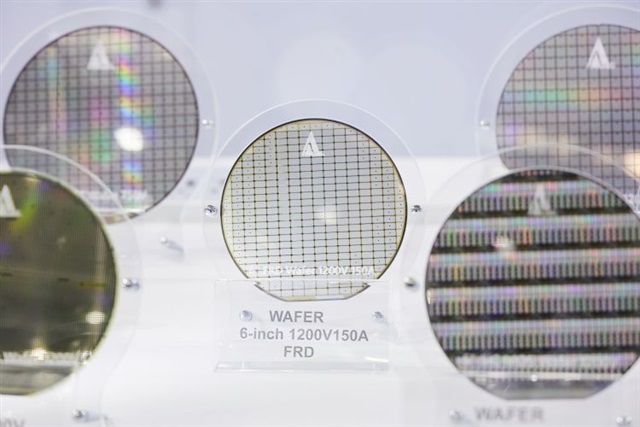
Facing intense price wars triggered by China's rapid expansion in the global silicon carbide (SiC) wafer industry, Sino-American Silicon Products (SAS) chairwoman Doris Hsu has decisively reshaped the company's resource allocation. She revealed that standard SiC wafer prices have plunged 60-70% within six months due to market turbulence. In response, SAS is withdrawing from the commoditized power segment for GlobalWafers' SiC wafers and prioritizing three niche markets focused on high-barrier applications.
The top strategic focus is developing 12-inch SiC wafers with high thermal conductivity designed to address heat dissipation challenges posed by advanced packaging and high-performance computing, rather than traditional voltage endurance targets.
Hsu added that the 12-inch wafers are currently in validation stages, with sample deliveries slated for the fourth quarter of 2025 and expected market adoption growth starting in 2026. This pivot toward thermal management applications effectively avoids red ocean competition while securing a critical entry point into the high-end computing supply chain.
Moreover, Hsu identified semi-insulating SiC as a strategic core for future AI smart glasses.
Leveraging SiC's superior physical properties, this innovative application enables eyeglass frames to provide power and conduct sound through the temple structure, allowing real-time voice feedback when users ask questions.
She believes that SiC currently represents the best material choice for smart glasses lenses. Although production costs remain high at present, scaling up to 12-inch wafer manufacturing will drive cost reductions and spark a technological revolution in wearable devices.
For mature power device segments, SAS maintains its 8-inch SiC wafer production, focusing on high-end applications to preserve profit margins without pursuing unnecessary scale expansion.
Within the automotive power semiconductor ecosystem, SAS subsidiary Actron Technology (ATC) plays an indispensable role.
ATC leads globally in automotive alternator diodes, excelling in efficient and ultra-efficient diode products aligned with fuel vehicle emission reduction trends and integrated starter-generator modules for 48V mild hybrid systems. ATC is also actively developing SiC high-performance power modules for electric vehicles (EVs). With technology development and customer certifications nearing completion, significant revenue growth is anticipated in 2026.
Article translated by Charlene Chen and edited by Jack Wu